


Why a Reliable Supplier of 1500V Solar Technology is Your Key to Utility-Scale Success
If you're developing a large-scale solar farm, you've undoubtedly encountered the term "1500V solar." It's more than just a technical specification; it's the backbone of modern utility-scale and large commercial solar projects, enabling higher power output, reduced balance-of-system costs, and improved overall efficiency. But the transition to 1500V architecture isn't just about buying components. Its true success hinges on partnering with an experienced, integrated supplier of 1500v solar technology—one that provides not just hardware, but the deep system expertise to ensure reliability and maximize return on investment over decades. Let's explore why this partnership is critical.
Table of Contents
- The 1500V Shift: From Component to System Philosophy
- The Data Difference: Quantifying the 1500V Advantage
- Case Study: A Texan Solar Farm's Journey with Highjoule
- Expert Insights: Navigating 1500V System Complexities
- Highjoule's Role as Your Integrated 1500V Partner
- The Future Horizon: What's Next for 1500V Systems?
The 1500V Shift: From Component to System Philosophy
For years, the industry standard for large arrays was 1000V. The move to 1500V might seem like a simple voltage bump, but in reality, it represents a fundamental shift in system design. Higher string voltage allows for longer strings of solar panels, meaning you can connect more panels in a single series. This directly reduces the number of combiner boxes, trackers, and DC cables needed. Think of it like plumbing: a wider pipe (higher voltage) can carry more water (power) with less friction (losses) over longer distances. However, this "wider pipe" demands every component—from inverters and combiner boxes to disconnects and monitoring systems—to be meticulously designed and certified for the higher voltage. This is where a specialized supplier of 1500v solar systems becomes invaluable, ensuring every link in the chain is optimized for safety, performance, and longevity.
The Data Difference: Quantifying the 1500V Advantage
The theoretical benefits are compelling, but what do the numbers say? Studies and real-world deployments consistently show significant advantages. According to the National Renewable Energy Laboratory (NREL), moving from 1000V to 1500V architectures can reduce balance-of-system (BOS) costs by up to 3 cents per watt. For a 100 MW project, that translates to approximately $3 million in savings on wiring, trenching, and hardware alone. Furthermore, longer strings mean fewer maximum power point trackers (MPPTs), simplifying the system and potentially increasing energy harvest by minimizing mismatch losses. The table below summarizes the key impacts:
| Metric | 1000V System | 1500V System | Impact |
|---|---|---|---|
| Typical String Length | 20-25 panels | 30-40 panels | Fewer strings per MW |
| DC Cable & Trenching | Baseline | Up to 30% reduction | Lower material & labor cost |
| BOS Cost (NREL Data) | Higher | Lower by ~$0.03/W | Major CAPEX savings |
| System Complexity | Higher # of combiners/MPPTs | Reduced component count | Higher reliability, easier O&M |
Case Study: A Texan Solar Farm's Journey with Highjoule
Let's ground this data in reality. A developer in West Texas was planning a 150 MWac solar farm. Their initial design used a conventional 1000V architecture with multiple, dispersed inverter stations. While functional, the projected BOS costs and energy losses across the vast, uneven terrain were concerning. They needed a partner, not just a vendor.
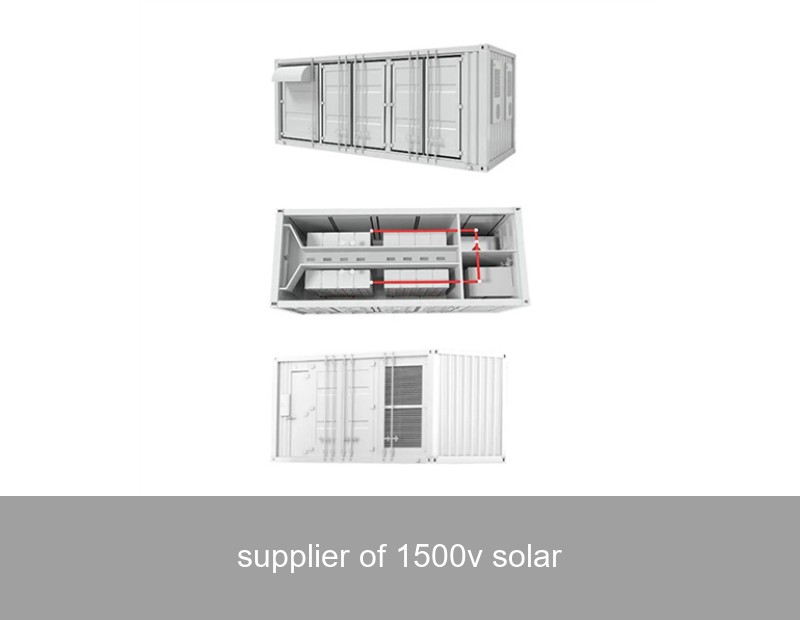
They engaged Highjoule as their integrated supplier of 1500v solar and storage solutions. Highjoule's team didn't just sell inverters; they conducted a full system redesign. The solution centered on Highjoule's HX-1500 Utility Power Station, a containerized solution housing 1500V string inverters, advanced DC combiner panels with string-level monitoring, and a built-in MV transformer. Crucially, Highjoule's design enabled longer, more efficient string routing, significantly reducing DC cabling.

The results were tangible:
- CAPEX Reduction: Achieved a 12% saving on balance-of-system costs compared to the original 1000V plan, primarily from reduced cabling and fewer foundation points.
- Energy Yield: The optimized string design and Highjoule's advanced inverter algorithms reduced mismatch losses, leading to a projected 1.5% higher annual energy yield.
- Future-Proofing: The site was prepared for a second-phase battery energy storage system (BESS) integration using Highjoule's compatible HX-Store platform, allowing for simple DC-coupling later.
This case underscores that the value of a true 1500V partner lies in holistic system optimization, not just component specification.
Expert Insights: Navigating 1500V System Complexities
So, what should you be mindful of when adopting 1500V technology? First, safety and standards are paramount. Higher DC voltage increases arc flash risk. Your supplier must provide components with robust safety certifications (UL, IEC) and design for safe maintenance procedures. Second, consider compatibility and monitoring. Not all 1500V panels, combiners, and inverters communicate seamlessly. An integrated supplier like Highjoule ensures their ecosystem is interoperable, providing granular, string-level data through a unified platform. This is crucial for rapid fault detection and maximizing uptime. Finally, think about grid integration and storage. As noted by the U.S. Department of Energy's Solar Futures Study, the grid of the future requires inverter-based resources to provide stability. Modern 1500V inverters from leading suppliers are equipped with advanced grid-forming capabilities, ready to support the grid rather than just drawing from it.
Highjoule's Role as Your Integrated 1500V Partner
At Highjoule, with nearly two decades of experience since 2005, we've evolved from a component provider to a comprehensive supplier of 1500v solar and storage systems. Our approach is built on three pillars:
- Integrated System Design: We offer a pre-engineered, compatible suite of 1500V products—from our HX-Series String Inverters and smart combiner boxes to our fully containerized Power Stations. This eliminates compatibility guesswork.
- Proactive Intelligence: Our Highjoule Nexus platform offers AI-driven analytics, giving you insights into system health and performance, predicting maintenance needs before they cause downtime.
- Storage-Ready Architecture: Every Highjoule 1500V solar solution is designed with DC-coupling in mind, allowing for seamless, high-efficiency integration of our battery storage systems when you're ready to add firming or energy shifting.

We act as your single point of accountability, ensuring your 1500V system delivers on its promise of lower LCOE (Levelized Cost of Energy) from day one and for the next 25 years.
The Future Horizon: What's Next for 1500V Systems?
The evolution of 1500V technology is far from over. We're seeing a clear trend towards even higher power string inverters and the integration of bifacial panels, which produce more energy and benefit greatly from the detailed monitoring that advanced 1500V systems provide. Furthermore, the line between solar plant and power plant is blurring. The next-generation supplier of 1500v solar technology must deliver true hybrid plants that combine solar generation, storage, and grid services in one intelligent, software-defined asset. This is where platforms like Highjoule's are essential, managing the complex interplay between DC and AC sides, storage dispatch, and market signals.
As you plan your next project, ask yourself this: Is your current supplier providing you with a box of parts, or are they offering a certified, optimized, and future-ready energy system? The distinction will define your project's financial and operational success for decades to come. What specific grid challenge in your region—whether it's intermittency, congestion, or frequency regulation—could be solved by rethinking your solar plant as an intelligent, 1500V-powered grid asset?
 Inquiry
 Online Chat