


TMEIC Inverters: How Much Do They Cost and Are They Worth the Investment?
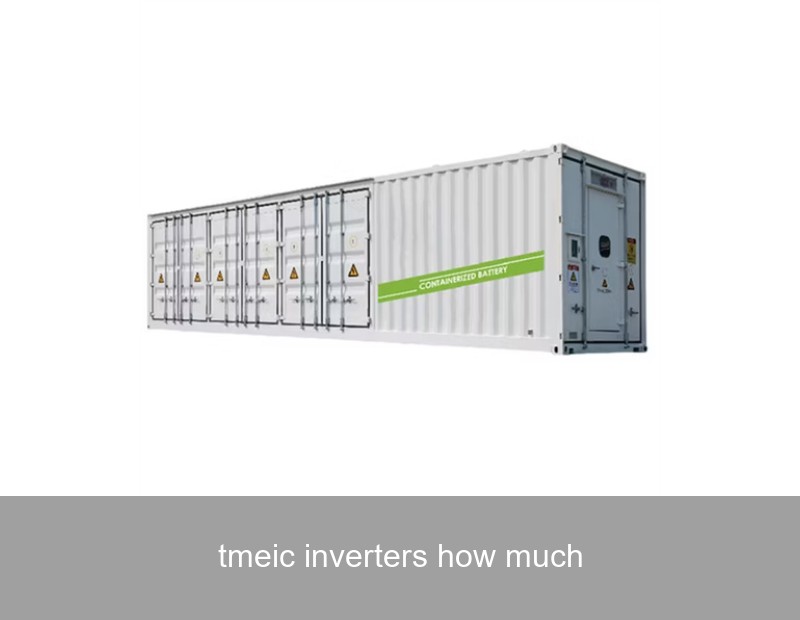
If you're planning a large-scale solar or energy storage project, you've likely come across TMEIC inverters. Renowned for their robustness in utility and industrial applications, a common and crucial question arises: TMEIC inverters how much? While a simple price tag is tempting, the real answer is more nuanced. The cost isn't just about the unit price; it's about the total value over the system's 20+ year lifespan. As a global leader in advanced energy storage systems, Highjoule often integrates top-tier components like TMEIC inverters into comprehensive solutions. This article will break down the cost factors, compare value, and show you how to make the most financially sound decision for your energy project.
Table of Contents
The Real Cost Breakdown of a TMEIC Inverter
Asking "how much" for a TMEIC inverter is like asking how much a high-performance engine costs without specifying the car. Prices vary dramatically based on model, power rating, and configuration.
Key Factors Influencing Price:
- Power Rating: TMEIC inverters are built for scale. A 500kW inverter will have a vastly different price point than a 2.5MW central inverter. Commercial and utility projects typically see prices quoted in $/Watt for the overall system, with the inverter being a significant portion.
- Model Type: Are you looking at their central inverter series (like the PVL-L) for a massive solar farm, or a solar-wind hybrid converter? The technology complexity directly impacts cost.
- Configuration & Accessories: The base unit is just the start. Costs add up with necessary switchgear, communication systems, step-up transformers, and medium-voltage integration components.
- Installation & Logistics: These are large, heavy pieces of industrial equipment. Professional installation, specialized electrical work, and potential crane usage contribute to the total installed cost.
So, while we can't publish exact figures (as they are project-specific), understand that TMEIC positions itself in the premium segment. You're not just buying an inverter; you're investing in industrial-grade engineering designed for maximum uptime and longevity in demanding environments.

Credit: Unsplash - Photon. Large-scale projects require robust, industrial-grade inverter solutions.
TMEIC vs. Other Inverter Brands: A Value Comparison
Let's move beyond upfront cost and think about value. For a commercial or utility operator, downtime is revenue lost. Here’s where TMEIC often justifies its premium.
| Consideration | TMEIC (Premium Industrial) | Standard Commercial Brands |
|---|---|---|
| Primary Use Case | Utility-scale solar farms, large industrial plants | Commercial rooftops, smaller community solar |
| Durability & Lifespan | Designed for 25+ years in harsh conditions | Typically designed for 15-20 year system life |
| Efficiency at High Load | Exceptional peak and weighted efficiency (often >99%) | High efficiency, but may vary under extreme continuous load |
| Grid Support Features | Advanced grid-forming capabilities, high fault current tolerance | Grid-following, standard compliance features |
| Total Cost of Ownership (TCO) | Higher upfront cost, but lower long-term O&M and replacement risk | Lower upfront cost, potential for higher O&M or earlier replacement |
The choice becomes clear: if your project is a critical, revenue-generating asset where reliability is paramount, the TMEIC investment makes financial sense over the long haul. For smaller-scale projects, the premium may be harder to justify.
Case Study: A 5MW Solar Farm in Spain
Let's look at real-world data. A 5MW solar farm in Andalusia, Spain, faced a critical decision in 2021. The developer evaluated two inverter options: a premium brand (TMEIC) and a standard commercial alternative.
The Challenge: The site experienced high ambient temperatures and needed superior grid support functions to meet local utility requirements.
The Decision & Data: They opted for TMEIC PVL-L central inverters. While the initial inverter investment was approximately 15% higher, the project saw tangible benefits:
- Energy Yield: The inverters' higher weighted efficiency translated to an estimated 1.5% more annual energy production. For a 5MW farm, that's tens of thousands of kilowatt-hours of additional revenue each year. (NREL Best Practices)
- O&M Savings: The robust design and sealed cooling system resulted in lower filter maintenance and higher reliability in dusty conditions, reducing estimated annual O&M costs by roughly 20%.
- Grid Compliance: The advanced features simplified interconnection approval, avoiding costly delays or additional hardware.
The Outcome: A financial model showed the payback period for the higher initial investment was under 4 years, with significant net present value (NPV) gains over the project's 25-year life. This case perfectly illustrates why "how much" must be answered with lifetime value, not just purchase price.
Beyond the Inverter: The Power of System Integration
An inverter, even a superb one like TMEIC's, is just one component. Its true potential is unlocked when seamlessly integrated into a holistic energy system. This is where Highjoule adds immense value.
Think of us as the conductor of your energy orchestra. We don't just supply components; we design, integrate, and optimize complete Battery Energy Storage Systems (BESS) and microgrid solutions. A TMEIC inverter can become even more powerful when paired with a Highjoule BESS.
Highjoule's Role in Maximizing Your Investment:
- Intelligent Coupling: Our proprietary energy management system (EMS) can dynamically control when to send solar power directly to the grid via the TMEIC inverter, when to charge batteries for later use, and when to discharge to maximize self-consumption or provide grid services.
- Enhanced Reliability: For critical industrial or microgrid applications, our storage systems provide backup power and grid stability, complementing the inverter's own capabilities.
- Financial Optimization: In markets with time-of-use rates or capacity markets, our systems automatically decide the most profitable use for every kilowatt-hour you generate, significantly improving the ROI of both the solar array and the inverter.
By choosing a partner like Highjoule, you're not just buying hardware; you're acquiring a future-proof energy asset designed for performance and profitability. (U.S. Department of Energy on Solar+Storage)

Credit: Unsplash - American Public Power Association. System integration and smart control are key to maximizing value.
Making the Right Investment Decision
So, how do you decide? Start by moving the conversation from "TMEIC inverters how much?" to "What is the optimal total system solution for my specific goals?"
Ask yourself and your team these key questions:
- Project Scale & Criticality: Is this a 50MW utility plant or a 500kW warehouse? Is maximum uptime directly tied to financial loss?
- Financial Model: Have you modeled the Levelized Cost of Energy (LCOE) and NPV with different inverter options, including estimated O&M and energy yield differences?
- Future-Proofing: Do you plan to add storage or participate in grid services markets in the future? Your inverter choice should enable that.
- Partner Expertise: Do you have a supplier who can provide deep technical integration support, or are you just buying a box?
At Highjoule, we specialize in navigating these complex questions. With nearly two decades of experience since 2005, we provide the intelligence and integration layer that turns premium components like TMEIC inverters into optimized, revenue-generating systems for commercial, industrial, and microgrid applications worldwide.
Ready to Calculate the True Value for Your Project?
Instead of searching for a generic price, why not get a tailored analysis? What specific energy challenge are you trying to solve with your next solar or storage project, and how can the right inverter choice be the cornerstone of that solution? (IEA Report on Inverters)
 Inquiry
 Online Chat