


Finding the Right Supplier of CRS Solar: Your Guide to Commercial Rooftop Success
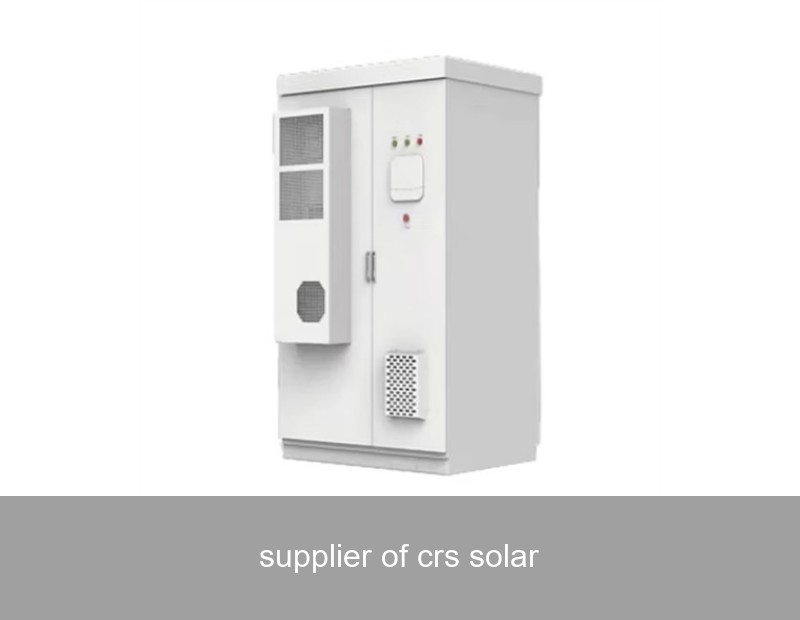
Imagine your commercial building's vast, unused rooftop. Now, imagine it transformed into a silent, powerful revenue generator, slashing energy bills and insulating your business from volatile electricity prices. This isn't a distant dream; it's the reality delivered by Commercial Rooftop Solar (CRS) systems. However, the journey from a bare roof to a profitable power plant hinges on one critical decision: choosing the right supplier of CRS solar. This choice determines not just the initial cost, but the system's performance, longevity, and ultimately, your return on investment for decades to come.
Table of Contents
- The CRS Advantage: More Than Just Panels on a Roof
- Beyond Panels: What a True Supplier of CRS Solar Provides
- A Data-Driven Case: The Highjoule CRS Solution in Action
- Key Selection Criteria for Your CRS Partner
- Future-Proofing Your Investment: The Storage Question
The CRS Advantage: More Than Just Panels on a Roof
Let's address the "why" first. For businesses across Europe and the U.S., commercial rooftop solar represents a strategic shift from energy consumption to production. The phenomenon is clear: energy costs are a significant and unpredictable operational expense. The data is compelling: according to the International Renewable Energy Agency (IRENA), solar PV is consistently one of the lowest-cost sources of electricity in history, with commercial-scale costs continuing to fall. But the real magic happens when you view a CRS system not as an expense, but as a capital asset with a clear financial yield.
Think about it this way: once installed, your fuel source (sunlight) is free and immune to geopolitical shocks. The system directly offsets your grid consumption, leading to predictable, dramatically lower utility bills. In many regions, excess energy can be sold back to the grid, creating a new income stream. Furthermore, with increasing corporate focus on ESG (Environmental, Social, and Governance) goals, a visible commitment to renewable energy enhances your brand's reputation and meets stakeholder demands for sustainability.
The Hidden Challenge: System Integration
Here’s where many first-time buyers stumble. A CRS project isn't simply about buying the shiniest solar panels. It's a complex integration of structural engineering, electrical systems, software, and ongoing performance management. A panel-only vendor might leave you with a suboptimal layout, inefficient inverters, or a system that doesn't communicate effectively with your building's energy management system. This is why partnering with a seasoned, holistic supplier of CRS solar is non-negotiable.
Beyond Panels: What a True Supplier of CRS Solar Provides
A leading supplier of CRS solar acts as your single point of accountability for the entire lifecycle of your energy asset. At Highjoule, with nearly two decades of experience since 2005, we define this role through four core pillars:
- Precision Engineering & Design: We don't use generic templates. Our team analyzes your roof's specific load-bearing capacity, shading patterns, and local weather data to design a system that maximizes energy yield per square meter.
- Intelligent Hardware Selection: We integrate tier-1 solar panels with high-efficiency inverters and our own smart monitoring hardware. The focus is on component synergy for long-term reliability, not just on the cheapest individual parts.
- Seamless Software & Monitoring: Our proprietary energy management platform gives you real-time and historical insights into your system's performance, energy savings, and carbon footprint from any device. You're always in control.
- Lifetime Performance Assurance: Our relationship begins at installation, not ends there. We offer comprehensive O&M (Operations & Maintenance) packages to ensure your system operates at peak efficiency for its entire 25+ year lifespan.
This integrated approach transforms a capital purchase into a managed energy solution, removing the technical burden from your team.

Image: A modern commercial rooftop solar installation. Source: Unsplash (Representative image)
A Data-Driven Case: The Highjoule CRS Solution in Action
Let's move from theory to tangible results. Consider a recent project we completed for a mid-sized food processing plant in Bavaria, Germany. The plant operated 24/7, leading to massive and costly energy consumption, primarily during daylight hours—a perfect profile for solar.
The Challenge: High daytime energy costs, pressure to meet corporate decarbonization targets, and a roof with varying elevations and equipment shadows.
The Highjoule Solution: We deployed a 542 kWp CRS system featuring bifacial solar panels (capturing light from both sides) and a string inverter solution optimized for the complex roof layout. Crucially, we integrated our Highjoule Energy Router (HER), a smart device that dynamically manages how solar energy is distributed—prioritizing on-site consumption first, then charging a small buffer battery, and finally exporting to the grid at the most profitable times.
The Results (12 Months Post-Installation):
| Metric | Result | Impact |
|---|---|---|
| Annual Energy Production | 498 MWh | Covers ~35% of plant's daytime load |
| Annual Cost Savings | €68,000 | Direct reduction in operating expenses |
| CO2 Emissions Avoided | ~312 tonnes | Equivalent to planting over 5,000 trees |
| Return on Investment (ROI) | Under 7 years | With a system lifespan of 25+ years |
This case underscores that the right supplier of CRS solar delivers measurable financial and environmental ROI by tailoring the technology to the specific site and consumption profile.
Key Selection Criteria for Your CRS Partner
So, how do you evaluate a potential partner? Look beyond the price-per-watt quote. Ask these questions:
- Do you provide a detailed, site-specific production estimate? (Beware of generic promises.)
- What is your approach to system monitoring and long-term maintenance? (Is software included? What are O&M costs?)
- Can you provide case studies with verifiable performance data from similar businesses in my region? (Experience in your local climate and regulatory environment is key.)
- How do you ensure the system integrates with my future needs, like adding battery storage or EV charging? (A forward-thinking design is essential.)
At Highjoule, we welcome these questions. Our consultations always start with a deep dive into your energy data, your sustainability goals, and your facility's unique characteristics to build a business case, not just a technical proposal.
Future-Proofing Your Investment: The Storage Question
Many businesses exploring CRS today are immediately curious about battery storage. It's a logical next step. While a solar-only system maximizes daytime self-consumption, adding a Battery Energy Storage System (BESS) allows you to store excess solar energy for use in the evening, during peak tariff periods, or as a backup during grid outages.
This is where Highjoule's core expertise as an advanced supplier of CRS solar and integrated storage solutions truly shines. Our IntelliBESS product line is designed from the ground up to seamlessly pair with our CRS installations. The system's AI-driven software learns your consumption patterns and automatically decides the most economical time to charge or discharge the battery—maximizing your savings and providing unparalleled energy resilience.
For a distribution center in New Jersey, USA, we combined a 800 kW solar array with a 500 kWh IntelliBESS. The system not only cuts demand charges (a significant cost for commercial users) by strategically discharging the battery during short periods of peak grid demand but also provides critical backup power for their refrigeration units. According to the National Renewable Energy Laboratory (NREL), pairing solar with storage can increase the value of solar by 20-40% for commercial users, a figure our real-world data confirms.

Image: A technician performing maintenance on a commercial battery storage system. Source: Unsplash (Representative image)
Your Next Step: From Consideration to Conversation
The journey to energy independence and cost predictability starts with a single, informed conversation. The landscape of commercial solar is filled with options, but the distinction between a simple equipment vendor and a true long-term supplier of CRS solar is profound.
What specific energy challenge—be it unpredictable bills, ambitious sustainability targets, or a need for greater resilience—could a tailored Highjoule CRS solution solve for your business in the next 12 months?
 Inquiry
 Online Chat