


Finding the Right Supplier of Giga Rhino: Your Guide to Mega-Scale Energy Storage
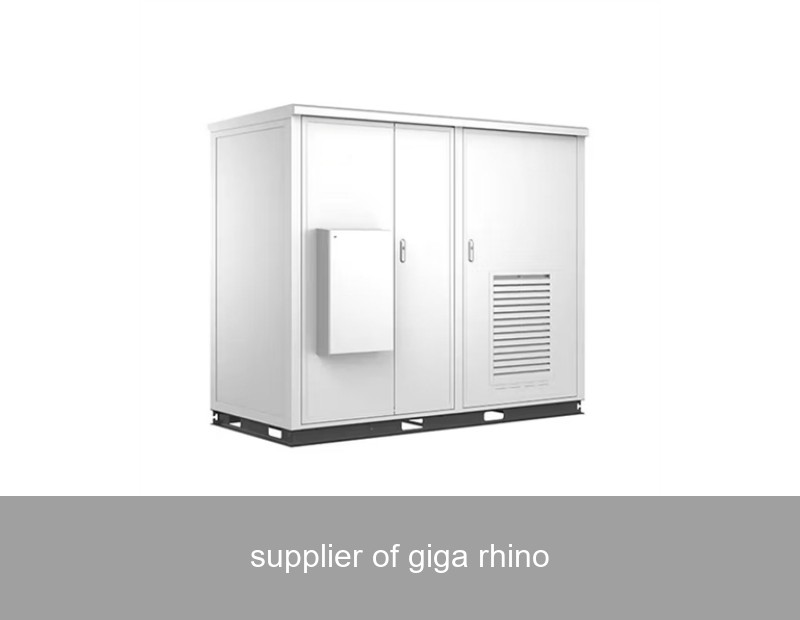
You've heard the term "Giga Rhino" buzzing around the energy sector. It's not a new prehistoric discovery, but a powerful metaphor for the colossal, resilient energy storage systems needed to anchor our modern grid. As renewable energy penetration soars, the challenge shifts from generation to reliability. The sun sets, the wind calms, but demand for power never stops. This is where the search for a true, capable supplier of Giga Rhino-class battery energy storage systems (BESS) begins. It's about finding a partner who can deliver not just massive capacity, but the intelligence and durability to make that capacity work for decades.
Table of Contents
The Giga Rhino Phenomenon: Why Size and Strength Matter
Let's talk scale. We've moved past kilowatt-hour (kWh) residential units and even megawatt-hour (MWh) commercial projects. The frontier is now the gigawatt-hour (GWh) realm—installations that can store enough energy to power hundreds of thousands of homes for several hours. Think of it this way: if a home battery is a sturdy ox, a Giga Rhino is, well, the rhino. It's defined by:
- Giga-scale Capacity: Systems typically starting at hundreds of MWh and scaling beyond 1 GWh.
- Unmatched Resilience (The "Rhino Hide"): Built to withstand thousands of deep charge/discharge cycles over a 20+ year lifespan, often in harsh environmental conditions.
- Grid-Forming Power: The ability to not just follow the grid's lead, but to actively stabilize it, supporting voltage and frequency during disturbances—a critical feature as fossil-fuel plants retire.
The driver is clear. The International Energy Agency (IEA) notes that global renewable capacity additions jumped nearly 50% in 2023, with solar PV alone accounting for three-quarters of this growth. This variable output creates a massive opportunity—and an absolute necessity—for storage at the giga-scale.
Beyond the Battery Cell: What Makes a True Giga Rhino Supplier?
Choosing a supplier of Giga Rhino solutions isn't just about buying containerized batteries in bulk. It's a strategic partnership for critical infrastructure. The leading suppliers differentiate themselves on three pillars beyond the basic hardware.
System Intelligence & Software
The battery management system (BMS) is the brain, but the energy management system (EMS) and optimization platform are the central nervous system. A top-tier supplier provides AI-driven software that decides, in milliseconds, when to store, when to discharge, and for which revenue stream—be it energy arbitrage, frequency regulation, or capacity services. This intelligence is what turns a capital expense into a revenue-generating asset.
Safety, Compliance & Longevity
Giga-scale storage brings giga-scale responsibility. A credible supplier adheres to the strictest international standards (like UL 9540A for fire safety, IEC standards for grid connection) and designs with thermal propagation prevention at the core. Their warranty and performance guarantees are backed by robust lifecycle modeling, not just marketing promises.

Credit: Photo by American Public Power Association on Unsplash - Centralized control is key for Giga-scale assets.
Grid Integration Expertise
Can their system "talk" to the grid operator? Deep expertise in grid codes, interconnection studies, and power electronics (like advanced inverter technology) is non-negotiable. The supplier must be a consultant and engineer, not just a vendor, navigating the complex regulatory landscapes of markets like Europe and the United States.
Case Study: Grid Stability in Central Europe
Let's look at a real-world application. In 2023, a major utility in Germany faced a dual challenge: the scheduled decommissioning of a conventional power plant and increasing grid congestion from northern wind farms. They needed a solution to provide black-start capability and frequency containment reserve (FCR).
They partnered with a leading supplier of Giga Rhino technology to deploy a 280 MWh / 140 MW battery storage system. Here's the impact:
| Metric | Result |
|---|---|
| Frequency Response Time | < 1 second (vs. several minutes for thermal plants) |
| Annual Grid Service Revenue | Projected €12-15 million |
| CO2 Displacement | Equivalent to ~25,000 tons annually |
| Stabilized Grid Region | Serves a critical node for ~200,000 residents |
This project exemplifies the Giga Rhino's role: a massive, responsive, and financially viable grid asset that directly enables the clean energy transition. Data from the Ember Climate European Electricity Review 2024 shows that such storage is becoming the linchpin for grids with high wind and solar shares.
The Highjoule Approach: Engineering the Intelligent Giga Rhino
At Highjoule, with nearly two decades of experience since 2005, we've evolved alongside the storage industry. We understand that being a supplier of Giga Rhino systems is about delivering a holistic power solution. Our Titan-G Series utility-scale BESS is engineered from the ground up for giga-scale responsibility.
- Proprietary Adaptive EMS: Our neural network-based platform, GridSynth AI, continuously optimizes for multiple value streams, maximizing your ROI.
- Cell-to-Grid Safety Architecture: We incorporate passive fire suppression, active thermal runaway containment channels, and cybersecurity hardened from the component level up.
- Grid-Forming Inverters: Our systems are designed to provide essential stability services, acting as a virtual synchronous generator to strengthen grid inertia.
For commercial and industrial (C&I) clients, our MegaPack solutions bring this same robust engineering to the 10-100 MWh scale, ensuring businesses can achieve energy independence and participate in demand response programs. Whether it's a solar-plus-storage microgrid for an industrial park or a front-of-the-meter installation supporting a national grid, Highjoule acts as a true technology partner.

Credit: Photo by Andreas Gücklhorn on Unsplash - The future is integrated solar and Giga-scale storage.
Choosing Your Partner: Key Questions to Ask
As you evaluate potential suppliers, move beyond datasheets. Engage in technical dialogues. Here are critical questions to pose:
- "Can you provide a detailed lifecycle analysis and degradation model for a 20-year horizon?"
- "How does your EMS algorithm prioritize between conflicting revenue opportunities in real-time?"
- "Can you share a case study and reference for a system of similar scale and purpose in a market with comparable grid codes (e.g., FERC in the U.S., ENTSO-E in Europe)?"
- "What is your internal testing protocol for safety, and can we audit it?"
The right partner will welcome these questions with transparent, data-backed answers.
So, as you embark on your project to secure clean, reliable power, we leave you with this: What is the one grid challenge in your region that a Giga Rhino-class storage system could solve, not just for today, but for the energy landscape of 2050? We're here to explore that answer with you.
 Inquiry
 Online Chat