


Storing Lightning Energy: The Ultimate Goal and Today's Practical Solutions
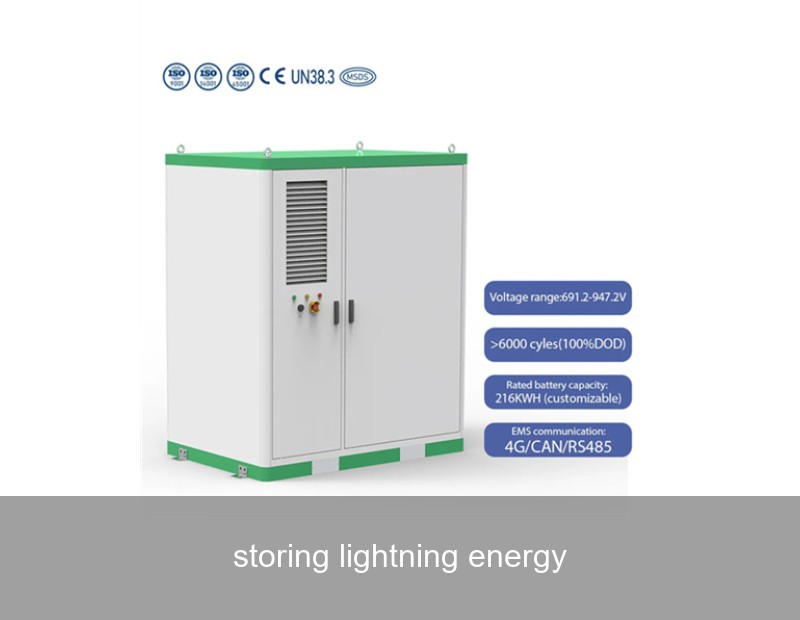
Imagine capturing the raw, awesome power of a lightning strike—a single bolt can contain over a billion joules of energy. The idea of storing lightning energy has captivated scientists and dreamers for centuries. While directly harnessing lightning remains in the realm of research, the quest it represents is very much alive today: capturing unpredictable, high-power energy bursts and making them usable on demand. This is precisely the challenge and opportunity at the heart of the modern energy revolution, where solar flares and wind gusts are our new "lightning," and advanced battery storage systems are our modern-day lightning rods.
Table of Contents
- The Lightning Metaphor for Modern Renewables
- The Core Challenge: Intermittency Meets Demand
- From Lead-Acid to Lithium: The Battery Evolution Enabling "Energy Capture"
- Real-World Case Study: Storing the Sun's "Lightning" in California
- Highjoule's Role: Building the Intelligent "Battery Brain" for Your Energy
- Future Horizons: Beyond Lithium-Ion
- Your Energy Questions, Answered
The Lightning Metaphor for Modern Renewables
Think about it. Lightning is powerful, instantaneous, and occurs at unpredictable times and places. Now, consider a sudden gust of wind that spins turbines at full capacity, or a cloud passing away to reveal intense, direct sunlight on a solar farm. These events create surges of clean energy—modern "lightning bolts" for our grid. The problem? Our homes and factories need power consistently, not just in bursts. Without a way to capture and hold that energy, these precious surges are often curtailed or wasted. This is the fundamental problem that makes storing lightning energy, or more accurately, storing renewable energy, the holy grail for a sustainable grid.
The Core Challenge: Intermittency Meets Demand
The data paints a clear picture. In regions like California and Germany, there are midday periods where solar generation frequently exceeds immediate demand. According to the U.S. Department of Energy, managing this overgeneration is a key grid challenge. Conversely, energy demand typically peaks in the early evening when solar production drops—a phenomenon known as the "duck curve." This mismatch isn't just an engineering puzzle; it's a economic and logistical one that limits renewable penetration.
- Phenomenon: Renewable energy generation is variable and doesn't always align with consumption patterns.
- Data: In 2023, the California Independent System Operator (CAISO) reported curtailment of over 2.4 million MWh of solar and wind energy, largely due to lack of sufficient storage or transmission.
- Insight: Effective energy storage acts as a time machine for electrons, moving power from times of abundance to times of need, flattening the duck curve and maximizing the value of every renewable kilowatt-hour.

Image: Modern solar farms increasingly integrate battery storage to capture excess generation. Source: Unsplash
From Lead-Acid to Lithium: The Battery Evolution Enabling "Energy Capture"
The quest for storing lightning energy has driven incredible innovation in battery technology. We've moved from bulky, shallow-cycle lead-acid batteries to sophisticated lithium-ion systems. Today's Lithium Iron Phosphate (LFP) batteries, in particular, offer the safety, longevity, and rapid response needed to capture those renewable "bolts." They can charge at full power when the sun is brightest or the wind strongest, hold that charge with minimal loss, and dispatch it in milliseconds when a cloud passes or demand spikes. This isn't just incremental improvement; it's the enabling technology that transforms renewables from supplemental to foundational.
Real-World Case Study: Storing the Sun's "Lightning" in California
Let's look at a concrete example. The Moss Landing Energy Storage Facility in California, one of the world's largest, acts as a giant "lightning jar" for the state's grid. While not a Highjoule project, it exemplifies the scale and impact of the technology. With a capacity of over 1600 MWh, it can store vast amounts of excess solar energy generated during the day. During a heatwave in September 2022, this facility and others like it were critical in discharging stored energy to the grid over several evenings, preventing blackouts and stabilizing power prices. It demonstrated that grid-scale storage is no longer a pilot concept but an operational necessity. The facility reportedly helped offset the need for several natural gas "peaker" plants during that critical period.
| Metric | Detail | Impact |
|---|---|---|
| Total Capacity | 1600 MWh / 400 MW | Can power ~300,000 homes for 4 hours |
| Primary Function | Store midday solar, discharge at peak evening demand | Flattens the "duck curve," reduces curtailment |
| Real-World Test | September 2022 Heatwave | Provided critical evening power, supported grid reliability |
Highjoule's Role: Building the Intelligent "Battery Brain" for Your Energy
This is where Highjoule translates the grand vision of storing lightning energy into reliable, daily reality for businesses, industries, and communities. We understand that a battery is more than just cells in a container; it's an intelligent system. Since 2005, Highjoule has specialized in integrating advanced battery hardware with sophisticated energy management software (EMS).
For a commercial business with a large rooftop solar array, our H-IQ Commercial ESS does more than just store excess solar. Its AI-driven platform predicts energy generation and consumption patterns, automatically deciding the most economical moment to store or discharge energy—whether to avoid peak demand charges, provide backup power, or even participate in grid services. For a remote microgrid, our containerized MegaCube Industrial BESS provides the robust, high-capacity foundation needed to stabilize a grid powered mainly by variable renewables, effectively creating a local energy reservoir. We provide the control system that makes capturing those renewable "lightning bolts" not just possible, but profitable and seamless.

Image: Advanced energy management systems are the 'brain' behind effective storage. Source: Unsplash
Future Horizons: Beyond Lithium-Ion
The innovation continues. While lithium-ion dominates today, the future of storing lightning energy may involve a mix of technologies. Flow batteries, with their potential for extremely long duration storage (10+ hours), are ideal for seasonal shifting. Compressed air and gravity storage offer solutions at the utility scale. Highjoule actively monitors and evaluates these technologies, ensuring our system architectures are future-ready. The goal remains constant: to provide the most intelligent, efficient, and sustainable buffer between energy generation and consumption, no matter the source.
Your Energy Questions, Answered
You might be wondering: "Is this technology ready for my home or business now?" The answer is a resounding yes. The economic and resilience case for pairing solar PV with battery storage has never been stronger, both in Europe and the United States. With incentives like the U.S. Investment Tax Credit (ITC) and various European Union grants, the payback period continues to shrink. The question is no longer "if" but "how" to design a system that meets your specific load profile, sustainability goals, and financial criteria.
What specific energy challenge—be it rising utility costs, backup power needs, or a desire to increase renewable consumption—could a modern "lightning jar" solve for you?
 Inquiry
 Online Chat