


Finding the Right Supplier of NREL Solar Research-Backed Energy Storage
Have you ever wondered what separates a truly resilient and efficient solar-plus-storage system from a merely adequate one? The difference often lies not just in the panels on your roof, but in the intelligence of the battery system and the quality of the research that informs its design. For commercial, industrial, and residential energy leaders across Europe and the U.S., aligning with a supplier of NREL solar and storage-integrated solutions means partnering with a company grounded in the world's leading renewable energy science. The National Renewable Energy Laboratory (NREL) sets the gold standard for photovoltaic (PV) and grid integration research. A supplier deeply familiar with this research translates complex findings into reliable, daily energy independence. This is where expertise meets application, ensuring your investment is built on a foundation of validated science, not just specifications.
Table of Contents
- The NREL Standard: Why It Matters for Your Energy System
- Beyond the Battery: The Intelligent Hub for Solar
- Case Study: A U.S. Manufacturing Plant's Journey to Resilience
- Choosing Your Supplier: Key Questions Informed by NREL Insights
- The Highjoule Approach: Engineering with Foresight
The NREL Standard: Why It Matters for Your Energy System
NREL's research isn't conducted in an ivory tower; it tackles the gritty, real-world challenges of integrating variable solar power into our grids and buildings. Their work on PV module reliability, battery degradation under various cycles, and advanced grid-forming inverter technology is pivotal. For a supplier, leveraging this research means proactively solving problems before they hit your site. Think about it: NREL models weather extremes, partial shading scenarios, and complex demand charges. A supplier attuned to this work designs systems that aren't just sized for perfect, sunny days but are optimized for the chaotic reality of energy markets and weather patterns.
Consider the critical issue of battery lifespan. NREL's extensive cycle testing provides frameworks for battery management software (BMS) to operate batteries in a "sweet spot" that maximizes cycle life while delivering needed power. A supplier unaware of these nuances might simply connect batteries to solar, leading to premature degradation and a disappointing return on investment.

Image: A technical team designs a solar-integrated storage system, a process deeply informed by leading research. Source: Unsplash
Beyond the Battery: The Intelligent Hub for Solar
When evaluating a supplier of NREL solar-informed technology, look beyond the hardware specs. The true value is in the system's brain—the energy management system (EMS). This is where NREL's grid integration studies become tangible. A sophisticated EMS does more than switch between solar and battery power; it:
- Predicts Energy Production & Consumption: Using weather data and usage history to optimize charging/discharging schedules.
- Navigates Utility Rate Structures: Automatically avoiding peak demand charges, which can constitute up to 70% of a commercial electricity bill in some U.S. regions.
- Provides Grid Services: In advanced markets, systems can provide frequency regulation or voltage support, creating a new revenue stream.
This intelligence is what transforms a capital expense into a dynamic financial asset. For instance, Highjoule's Sentinel EMS platform embodies this principle. It integrates NREL's PVWatts calculation engine for production forecasting and uses algorithms inspired by grid resilience research to make millisecond-level decisions, ensuring every kilowatt-hour of solar energy is used or stored with maximum economic value.
Case Study: A U.S. Manufacturing Plant's Journey to Resilience
Let's ground this in a real example. A mid-sized automotive parts manufacturer in Ohio faced volatile energy costs and an unreliable grid, risking costly production halts. Their goal was twofold: lock in long-term energy costs and ensure uninterrupted operation.
They partnered with Highjoule as their supplier of NREL solar-aligned storage solutions. The project involved:
| Challenge | Highjoule Solution (NREL-Informed) | Result |
|---|---|---|
| High Demand Charges | Installed a 500kW/1.2MWh BESS with EMS programmed for peak shaving, using load forecasting models. | Reduced monthly demand charges by 40%, saving over $18,000 annually. |
| Grid Outages Halting Production | Designed a grid-forming inverter system capable of seamless islanding (a key NREL research area). | Provided 8+ hours of critical backup, preventing an estimated $250,000 in downtime losses in the first year. |
| Maximizing Solar Self-Consumption | Integrated with existing rooftop solar using advanced DC-coupled architecture for higher round-trip efficiency. | Increased solar self-consumption from 55% to over 90%, dramatically reducing purchased grid power. |
The system's performance is continuously benchmarked against NREL's capacity factor and performance data for similar climates, ensuring it operates at peak potential. This case exemplifies the move from passive consumption to active, intelligent energy management.
Choosing Your Supplier: Key Questions Informed by NREL Insights
So, how do you select a partner who brings this level of research-driven rigor? Ask these pointed questions:
- "How does your battery management system incorporate thermal and cycling degradation models to extend lifespan?" (This gets at core battery science).
- "Can your energy management system participate in grid service markets (like FFR or Capacity Markets), and how is that capability validated?" (This probes advanced grid integration knowledge).
- "What is your design process for ensuring reliability in my specific climate, and what tools do you use?" (Look for mentions of NREL's SAM, PVWatts, or similar).
The answers will quickly separate component assemblers from true engineering partners.

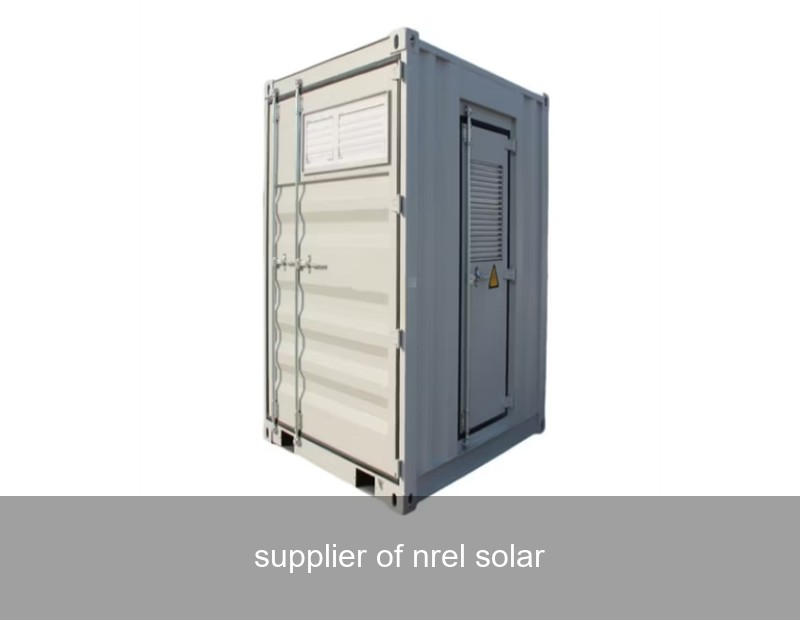
Image: A modern, containerized battery energy storage system (BESS) ready for integration. Source: Unsplash
The Highjoule Approach: Engineering with Foresight
At Highjoule, our role as a supplier of NREL solar and storage solutions is built on a commitment to translating pioneering research into field-proven performance. Founded in 2005, we've evolved alongside the renewable energy landscape, with our R&D team actively engaging with the latest findings from institutions like NREL and Fraunhofer ISE in Europe.
Our product suite, including the H-Series Commercial BESS and the Residential Energy Hub, is designed with this foresight. For example, our inverters use grid-forming technology—a major focus of recent NREL microgrid studies—to provide stronger, more stable off-grid power than traditional grid-following units. For our utility and microgrid clients, this means systems that don't just leave the grid but can potentially support and stabilize it.
Ultimately, the journey to energy independence and sustainability is a partnership. It requires a supplier who doesn't just sell hardware but brings a deep well of knowledge, a commitment to ongoing research, and a focus on your long-term operational and financial success.
 Inquiry
 Online Chat