


Choosing the Right Supplier of RCM Inverter: A Guide for Reliable Renewable Energy Systems
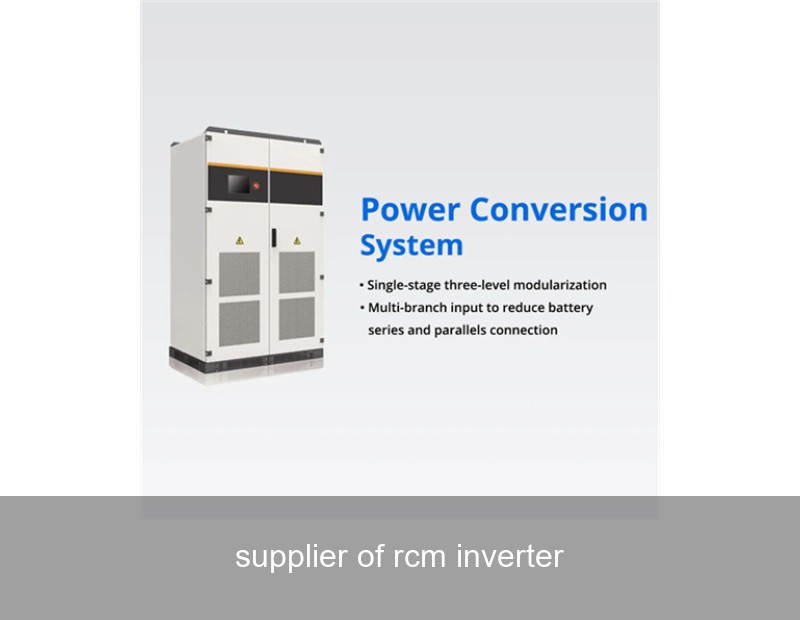
You've made the smart decision to invest in solar or battery storage. The panels are sleek, the battery is powerful, but there's a silent, crucial component that determines the safety and functionality of your entire system: the RCM inverter. Selecting the right supplier of RCM inverter isn't just a procurement step; it's a foundational choice for your project's long-term health and compliance. In this guide, we'll demystify why this choice matters and what you should look for.
Table of Contents
What is an RCM Inverter & Why is it Non-Negotiable?
Let's break it down. An RCM (Residual Current Monitor) inverter is an advanced solar or hybrid inverter with integrated, continuous earth leakage current monitoring. Think of it as a highly sophisticated guardian for your photovoltaic (PV) or energy storage system.
The Phenomenon: All electrical systems, including DC solar arrays, can develop insulation faults over time due to weathering, material fatigue, or physical damage. These faults can lead to "residual currents" – electricity leaking to earth. Without detection, this poses severe risks:
- Fire Hazard: Sustained arcing from DC faults is a leading cause of PV system fires.
- Electric Shock: Dangerous voltage potentials can appear on system frames.
- System Downtime: A major fault can shut down your entire energy generation.
The Data: A study highlighted by the NFPA emphasizes that electrical faults are a primary ignition source in PV fires. In regions with strict electrical codes like Europe (VDE-AR-E 2100-712) and North America (NEC 690.11), RCM functionality is increasingly mandated for rooftop systems. Your supplier of RCM inverter must provide products that don't just meet, but exceed these standards.

Image Source: Unsplash - Representative image of advanced inverter technology.
Beyond Price: 5 Critical Criteria for Your RCM Inverter Supplier
Choosing a supplier on price alone is a risky gamble with safety. Here’s what truly defines a top-tier supplier of RCM inverter:
| Criteria | Why It Matters | Key Question to Ask |
|---|---|---|
| 1. Certification & Local Compliance | Certifications (VDE, IEC, UL) are independent proof of safety and performance. A supplier must understand regional nuances (e.g., VDE for EU, UL 1741 for US). | "Can you provide the full certification dossier for this model for my specific market?" |
| 2. Technical Depth & Integration | RCM should be seamlessly integrated, not an add-on. It must work flawlessly with battery storage, energy management systems, and the grid. | "How is the RCM functionality integrated into the inverter's core firmware and communication protocols?" |
| 3. Monitoring & Diagnostics | Real-time monitoring and precise fault localization (down to the string level) are essential for quick, cost-effective maintenance. | "What granularity of fault data does your monitoring platform provide to the system owner and installer?" |
| 4. Proven Field Reliability | Long-term performance in diverse climates is king. Look for suppliers with a multi-year track record. | "What is your mean time between failures (MTBF) data for this product line over the last 5 years?" |
| 5. Support & Service Ecosystem | You need local technical support, training for installers, and a clear warranty process. A supplier is a partner for the system's lifetime. | "Describe your technical support structure and average response time for critical faults in my region." |
Real-World Impact: A Case Study from Germany
Let's look at a concrete example. A mid-sized logistics company in Bavaria installed a 250 kW rooftop PV system in 2019. The initial installer opted for a low-cost inverter with basic protection.
The Problem: In early 2023, the system began experiencing intermittent shutdowns, causing significant losses in self-consumed solar energy. Traditional troubleshooting was time-consuming and inconclusive.
The Solution: The company partnered with Highjoule to retrofit the system with our HPS Series Commercial Hybrid Inverters, which feature our proprietary ActiveShield™ RCM Technology. Within days of commissioning, the integrated monitoring platform pinpointed a sub-critical, fluctuating insulation fault on a single DC string located under a section of roofing that had experienced minor water ingress.
- Fault Identified: Insulation resistance dropped to 0.8 MΩ (well below the 1 MΩ alarm threshold) under wet conditions.
- Action Taken: The fault was precisely located and repaired in under 4 hours, minimizing downtime.
- Result: System reliability restored to 99.9%. The predictive alert prevented a potential arc-fault event and gave the company complete oversight. You can read more about the importance of such monitoring in grid-interactive systems from the NREL's research on inverter-based resources.
This case underscores that the right supplier of RCM inverter provides not just a device, but a diagnostic safety net.
The Highjoule Approach: Engineering Safety and Intelligence
At Highjoule, founded in 2005, we've built our reputation as a global leader on the principle that safety and intelligence are the bedrock of true sustainability. Our perspective is that an RCM inverter shouldn't be a silent trip device; it should be a communicative system asset.
Our product philosophy integrates this deep into our solutions for commercial, industrial, and residential applications:
- For Homes (Residential HES Series): Our home energy systems feature RCM as a standard, giving homeowners peace of mind with full visibility via the Highjoule Home app. It’s about protecting your family and your investment.
- For Businesses (Commercial HPS Series): As seen in our case study, our commercial inverters offer string-level RCM diagnostics, crucial for maintaining uptime and safety on large-scale installations.
- For Microgrids & Utilities (Utility-scale ESS): Our advanced RCM algorithms are part of a broader grid-supportive functionality, ensuring safe islanding and reconnection, a critical feature for grid stability.

Image Source: Unsplash - Representative image of industrial energy system monitoring.
We go beyond the hardware. Choosing Highjoule as your supplier of RCM inverter means accessing a suite of smart energy management services and global support, ensuring your system is not only safe but also optimized for performance and return on investment for decades.
The Future of Grid Interaction and Your Role
The energy landscape is shifting. With the rise of bidirectional EV chargers, virtual power plants (VPPs), and complex tariff structures, your inverter is becoming the brain of your energy ecosystem. The RCM function is evolving into part of a comprehensive "grid health" interface. The next generation of inverters will need to communicate fault data not just to you, but securely to grid operators, enabling a more resilient and safe electricity network for everyone. A report by the International Energy Agency (IEA) highlights this expanding role of smart inverters.
So, as you evaluate your options for a supplier of RCM inverter, ask yourself and your potential partner: Is this product just a compliance checkbox, or is it a future-ready platform for safety, intelligence, and grid participation?
What specific challenge in your upcoming renewable energy project keeps you up at night regarding long-term safety and system management?
 Inquiry
 Online Chat