


Navigating Malaysia's Solar Surge: A Guide for International Investors and Project Developers
As the global energy transition accelerates, all eyes are turning to Southeast Asia, and particularly to the vibrant syarikat solar di Malaysia (solar companies in Malaysia). The country's ambitious renewable energy targets, coupled with its strong solar irradiance, have created a dynamic and rapidly growing market. For European and US investors, energy consultants, and multinational corporations looking to expand their green portfolios, understanding this landscape is not just an opportunity—it's a strategic imperative. This article delves into the drivers, data, and real-world success stories shaping Malaysia's solar sector, and crucially, examines the role of advanced energy storage in ensuring these investments are both profitable and resilient.
Table of Contents
- The Phenomenon: Malaysia's Renewable Energy Ambition
- The Data: Quantifying the Solar Boom
- The Inevitable Challenge: Intermittency & Grid Stability
- The Critical Solution: Beyond Panels to Integrated Storage
- Highjoule's Role: Powering Reliability in Emerging Markets
- A Real-World Case Study: Stability for a Malaysian Industrial Park
- Future Outlook: Where is the Malaysian Solar Market Headed?
The Phenomenon: Malaysia's Renewable Energy Ambition
Malaysia has set a clear trajectory. The government's National Energy Transition Roadmap (NETR) targets a staggering 70% renewable energy capacity mix by 2050. A cornerstone of this strategy is large-scale solar (LSS) tenders, which have consistently attracted competitive bids from both local and international syarikat solar di Malaysia. This isn't just about government policy; it's a response to growing corporate demand. Multinational companies with operations in Malaysia are seeking to meet their own ESG (Environmental, Social, and Governance) goals by powering facilities with clean, locally generated electricity. This creates a powerful dual driver: top-down policy support and bottom-up corporate procurement.
The Data: Quantifying the Solar Boom
Let's look at the numbers. According to the International Energy Agency (IEA), Malaysia's solar PV capacity has seen exponential growth, jumping from a negligible amount a decade ago to over 1.8 Gigawatts by the end of 2023. The fourth round of the Large Scale Solar (LSS4) program auctioned another 1.2 GW of capacity. For context, 1 GW can power approximately 700,000 homes. This growth positions Malaysia as a ASEAN leader in solar adoption. However, this rapid influx of variable renewable energy presents a familiar challenge for grid operators and project developers alike: how to manage the sun's inherent intermittency to ensure consistent, dispatchable power.

Image: Large-scale solar farms are becoming increasingly common in Malaysia. (Photo by American Public Power Association on Unsplash)
The Inevitable Challenge: Intermittency & Grid Stability
Here's the technical reality every investor in a syarikat solar di Malaysia must grapple with. Solar generation peaks during midday, but energy demand for commercial and industrial (C&I) users often extends into the evening. This creates a mismatch—the "duck curve"—that can strain the grid, lead to curtailment (wasted solar energy), and reduce the financial returns of a solar asset. For off-grid or weak-grid applications, like remote manufacturing plants or agro-industrial facilities, this challenge is even more acute. Without a solution, the reliability of solar power is compromised.
The Limitations of Solar-Only Projects
- Reduced Self-Consumption: Excess midday solar generation is exported to the grid at lower feed-in-tariff rates, while expensive grid power is purchased in the evening.
- Grid Congestion: High concentrations of solar can overload local distribution networks, requiring costly grid upgrades.
- Unmet Demand: For facilities operating 24/7, a solar-only system cannot meet nighttime energy needs.
The Critical Solution: Beyond Panels to Integrated Storage
The answer lies in coupling solar PV with advanced Battery Energy Storage Systems (BESS). A solar-plus-storage solution transforms a variable generation source into a firm, dispatchable power plant. Energy generated during the day is stored and can be released precisely when needed—during peak demand hours, in the evening, or during brief grid outages. This not only maximizes the utility and value of every solar panel but also provides critical grid services like frequency regulation. For a syarikat solar di Malaysia, offering integrated storage solutions is fast becoming a key differentiator and a value-add for sophisticated clients.
Highjoule's Role: Powering Reliability in Emerging Markets
This is where global expertise meets local opportunity. At Highjoule, with nearly two decades of experience since 2005, we specialize in providing intelligent, efficient BESS solutions for precisely these scenarios. Our systems are designed to integrate seamlessly with solar PV installations, whether for a sprawling industrial facility, a commercial complex, or a community microgrid.
For developers and investors partnering with a syarikat solar di Malaysia, specifying Highjoule storage means:
- Enhanced ROI: Shift solar energy to high-price periods and increase self-consumption rates dramatically.
- Proven Grid Support: Our systems include advanced grid-forming inverters that can help stabilize local networks, a valuable feature in areas with grid constraints.
- Unmatched Safety: Our proprietary battery management system (BMS) and cell-to-pack technology ensure the highest levels of safety and longevity, a non-negotiable for C&I applications.
- Global Support, Local Relevance: We provide the engineering depth and global service network that international investors expect, configured for the specific climatic and operational conditions of Southeast Asia.
A Real-World Case Study: Stability for a Malaysian Industrial Park
Let's examine a concrete example. A major industrial park in Senai, Johor, housing several high-tech manufacturing plants, faced rising energy costs and pressure to reduce its carbon footprint. A local syarikat solar di Malaysia developed a 5 MW rooftop solar project across multiple factory buildings. However, the park's operations run 24 hours a day, and grid power in the area was prone to occasional voltage dips.
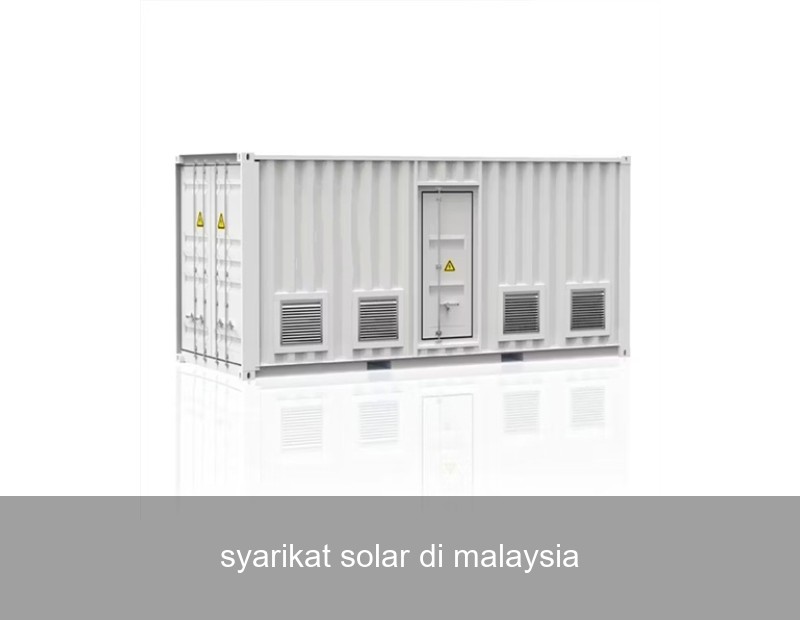
The Integrated Solution: The project was upgraded to include a 2.5 MWh Highjoule IntelliBESS containerized storage system.
The Data-Driven Outcome (After 12 Months):
| Metric | Result | Impact |
|---|---|---|
| Solar Self-Consumption | Increased from 65% to 92% | Dramatically reduced grid import during peak sun hours |
| Peak Grid Demand | Reduced by 1.8 MW | Lower capacity charges and grid dependency |
| Energy Cost Savings | Additional 18% savings on top of solar-only savings | Significantly improved project payback period |
| Power Quality | Zero production downtime from voltage dips | The BESS provided seamless backup during grid disturbances |
This case, documented in part with data from the U.S. Department of Energy's storage database, illustrates the transformative impact of adding storage. It turned a good solar project into an exceptional, resilient, and highly economical energy asset.

Image: Integrated BESS solutions, like those from Highjoule, ensure reliable power for industrial operations. (Photo by ThisisEngineering on Unsplash)
Future Outlook: Where is the Malaysian Solar Market Headed?
The next phase for syarikat solar di Malaysia is clear: sophistication. The market is moving beyond simple installation towards becoming comprehensive energy solution providers. This includes virtual power plants (VPPs), peer-to-peer energy trading enabled by blockchain, and offering Energy-as-a-Service (EaaS) models. In all these advancements, a smart, software-managed battery storage system is the central enabling technology. Furthermore, as highlighted by research from Wood Mackenzie, Southeast Asia's storage market is poised for growth, driven by declining battery costs and the need for grid flexibility.
Key Trends to Watch:
- C&I Behind-the-Meter Storage: The largest near-term growth segment, driven purely by economics.
- Green Data Centers: Hyperscale data centers entering Malaysia will require 24/7 clean power, making "solar + storage" the go-to solution.
- Regulatory Evolution: New frameworks for energy storage and ancillary services are expected, creating additional revenue streams.
The journey of a syarikat solar di Malaysia is evolving from panel providers to energy architects. For global partners, the question is no longer just "which solar company should we choose?" but "which partner has the vision and technical capability to deliver a fully optimized, storage-integrated clean energy system that will stand the test of time and technology?"
Is your organization evaluating a solar investment in Malaysia, and how are you quantifying the long-term value and resilience that an integrated storage solution would bring to the table?
 Inquiry
 Online Chat