


Tablero de Telecomunicaciones: The Unsung Hero of Network Stability and a Hidden Energy Challenge
Let's be honest, when you think about the backbone of our connected world—5G networks, fiber-optic internet, or cloud services—you probably picture towering cell sites or vast data centers. Rarely does the humble telecommunications board (or tablero de telecomunicaciones) come to mind. Yet, this critical panel is the silent nerve center in every commercial building, cell tower shelter, and remote network site, distributing power and ensuring the routers, switches, and servers never blink. But here's the pressing question for facility managers and network operators: As we demand more data and faster speeds, is your telecom board's power strategy keeping pace, or is it becoming a liability for reliability and energy costs?
The Silent Power Drain in Plain Sight
Walk into any modern office, hospital, or industrial facility, and you'll find it. The tablero de telecomunicaciones is the dedicated electrical distribution board that powers all critical communication and IT equipment. Its primary job is non-negotiable: provide clean, continuous, and protected power to ensure 100% network uptime. For decades, the solution was simple: connect it to the main grid and perhaps add a basic Uninterruptible Power Supply (UPS). However, the energy landscape and network demands have radically shifted.
Today's telecom boards feed power-hungry next-generation equipment. More importantly, they represent a concentrated point of energy consumption that is often overlooked in sustainability audits. When the grid fails—be it due to a storm in the Midwest or grid congestion in Southern Europe—the backup systems (often traditional battery banks) are thrust into action. These events are becoming more frequent. According to the U.S. Energy Information Administration, the average U.S. electricity customer experienced just over eight hours of power interruptions in 2020, with major events being a significant contributor. This vulnerability turns the telecom board from a passive panel into a critical resilience node.

Image Source: Unsplash - A modern telecommunications board is the heart of network infrastructure.
What is a Telecommunications Board (Tablero de Telecomunicaciones)?
Think of it as the specialized power command center for all things communication. Unlike a standard electrical panel, a telecom distribution board is designed with the unique needs of sensitive electronic equipment in mind. Its core functions include:
- Conditioned Power Distribution: Providing stable voltage to prevent damage from surges or sags.
- Circuit Protection: Isolating faults to prevent a single device failure from taking down the entire network.
- Backup Power Integration: Serving as the primary connection point for UPS systems and backup generators.
- Monitoring and Control: Advanced panels allow for remote monitoring of energy consumption and status.
In essence, it's the final gatekeeper between the raw power source and the equipment that keeps us online. Its reliability directly translates to network reliability.
The Hidden Energy Cost of 24/7 Connectivity
The phenomenon is clear: our appetite for data is insatiable, and the infrastructure supporting it must run 24/7. This leads to a significant, often inefficient, energy draw concentrated at the telecom board. Let's look at the data. A typical telecom shelter for a remote cell site or a floor distribution cabinet in an office building may consume between 3kW to 10kW continuously. That's 72 to 240 kWh per day, per site. Now, multiply that by hundreds or thousands of sites across a network. The operational expenditure (OpEx) on electricity is enormous, and a large portion of this load is constant, even during low-traffic hours.
The traditional response has been to install larger backup batteries. But this approach has flaws: it addresses only the symptom (outage), not the cause (grid dependency and cost). Lithium-ion batteries alone are a passive asset, waiting for a failure. The modern insight is to transform the tablero de telecomunicaciones from a cost center into a smart, efficient, and even revenue-generating asset through integrated energy management.
A Real-World Case: The Madrid Data Hub
Consider the challenge faced by a large data hub on the outskirts of Madrid, Spain. This facility houses critical telecommunications switching equipment for several service providers. Its telecommunications board was fed from the grid, with a diesel generator and lead-acid batteries as backup. The goals were threefold: slash energy costs, reduce carbon footprint, and achieve absolute power resilience against an increasingly unstable local grid.
The solution was not just a bigger battery. Highjoule engineers designed and deployed an integrated Solar Plus Storage system specifically for the site's critical load panel. Here's what was implemented:
- A 50kW rooftop solar PV array, directly coupled to a dedicated DC bus.
- A Highjoule HVC-150 containerized battery energy storage system (BESS) with 150 kWh of lithium-ion capacity and integrated bi-directional inverters.
- Smart energy management software that dynamically orchestrates between solar production, battery storage, and the grid.
The Highjoule system was seamlessly integrated downstream of the main tablero de telecomunicaciones, acting as an intelligent buffer. The results over 12 months were compelling:
| Metric | Result |
|---|---|
| Grid Energy Consumption | Reduced by 68% |
| Diesel Generator Runtime | Reduced by 95% |
| Power Availability | Maintained at 99.99% despite grid fluctuations |
| Payback Period | Estimated at 4.2 years |
This case demonstrates that the point of power distribution—the telecom board—is the ideal place to implement smart energy strategies, turning a passive node into an active participant in energy efficiency and resilience.

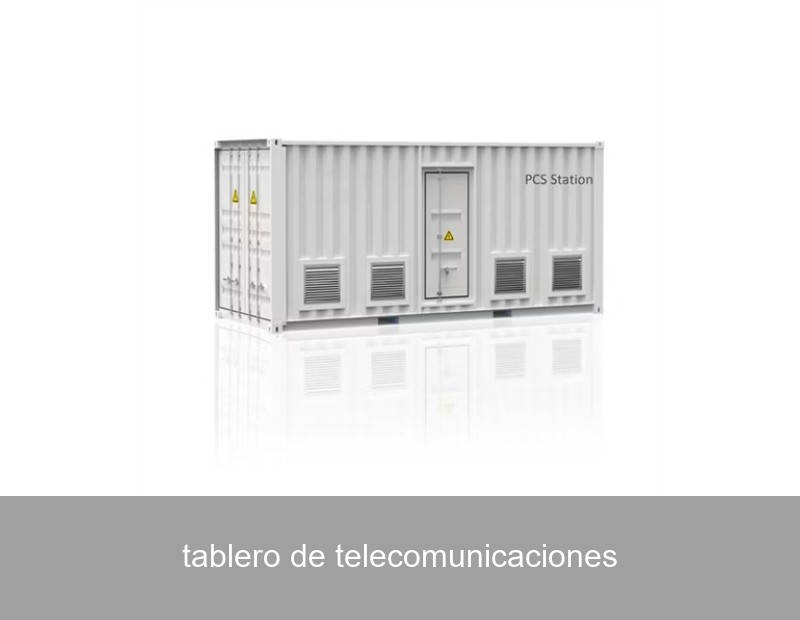
Image Source: Unsplash - A containerized BESS unit, like Highjoule's solutions, can provide robust backup and energy savings for telecom sites.
Beyond Backup: The Smart Energy Hub Strategy
The Madrid case illustrates the future. The modern tablero de telecomunicaciones should be viewed as a Smart Energy Hub. This is where Highjoule's expertise becomes pivotal. We don't just supply batteries; we provide holistic advanced energy storage systems designed to integrate with critical infrastructure.
For telecom and network applications, our HVC Series containerized storage and HVS Series for commercial buildings are engineered to connect directly to your critical distribution panels. They offer:
- Peak Shaving: Automatically use stored energy during high grid tariff periods, slashing demand charges.
- Solar Self-Consumption Optimization: Store excess solar energy for use at night, maximizing your on-site generation.
- Grid Services Participation: In some markets, aggregated systems can provide frequency regulation, creating a new revenue stream.
- Unparalleled Resilience: With millisecond-level switchover, ensuring your telecom equipment never experiences a power glitch.
By treating your telecom board as the anchor point for such a system, you future-proof your operations against rising energy costs and grid instability.
Future-Proofing Your Telecom Infrastructure
The transition to 5G, IoT expansion, and edge computing means more distributed telecom equipment, not less. Each new micro-cell or edge data center will have its own tablero de telecomunicaciones. Building them with integrated, intelligent storage from the start is the most cost-effective strategy. Retrofitting existing sites, as shown in Madrid, delivers a rapid and compelling return on investment.
The technology is proven, and the economic and environmental logic is undeniable. The question is no longer if you should upgrade the energy strategy around your critical power panels, but how and when.
Is your organization's network reliability being quietly undermined by an outdated power strategy at the telecommunications board? What would a 70% reduction in grid-related energy costs do for your operational budget this year?
 Inquiry
 Online Chat