


TEC Generators: How Much Do They Really Cost, and Are They Worth It?
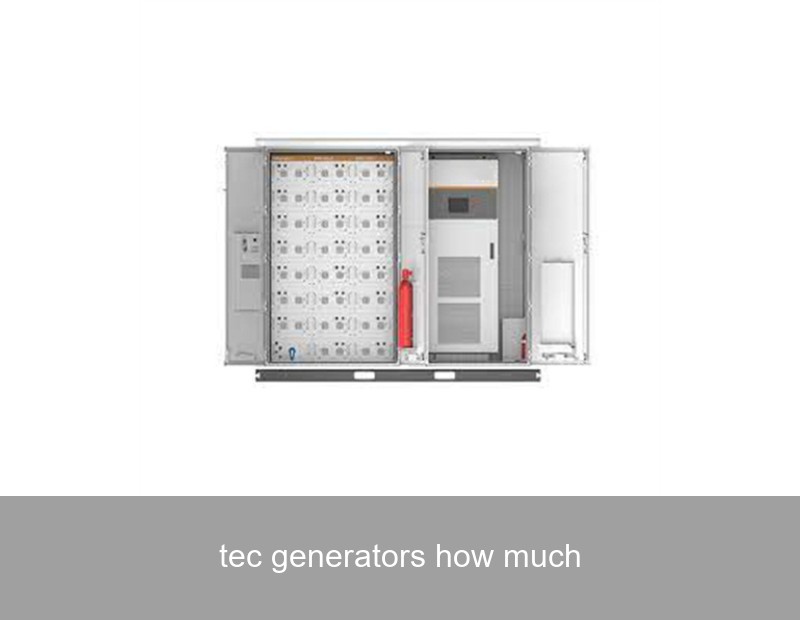
You're looking for reliable power, maybe for your off-grid cabin, a remote telecom site, or as a backup for your business. In your search, you've likely come across "TEC generators" or thermoelectric generators. They sound intriguing—silent, low-maintenance power from heat. But the immediate question that pops up is: TEC generators, how much? The price tag is just the starting point. To truly understand their value, we need to dive into what they are, their total cost of ownership, and how they stack up against modern alternatives like solar and battery storage. As a leader in advanced energy solutions, Highjoule often helps clients navigate these exact questions, balancing innovative tech with practical economics.
What Exactly is a TEC Generator?
A Thermoelectric Generator (TEG or TEC generator) is a solid-state device that converts heat directly into electricity using a principle called the Seebeck effect. Imagine a scenario where you have a significant heat source—like an industrial furnace, a gas pipeline, or even a wood stove. A TEC generator captures waste heat from these sources and produces DC power without any moving parts. This makes them incredibly reliable and silent. They are fantastic for niche applications where heat is abundant, maintenance is difficult, and power needs are modest (typically from watts to a few kilowatts).

Image Source: Wikimedia Commons, CC BY-SA
How Much Does a TEC Generator Cost? A Detailed Breakdown
Asking "how much" for a TEC generator is like asking the price of a car—it depends heavily on specifications. Let's break it down.
1. Upfront Capital Costs
The core thermoelectric modules themselves are just one part. A complete system includes:
- Thermoelectric Modules: These are the heart of the system. Costs vary with power output and quality. A rough estimate is $5 to $15 per watt of generated power. A 500W system could have a module cost of $2,500 to $7,500.
- Heat Exchangers: Crucial for efficiently transferring heat from your source to the modules. Custom fabrication can be expensive.
- Power Conditioning Unit: The raw DC output needs to be converted to stable, usable AC power, adding to the cost.
A small, off-the-shelf TEC unit for a camping stove might cost a few hundred dollars. A large, custom-engineered system for industrial waste heat recovery can easily run into tens of thousands.
2. Installation and Integration Costs
This is often overlooked. Installing a TEC generator isn't plug-and-play. It requires integrating with a high-temperature heat source, which may involve significant plumbing, safety systems, and engineering labor, especially in industrial settings.
3. Fuel Costs
Here's a critical factor. A TEC generator doesn't create energy; it converts heat to electricity. The "fuel" is the heat source. If you're using it with a propane burner, you're paying for propane continuously. Its efficiency is low, typically 5-10%. So, for every $100 of fuel, you might only get $5-$10 worth of electricity. The economics work best when the heat is free and otherwise wasted.
The Bigger Picture: Total Cost of Ownership (TCO)
To truly answer "how much," we must look beyond the price tag. TCO includes maintenance, fuel, and lifespan.
| Cost Factor | TEC Generator | Diesel Generator | Solar + Battery System |
|---|---|---|---|
| Upfront Cost | High | Medium | High |
| Fuel/Running Cost | High (if fuel not waste) | Very High | Very Low (sun is free) |
| Maintenance | Very Low | High | Low |
| Lifespan | Long (20+ years) | Medium | Long (25+ years for solar) |
| Noise & Emissions | Silent, Low | Loud, High | Silent, Zero |
As you can see, a TEC generator's sweet spot is defined by its unique advantages: silence and reliability in harsh, remote environments with a pre-existing waste heat stream.
Case Study: A Real-World Look at TEC vs. Solar + Storage
Let's examine a real scenario to ground our discussion in data. Consider a remote meteorological station in Northern Europe, requiring a constant 1kW of power for sensors and comms.
- Option A: TEC Generator using bottled propane. System cost: ~€15,000. Annual fuel cost for continuous operation: ~€3,500. Maintenance: minimal.
- Option B: Solar + Battery Storage System designed for low winter irradiance. System cost: ~€25,000. Annual fuel cost: €0. Maintenance: low.
At first glance, the TEC seems cheaper. But over a 10-year period, the TEC's fuel cost adds €35,000, making its TCO ~€50,000. The solar+storage system's TCO remains near its upfront cost, as operational costs are negligible. This is where companies like Highjoule add immense value. Our HI-Stack Commercial Battery Energy Storage System (BESS) can be seamlessly paired with solar PV to create a robust, off-grid power plant. With intelligent energy management and high-cycle lithium-ion batteries, it ensures 24/7 reliability without the ongoing fuel bill. For this station, the solar+Highjoule BESS solution would pay back the higher initial investment within 6-8 years and provide free power for decades thereafter.

Image Source: Unsplash - Representative image of solar and storage
The Future of Power: Integrating TEC with Modern Energy Systems
The conversation isn't always "either/or." Innovation lies in integration. Imagine a combined heat and power (CHP) plant where a TEC generator captures residual waste heat from the primary engine, boosting overall system efficiency. This incremental power could then be managed and stored in a Highjoule HI-Power Residential or HI-Stack Industrial BESS. Our systems are designed for such hybrid applications, capable of integrating multiple input sources—solar, wind, grid, and even generators—to optimize cost and carbon footprint.
For instance, a microgrid for an industrial campus might use a natural gas turbine for base load, TEC modules on exhaust flues for extra efficiency, a large solar carport, and a Highjoule HI-Stack BESS to balance it all. Our AI-driven energy management system makes these complex decisions in real-time, ensuring every kilowatt-hour is generated, stored, and used as economically as possible.
Making the Right Choice for Your Energy Needs
So, how much is a TEC generator? The answer is complex. It can be a highly specialized, cost-effective solution for waste heat recovery. But as a primary, fuel-burning power source, its low efficiency often leads to a high total cost of ownership compared to renewable alternatives.
Before you decide, ask yourself these key questions:
- Do I have a reliable, free, or waste heat source available?
- Is my power need constant, small, and in a location where maintenance is impossible?
- Am I prioritizing absolute silence and zero vibration?
If you answered "no" to the first question, your journey likely shouldn't end with TEC. The modern energy landscape offers powerful, sustainable alternatives. At Highjoule, with nearly two decades of experience, we specialize in designing intelligent, efficient, and sustainable power solutions that look at your entire energy ecosystem. From residential backup with the HI-Power series to grid-scale industrial storage with HI-Stack, we provide solutions that deliver predictable costs and clean power for the long term.
A Final Thought to Power Your Decision
Given the rapid decline in solar and storage costs, and the volatility of fossil fuel prices, what combination of technologies will give your home or business the greatest energy independence and cost certainty for the next 25 years?
 Inquiry
 Online Chat