


Understanding Today's Solar Inverter Price in Sweden: A 2024 Market Guide
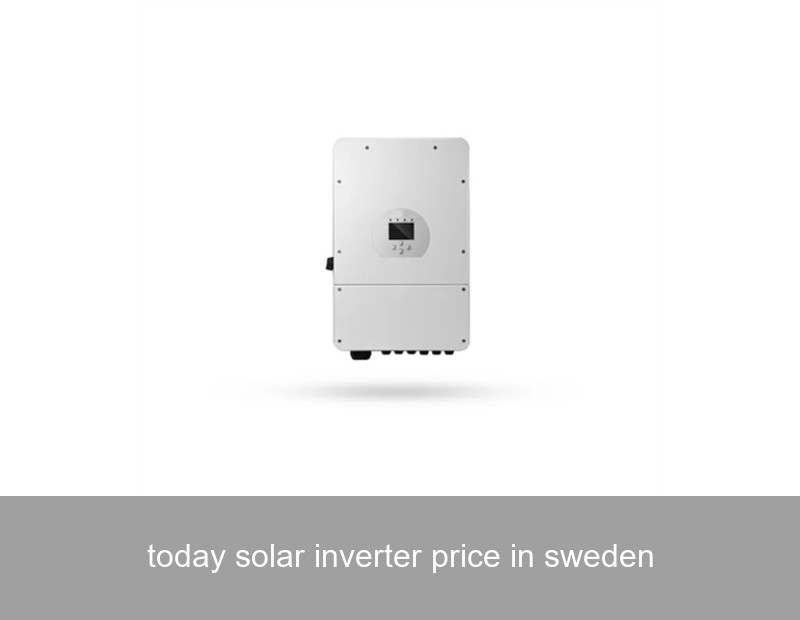
If you're considering solar power for your home or business in Sweden, one of the most crucial and often confusing components is the inverter. You're likely asking: what is the today solar inverter price in Sweden, and what factors truly determine that cost? The price tag you see is more than just a number; it's a reflection of technology, efficiency, and long-term value. In Sweden's unique energy landscape—with its seasonal light variations and a strong push for sustainability—choosing the right inverter is key to maximizing your investment. This guide will demystify the current market, break down the costs, and show you how the right system turns sunlight into reliable savings.
The Real Breakdown: What Goes Into a Solar Inverter Price in Sweden?
Let's be clear: when you search for "today solar inverter price in Sweden", you're rarely comparing apples to apples. The final cost is a sum of several components. Primarily, you have the inverter type. A standard string inverter is often the most budget-friendly entry point, suitable for simpler roof layouts. However, for Swedish homes with partial shading or multiple roof angles—a common scenario—microinverters or power optimizers (like those from Enphase or SolarEdge) become necessary. These systems maximize output per panel but increase the upfront cost.
Beyond the hardware, the price includes installation labor, which is significant in Sweden due to high standards and certified electrician requirements. You must also consider grid-connection fees, potential electrical upgrade costs, and of course, VAT (moms). Crucially, the inverter's power rating (measured in kW) must match your solar array size. A 5kW system will require a different inverter than a 10kW one, directly impacting the price.
Key Cost Components
- Inverter Unit Cost: The core hardware price, varying by type and brand.
- Installation & Labor: Certified electrician work for installation and grid compliance.
- Balance of System (BOS): Cabling, mounting hardware, monitoring systems, and safety equipment.
- Grid Connection & Permits: Administrative costs for connecting to the local grid (e.g., via Ellevio or E.ON).
- VAT (Moms): Standard 25% value-added tax applied in Sweden.
Current Market Trends & Price Ranges in 2024
As of 2024, the Swedish solar inverter market is dynamic. Increased competition and technological maturity have helped stabilize prices, though premium features command a premium. Based on aggregated data from installers and suppliers, here's a realistic snapshot for a typical residential system:
| System Size (Solar Panels) | Inverter Type | Estimated Inverter & Critical Hardware Price Range (SEK) | Typical Full Installed Cost Range (SEK)* |
|---|---|---|---|
| Small (4-6 kW) | String Inverter | 15,000 - 25,000 SEK | 70,000 - 110,000 SEK |
| Medium (6-10 kW) | Hybrid Inverter (with battery readiness) | 25,000 - 40,000 SEK | 110,000 - 180,000 SEK |
| Large (10+ kW) / Complex Roof | Microinverters or Optimizers + Inverter | 40,000 - 70,000 SEK+ | 180,000 - 300,000 SEK+ |
*Full installed cost includes panels, inverter, mounting, labor, and grid connection. Prices are pre-subsidy. Source: Compiled from Swedish Energy Agency data and industry reports.
A significant trend is the shift towards hybrid inverters. These devices are becoming the standard for new installations because they don't just convert DC to AC; they are built with a dedicated connection for a battery storage system. This is where the real future-proofing happens. Given Sweden's electricity price volatility and the desire for energy independence, an inverter that can seamlessly integrate storage is no longer a luxury—it's a wise strategic purchase.

Image Source: Unsplash (Representative image of a modern inverter)
From Quote to Kilowatt: A Real Swedish Case Study
Let's move from theory to practice. Consider the Andersson family in Västerås. In early 2023, they received three quotes for a 8.4 kW solar panel system. Their key requirement was readiness for a future battery.
- Quote A: Featured a basic string inverter. Lowest upfront hardware cost (18,500 SEK).
- Quote B: Featured a hybrid inverter from a mid-tier brand. Higher cost (32,000 SEK).
- Quote C: Featured a premium hybrid inverter integrated with a smart energy management system.
The family chose Quote B, the hybrid option. The total system cost was around 165,000 SEK. By the end of 2023, their system had produced 7,800 kWh. However, they were exporting over 50% of this to the grid during the day at lower rates, only to buy expensive electricity in the evening. This "clipping" of their solar investment's potential was the catalyst for their next step: adding a battery.
Because they had chosen a hybrid inverter, adding a Highjoule HomePower battery storage unit in 2024 was a straightforward, plug-and-play process. The existing inverter communicated seamlessly with the new battery. The result? Their self-consumption rate jumped from ~50% to over 85%, dramatically reducing their grid purchases. The initial higher investment in the hybrid inverter paid off by avoiding a complete inverter replacement later, saving them an estimated 40,000 SEK in avoided upgrade costs and maximizing their return on investment.
Looking Beyond the Price Tag: Efficiency, Warranty, and Smart Features
When evaluating the today solar inverter price in Sweden, the cheapest option can be the most expensive in the long run. Focus on these three non-negotiable factors:
- Peak Efficiency: This percentage (e.g., 97.5% vs. 98.5%) represents how much DC power from your panels is converted to usable AC. A small difference translates to hundreds of lost kWh over the system's life.
- Warranty Length & Terms: Inverters are electronic devices that degrade. A standard warranty is 5-10 years. Many premium brands, including those used by Highjoule, offer extendable warranties up to 20-25 years, ensuring long-term performance and peace of mind.
- Smart Monitoring & Grid Services: Can your inverter provide detailed, real-time production data via an app? Can it respond to grid signals or be part of a virtual power plant (VPP)? This intelligence is key for future energy participation.
How Highjoule Integrates Inverter Intelligence into Complete Storage Solutions
At Highjoule, we view the inverter not as a standalone commodity, but as the intelligent "brain" of a holistic energy ecosystem. Our approach for the European and Swedish market is to provide integrated solutions where our advanced battery storage systems are paired with rigorously tested, compatible hybrid inverters from leading manufacturers.
For instance, our Highjoule HomePower 10 system isn't just a battery box. It's a pre-engineered package that includes a high-efficiency hybrid inverter, lithium-iron-phosphate (LiFePO4) batteries known for safety and longevity, and our proprietary Energy Hub OS. This software intelligently manages energy flow: directing solar power to your home, charging the battery, and deciding when to export to the grid based on real-time pricing—a feature increasingly valuable in Sweden's dynamic electricity markets. By offering this integrated solution, we eliminate compatibility guesswork for the customer and installer, ensuring optimal performance and unlocking the full value of every kilowatt-hour your solar panels produce.
For commercial and industrial applications, our Highjoule C&I Stack solutions use central inverters and sophisticated energy management systems to perform peak shaving, demand charge reduction, and backup power, delivering a clear return on investment.

Image Source: Unsplash (Representative graphic of energy flow)
Making the Right Choice for Your Swedish Property
So, how do you navigate this decision? Start by asking the right questions. Don't just ask for "today solar inverter price in Sweden". Ask your installer: Is this a hybrid inverter? What is its peak and weighted efficiency? What is the full warranty period and what does it cover? How does the monitoring platform work? Most importantly, ask for a simulation of your self-consumption with and without a battery.
Consult authoritative sources like the Swedish Energy Agency for subsidy information (solcellsstöd) and the International Energy Agency (IEA) for global technology trends to inform your decision.
Your Next Step
The landscape of solar energy in Sweden is evolving from simple production to intelligent consumption and storage. The inverter is at the heart of this shift. Given your home's specific architecture, energy needs, and vision for energy independence, what single feature in an inverter system would provide you the most value: maximum efficiency rating, seamless battery expansion, or advanced grid interaction capabilities?
 Inquiry
 Online Chat