


How Advanced Energy Storage is Revolutionizing Solar Manufacturing: A Look at Toyo Solar and One Member PLC
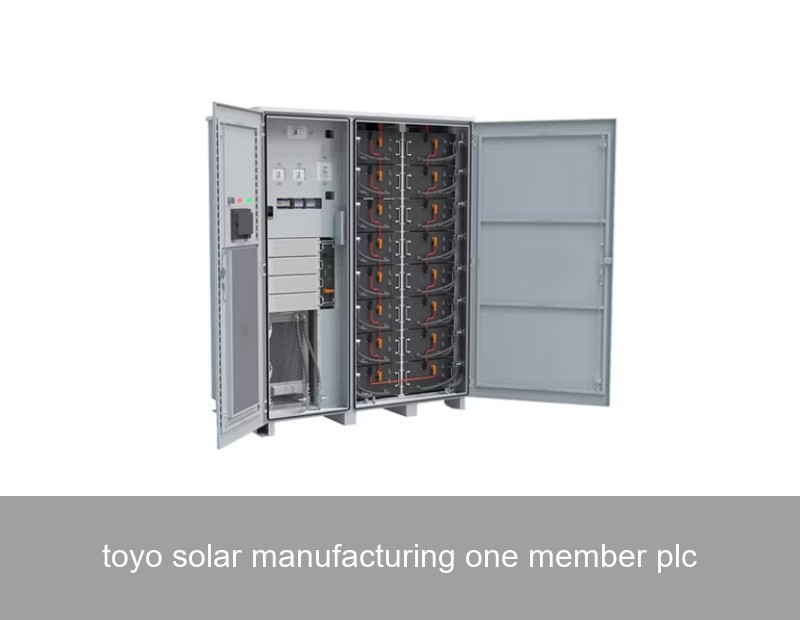
In the high-stakes world of solar panel manufacturing, companies like Toyo Solar Manufacturing One Member PLC face a unique challenge. Their success hinges on producing high-quality photovoltaic (PV) modules efficiently and cost-effectively. However, the very process that powers our clean energy future—solar manufacturing—is incredibly energy-intensive. From purifying silicon to laminating cells, factories require a massive, consistent, and high-quality power supply. Any interruption or fluctuation can lead to costly downtime, product defects, and missed production targets. This is where the synergy between solar manufacturing and advanced, behind-the-meter battery energy storage systems (BESS) becomes not just beneficial, but essential for competitive advantage and sustainability goals.
Table of Contents
The Power Problem in Modern Solar Manufacturing
Imagine you're the plant manager at a facility like Toyo Solar Manufacturing One Member PLC. Your production line is a marvel of precision engineering, but it's also a power hog. Critical processes such as:
- Poly-Silicon Production & Ingot Casting: Requires temperatures exceeding 1400°C, often using electric arc furnaces.
- Wafer Slicing: Diamond-wire saws operating with extreme precision under constant power.
- Cell Processing & Lamination: Cleanrooms and laminators that demand stable, uninterrupted electricity.
A voltage dip lasting just a few milliseconds can trip safety systems, halt robotic arms, and force a lengthy restart procedure. In an industry with razor-thin margins, such events directly impact profitability. Furthermore, as global manufacturers commit to greener operations, simply drawing power from a potentially fossil-fuel-heavy grid contradicts the very product they create. The question becomes: how can a solar manufacturer ensure its own power is as clean, reliable, and cost-effective as the panels it produces?
The Data: Energy Demand and Grid Vulnerability
Let's talk numbers. According to the International Energy Agency (IEA), manufacturing accounts for about 80% of the total carbon footprint of a solar PV system. While much of this is process emissions, the electricity source is a major contributor. In regions like Europe and the U.S., where grid decarbonization is underway, volatility remains. The U.S. Energy Information Administration notes that manufacturers face an average of 5-6 hours of power interruptions per year, not counting minor fluctuations. For a solar plant running 24/7, this can translate to millions in lost revenue and wasted materials.

Image: A modern automated manufacturing line. Power stability is non-negotiable for such precision. Source: Unsplash
Case Study: A European Solar Manufacturer's Strategic Shift
Consider the experience of a major European solar panel producer (with operational parallels to Toyo Solar Manufacturing One Member PLC). Facing rising time-of-use energy charges and an increasing frequency of grid congestion warnings, they sought a solution to:
- Protect their sensitive production equipment from grid disturbances.
- Reduce their overall energy costs by optimizing consumption patterns.
- Increase their on-site consumption of renewable energy from their own rooftop PV system.
They partnered with Highjoule to implement a turnkey, containerized IntelliBESS 500 system with 2 MWh capacity and 1.5 MW power output. The results, measured over one year, were compelling:
| Metric | Before Highjoule BESS | After Highjoule BESS | Improvement |
|---|---|---|---|
| Production Downtime from Power Events | ~18 hours/year | 0 hours/year | 100% reduction |
| Energy Cost from Grid | Base cost + peak charges | Optimized via load shifting | 23% savings |
| On-Site Solar Self-Consumption | 35% | 89% | 154% increase |
The BESS acts as a buffer. It charges during periods of low grid demand (or high solar production) and discharges during expensive peak hours or when the grid is weak. This "peak shaving" and "load shifting" capability transformed their energy profile from a passive expense into an active, manageable asset.
The Storage Solution: Beyond Backup Power
For forward-thinking companies, the approach has evolved. It's no longer just about emergency generators. Modern battery energy storage provides a multi-functional platform:
- Power Quality & Reliability: Instantaneous response to grid sags, swells, or interruptions, keeping production online.
- Energy Arbitrage: Buying/store cheap energy, using/selling during expensive periods.
- Renewable Integration: Soaking up excess solar generation from on-site rooftops for use at night, maximizing the value of self-generation.
- Grid Services: In some markets, providing frequency regulation services for additional revenue.
This turns the manufacturing facility into a proactive node in the energy system, enhancing its resilience and sustainability narrative—a powerful message for investors and customers alike.
How Highjoule Empowers Industrial Energy Resilience
This is where Highjoule's expertise becomes critical. Since 2005, we have specialized in designing and deploying intelligent storage solutions for demanding industrial and commercial applications. For a manufacturer like Toyo Solar Manufacturing One Member PLC, we wouldn't just deliver a battery box. We provide a comprehensive Industrial Energy Resilience Platform.
Our IntelliBESS product line, coupled with our proprietary Energy Management System (EMS), is engineered for the harsh, high-availability environment of a factory. The system features:
- Ultra-Fast Response: Sub-100 millisecond reaction to grid anomalies to protect sensitive loads.
- Advanced Thermal Management: Ensuring safety and longevity even in hot industrial settings.
- AI-Powered Optimization: Our EMS learns the facility's load patterns and electricity tariffs to autonomously execute the most cost-effective strategy.
- Scalable Architecture: From modular cabinet systems to large containerized solutions, we scale to meet any manufacturing plant's needs.

Image: A technician performing maintenance on a containerized BESS. Reliability is engineered into every Highjoule system. Source: Unsplash
Our service extends beyond installation. Highjoule offers long-term performance monitoring, maintenance, and software updates, ensuring your energy storage asset delivers value for its entire 15+ year lifespan.
The Future Outlook for Solar Producers
The trajectory is clear. As solar manufacturing scales up to meet global decarbonization targets, the energy-smart factory will have a distinct competitive edge. Regulatory pressures, like the EU's Carbon Border Adjustment Mechanism (CBAM), will make low-carbon manufacturing processes a financial imperative, not just a branding choice. Integrating advanced storage is a definitive step towards achieving "green manufacturing" status.
It also future-proofs the business. As solar technology evolves towards higher-efficiency cells like TOPCon and HJT, which may have even more precise energy requirements, having a stable, clean microgrid powered by on-site solar and buffered by storage will be a key enabler of innovation and quality.
The story of solar manufacturing is no longer just about the panels rolling off the line. It's about the power behind their creation. For a company at the forefront, like Toyo Solar Manufacturing One Member PLC, the integration of advanced energy storage represents the next logical step in operational excellence, cost control, and environmental leadership. It aligns the manufacturing process with the promise of the final product: a smarter, more sustainable future.
Is your manufacturing operation ready to transform its energy profile from a volatile cost center into a resilient, value-generating asset? What would a 20% reduction in your energy bills and zero downtime from power events mean for your annual output and sustainability report?
 Inquiry
 Online Chat