


VRE Integration for Sale: Unlocking the True Potential of Your Renewable Energy Assets
Have you ever looked at your solar panels or wind turbines and wondered, "Am I getting the most out of this investment?" You're not alone. Across Europe and the US, businesses and communities are generating more clean energy than ever. Yet, a persistent challenge shadows this success: the sun doesn't always shine, and the wind doesn't always blow. This intermittency is the fundamental hurdle of Variable Renewable Energy (VRE). But what if the solution wasn't just about generating more, but about intelligently integrating what you already have? This is where the concept of "VRE Integration for Sale" comes into play—it's not a physical product, but a comprehensive capability you can acquire to transform volatility into value.
Table of Contents
- The VRE Dilemma: More Power, More Problems?
- What is VRE Integration, Really?
- The Data Behind the Challenge: Curtailment and Cost
- Case Study: A Bavarian Industrial Park's Journey to Energy Independence
- The Highjoule Solution: Smart Integration as a Service
- Key Components of a VRE Integration System
- Does Advanced VRE Integration Make Financial Sense?
The VRE Dilemma: More Power, More Problems?
a bright, windy afternoon at your facility. Your solar arrays and turbines are operating at peak capacity, pouring clean electricity into your local grid or microgrid. But your facility's demand is low. Suddenly, you're facing a tough choice: waste the excess energy (curtail it) or risk overloading the network. This isn't a hypothetical; it's a daily reality in regions with high VRE penetration. The grid, designed for predictable fossil fuel generation, struggles with these fluctuations. The result? Potential revenue loss, grid instability penalties, and a ceiling on your renewable ambitions.
What is VRE Integration, Really?
Think of VRE integration not as a single device, but as a sophisticated energy orchestra. It's the combination of advanced hardware, predictive software, and strategic services that work in concert to smooth out renewable energy's peaks and valleys. When we talk about "VRE Integration for Sale," we're referring to the turnkey systems and expertise that deliver this harmony. The core mission is threefold: store excess energy, dispatch it on demand, and intelligently manage the entire flow to maximize self-consumption, grid services, and financial returns.
The Data Behind the Challenge: Curtailment and Cost
The scale of the issue is backed by hard data. In California's CAISO grid, a leader in solar adoption, curtailment of renewable energy has reached significant levels, with over 2.4 million MWh wasted in a recent year—enough to power nearly 350,000 homes. In Europe, grid congestion in renewable-rich nations like Germany leads to similar inefficiencies. This isn't just an environmental concern; it's a direct hit to your project's ROI. The financial argument for integration is compelling: converting wasted energy into usable power translates directly to improved payback periods and asset valuation.
Case Study: A Bavarian Industrial Park's Journey to Energy Independence
Let's make this concrete with a real-world example. A mid-sized manufacturing park in Bavaria, Germany, operated with a 2.5 MW rooftop solar PV system. Despite their green credentials, they faced two major issues: 1) 30% of their solar generation was routinely curtailed during weekends and low-production periods, and 2) they remained vulnerable to peak utility charges during early evenings when solar output faded.
Their solution was a comprehensive VRE integration package. The centerpiece was a Highjoule H-Ion 2.0 MWh Battery Energy Storage System (BESS), coupled with our Aurora Energy Management System (EMS) platform. The results, measured over 12 months, were transformative:
| Metric | Before Integration | After Integration |
|---|---|---|
| Solar Self-Consumption Rate | 68% | 94% |
| Grid Energy Import (Peak Hours) | 100% of need | 15% of need |
| Annual Energy Cost Savings | Baseline | €182,000 |
| Renewable Curtailment | 30% | <2% |
The Aurora EMS uses AI-driven forecasting to predict solar generation and load patterns, pre-charging the battery ahead of peak tariffs and automatically selling small bursts of excess stored power to the grid frequency market—creating a new revenue stream. For this park, VRE integration became a profit center, not just a cost.

Modern industrial energy solutions combine solar generation with on-site battery storage for full VRE integration.
The Highjoule Solution: Smart Integration as a Service
At Highjoule, we've moved beyond simply selling battery racks. We provide a holistic VRE integration capability. Since 2005, our focus has been on designing systems where the whole is greater than the sum of its parts. For a commercial or industrial client, this means we analyze your specific generation mix, load profile, tariff structures, and local grid regulations to design a system that optimizes for your unique financial and operational goals.
Our IntelliGrid Microgrid Platform is a prime example. It allows a site with solar, wind, and backup generators to operate seamlessly as an island during outages or to intentionally disconnect from the main grid during periods of high cost or low reliability, all while prioritizing renewable sources. This level of control is the ultimate form of VRE integration, turning your energy assets into a resilient, adaptive power ecosystem.
Key Components of a VRE Integration System
So, what are you actually "buying" when you invest in VRE integration? The package typically includes:
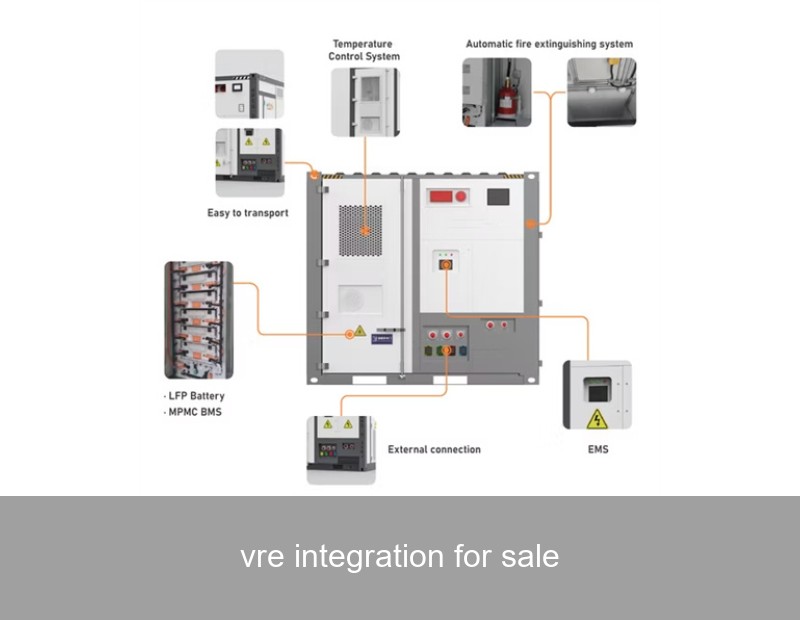
- Advanced Battery Storage (BESS): The physical heart. Highjoule's systems use lithium-ion phosphate (LFP) chemistry, known for safety, long lifespan (often over 6,000 cycles), and stable performance. We offer scalable solutions from 100 kWh to multi-megawatt-hour installations.
- Bi-Directional Inverters: The translators. These sophisticated devices efficiently convert DC from batteries and solar to AC for your facility and back again, managing the flow in both directions.
- Energy Management System (EMS): The brain. This is where the magic happens. Our Aurora EMS uses real-time data and machine learning to make dispatch decisions in milliseconds, optimizing for self-consumption, arbitrage, frequency regulation, or a blend of all three.
- System Integration & Grid Interconnection Services: The crucial expertise. Navigating utility interconnection agreements and national grid codes (like UL 9540 in the US or IEC 62933 in Europe) is complex. Our team handles this from start to finish.
Does Advanced VRE Integration Make Financial Sense?
Absolutely. The business case rests on multiple revenue and savings streams:
- Reduced Demand Charges: Shave peak power draws from the grid, often the largest portion of a commercial electricity bill.
- Energy Arbitrage: Buy grid electricity when it's cheap (at night), store it, and use it or sell it back when prices are high.
- Ancillary Grid Services: In many markets, you can be paid for helping the grid maintain frequency stability—a service perfectly suited for fast-responding battery systems. The Federal Energy Regulatory Commission (FERC) Order 841 has been pivotal in opening US markets for this.
- Increased Renewable ROI: By eliminating curtailment, every kilowatt-hour your solar or wind asset produces becomes valuable.
- Resilience & Backup Power: While harder to quantify, avoiding downtime during outages has immense value for critical operations.

Smart energy management systems visualize and control complex flows between generation, storage, and consumption.
Preparing for the Future Grid: Your Next Step
The energy landscape is shifting from a one-way street to a dynamic, decentralized network. Technologies like vehicle-to-grid (V2G) and AI-optimized virtual power plants (VPPs) are on the horizon. Investing in robust VRE integration today positions you at the forefront of this transition. It future-proofs your energy assets against changing regulations, volatile fossil fuel prices, and increasing grid demands.
So, the question isn't really "Can I afford to integrate my variable renewables?" The more pressing question is, "What is the cost of *not* capturing the full value of the clean energy I'm already generating?" The capability to seamlessly integrate VRE is, effectively, for sale. The return on that investment is measured in energy security, sustainability, and long-term economic gain.
Is your organization ready to conduct a detailed analysis of the VRE integration potential hidden within your current operations? What would a 25% reduction in your annual energy costs and a significant boost to your sustainability targets mean for your bottom line and your mission?
 Inquiry
 Online Chat