


Understanding the Working Principle of a Solar Power Plant: From Sunlight to Socket
Have you ever driven past a field of glistening panels or seen them on a rooftop and wondered, "How does that actually create electricity for my home or business?" You're not alone. The working principle of a solar power plant, whether a massive utility-scale farm or a smaller commercial installation, is a marvel of modern engineering that seems almost magical. But at its core, it's a beautifully logical process of converting abundant sunlight into reliable, clean power. As energy costs fluctuate and sustainability goals become paramount, understanding this principle is the first step to harnessing its potential. For over 18 years, Highjoule has been at the forefront, not just installing panels, but designing intelligent solar power plants integrated with advanced battery storage, ensuring that the sun's energy works harder and smarter for our clients across Europe and North America.
Table of Contents
- The Core Phenomenon: It Starts with a Photon
- From Cell to Plant: Scaling Up the Solar Principle
- Key Components of a Modern Solar Power Plant
- The Storage Imperative: Completing the Solar Cycle
- Case Study: A German Manufacturing Plant's Journey to 24/7 Solar
- Beyond Generation: The Intelligence Behind Modern Solar Farms
The Core Phenomenon: It Starts with a Photon
The entire working principle of a solar power plant hinges on a physical process called the photovoltaic (PV) effect. Discovered in 1839, it's the ability of certain materials to generate an electric current when exposed to light. Today's solar panels are built with silicon cells, which are semiconductor materials. Here's the step-by-step magic:
- Photon Absorption: Sunlight is composed of energy particles called photons. When these photons strike the silicon cell, they transfer their energy to the atoms in the silicon.
- Electron Excitation: This energy knocks electrons loose from their atomic bonds, creating "free" electrons and leaving behind "holes" (positive charges).
- Electric Field Direction: A built-in electric field within the cell, created by doping the silicon with other elements (like boron and phosphorus), forces these freed electrons to move in a specific direction.
- Current Creation: This directed flow of electrons is an electric current (Direct Current - DC). Metal contacts on the cell capture this DC electricity.
One single cell produces only a few watts. But connect hundreds of them in a panel, and thousands of panels in an array, and you have the foundation of a solar power plant capable of powering entire communities.

Image: The heart of the solar principle - photovoltaic cells converting sunlight. Credit: Unsplash.
From Cell to Plant: Scaling Up the Solar Principle
So, how do we go from a 400W panel on a roof to a 50 MW plant powering 15,000 homes? The working principle of a solar power plant involves sophisticated scaling and system integration. It's not just about more panels; it's about intelligent design and conversion.
| Component | Function | Analogy |
|---|---|---|
| PV Array | The collective grouping of all solar panels, connected in series and parallel to achieve desired voltage and current. | The "fields" of the farm, harvesting raw sunlight. |
| Inverters | Converts the DC electricity produced by the panels into the Alternating Current (AC) used by the grid and appliances. | The "translator" that makes solar energy usable for our homes and businesses. |
| Transformer & Switchgear | Steps up the voltage for efficient long-distance transmission and manages connection to the grid. | The "highway on-ramp" for solar energy to enter the public grid. |
| Monitoring & Control System | Continuously tracks performance, detects faults, and optimizes output. | The "brain" of the plant, ensuring peak efficiency. |
This is where expertise matters immensely. Highjoule's engineering team specializes in designing this entire ecosystem, ensuring each component from the panel brand to the central inverter is optimally matched for the specific site's insolation, climate, and energy profile. Our solar power plant solutions for commercial and industrial clients focus on maximizing return on investment through precision engineering.
The Storage Imperative: Completing the Solar Cycle
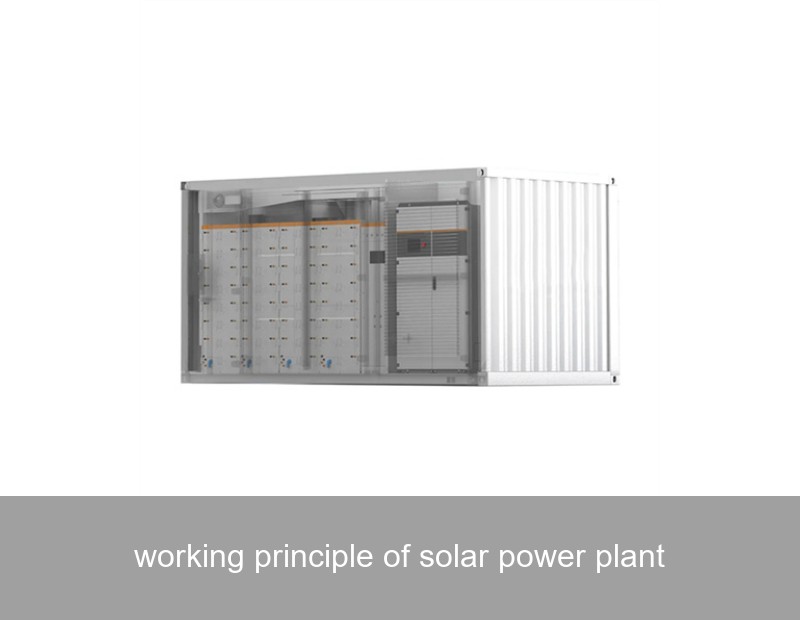
Here's a fundamental challenge in the classic working principle of a solar power plant: the sun doesn't always shine. This creates a mismatch between generation (daytime) and consumption (often peaking in morning and evening). This is where the modern solar plant evolves. The most advanced systems are no longer just generators; they are integrated power hubs that include battery energy storage systems (BESS).
Think of it this way: without storage, a solar plant is like a spring that only flows at noon. With storage, we build a reservoir. Excess solar energy produced during peak sun hours is stored in batteries instead of being curtailed or sold back to the grid at low rates. This stored energy can then be dispatched:
- During Peak Demand: To avoid expensive grid power during high-tariff periods (a strategy called peak shaving).
- After Sunset: To extend solar self-consumption into the night, increasing energy independence.
- For Grid Services: Providing stability and backup power to the microgrid or local network.
This is a core part of Highjoule's value proposition. Our HPS Series integrated storage systems are engineered to seamlessly couple with our solar plants. They feature high-cycle life lithium-iron-phosphate (LFP) batteries, sophisticated thermal management, and an energy management system (EMS) that autonomously decides when to charge, store, or discharge based on weather forecasts, usage patterns, and tariff schedules. This transforms a solar installation from a partial solution into a comprehensive, 24/7 power asset.
Case Study: A German Manufacturing Plant's Journey to 24/7 Solar
Let's look at a real-world application. A mid-sized automotive parts manufacturer in Bavaria, Germany, faced rising energy costs and stringent corporate sustainability targets. They had a large, flat factory roof and high energy consumption across two day shifts.
- Phenomenon: High grid dependency, volatile energy prices, and a desire to utilize renewable energy.
- Data & Solution: Highjoule designed and deployed a 1.2 MW rooftop solar power plant, integrated with a 500 kWh/750 kVA HPS battery storage system. The system was designed to cover over 60% of the facility's annual load.
- Outcome: The solar array generates power during the day. The intelligent EMS charges the batteries with excess solar and strategically discharges them during the high-price evening hours and to support critical loads during brief grid interruptions. In the first year of operation, the plant achieved:
- A 40% reduction in grid electricity costs.
- Over 950 tons of CO2 emissions avoided annually.
- Enhanced power quality and backup resilience for sensitive machinery.
This case exemplifies the modern working principle of a solar power plant—it's a dynamic, intelligent system, not a static set of panels.

Image: A commercial-scale rooftop solar installation. Credit: Unsplash.
Beyond Generation: The Intelligence Behind Modern Solar Farms
The final layer in today's solar power plant principle is digital intelligence. Through platforms like Highjoule's EnergyOS, plant operators and business owners have a virtual window into every kilowatt-hour. This platform provides:
- Real-time and historical performance analytics.
- Predictive maintenance alerts based on AI-driven analysis of component data.
- Remote control and optimization of storage dispatch strategies.
- Detailed reporting on financial savings and carbon impact.
This level of insight turns a capital expenditure into a managed asset with a clear, measurable performance trajectory. It demystifies the working principle of a solar power plant for the operator, providing actionable data to ensure the system delivers on its promises for decades. According to the National Renewable Energy Laboratory (NREL), advanced monitoring and O&M practices can improve the levelized cost of energy (LCOE) by several percentage points over a plant's lifetime.
Highjoule's Integrated Approach
At Highjoule, we view the working principle of a solar power plant as an integrated symphony of physics, engineering, and software. From initial site assessment and financial modeling to engineering, procurement, construction (EPC), and lifelong operations & maintenance, we provide a single-point solution. Our products, like the high-efficiency bifacial panel-compatible mounting structures, our range of string and central inverters, and the HPS storage series, are all designed to work in concert for maximum reliability and return.
Given that the efficiency of solar conversion and the economics of storage are continually improving, what specific energy challenge—be it unpredictable demand charges, grid instability, or a hard-to-meet sustainability target—could a reimagined solar-plus-storage principle solve for your operation?
 Inquiry
 Online Chat