


XL Solar Panels: How Much Do They Really Cost and Are They Worth It?
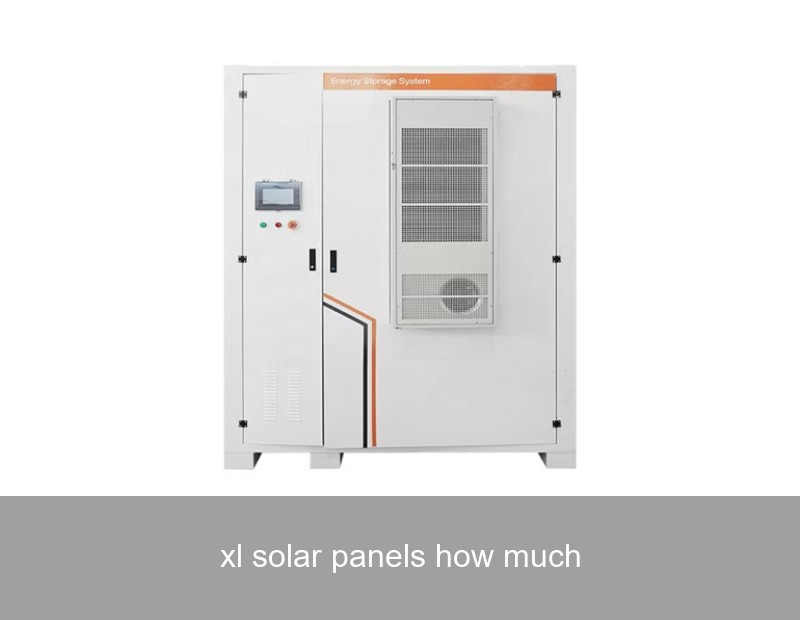
If you're researching solar for your home or business, you've likely encountered the term "XL solar panels." These larger-format, high-wattage modules are becoming the new standard, promising more power from your roof. But the immediate question that follows is, of course, "XL solar panels, how much?" The price tag is just the starting point. To truly understand the value, we need to dive into the full financial picture—from upfront costs to long-term energy independence. As a product technology expert at Highjoule, a global leader in advanced energy storage systems since 2005, I see daily how pairing the right solar technology with intelligent storage unlocks the true potential of every kilowatt-hour generated.
What Are XL Solar Panels?
XL solar panels, often referred to as "large-format" panels, are a significant evolution from traditional 60-cell or 72-cell modules. Typically built on 120-half-cut or 144-half-cut cell architectures, these panels can exceed 2 meters in length and boast power outputs ranging from 400 watts to over 600 watts. Their key advantage is power density: you generate more electricity from the same roof area, which reduces the number of panels, racking, and labor needed for a given system size. This efficiency gain is central to answering the true cost question.

Image: XL panels offer higher power density. Source: Unsplash
The Cost Breakdown: XL Solar Panels, How Much?
Let's dissect the costs. Remember, you're not just buying panels; you're investing in an energy system.
Panel Costs
Per panel, XL modules have a higher upfront cost. Where a standard 370W panel might cost $200-$250, a 550W XL panel could range from $275-$350. However, the critical metric is cost per watt ($/W). Due to economies of scale in manufacturing, the $/W for XL panels is often competitive or even lower. You might pay $0.70-$0.90 per watt for the panel itself, similar to premium standard panels.
Full System & Installation Costs
This is where XL panels shine. A 10kW system using standard panels might require 27 panels. The same 10kW system with XL panels might need only 18. This translates to:
- Lower Balance of System (BOS) Costs: Fewer racking components, fewer connectors, less wiring.
- Reduced Labor: Fewer panels to handle, mount, and electrically connect can cut installation time by 20-30%.
- Optimized Logistics: While larger, the total number of pallets delivered may be less.
According to the National Renewable Energy Laboratory (NREL), these BOS and labor savings are a primary driver for the industry's shift toward high-wattage modules.
| Cost Component | Standard Panels (e.g., 370W) | XL Panels (e.g., 550W) | Notes |
|---|---|---|---|
| Number of Panels | 27 | 18 | To achieve ~10kW output |
| Panel Cost (approx.) | $6,750 | $5,670 | Assuming $0.75/W for panels |
| Estimated BOS & Labor Savings | Baseline | 15-25% lower | Due to fewer units |
| Potential Total System Cost Impact | Higher Baseline | Potentially 5-15% Lower | Highly dependent on installer and site |
The Long-Term Value Equation
The "how much" question extends over 25+ years. Higher output per panel means you maximize energy production on space-constrained roofs. This leads to greater lifetime energy savings and a faster payback period. In markets with time-of-use rates or export tariffs, generating more power during peak sun hours is financially advantageous.
A Real-World Case: Commercial Rooftop in Germany
Let's look at data. A medium-sized logistics company in Bavaria retrofitted its 4,000 sqm warehouse roof in 2023. The goal: maximize on-site consumption to offset high commercial energy prices.
- Original Plan (Standard Panels): 415W panels, 580 units, 240.7kWp system. Estimated annual production: 225,000 kWh.
- Chosen Solution (XL Panels): 605W bifacial XL panels, 398 units, 240.8kWp system. Fewer roof penetrations were a key benefit.
The result? The XL system achieved a 12% lower installation cost per kWp due to reduced labor and hardware. Furthermore, the higher efficiency and bifacial gain led to an actual first-year production of 248,000 kWh, exceeding projections. This extra 23,000 kWh, valued at ~€0.28/kWh, added over €6,400 in annual savings. The project's payback time was reduced by nearly two years. This case clearly shows that the initial query of "XL solar panels how much" is best answered by looking at total lifecycle value, not just module sticker price.
Maximizing Your XL Panel Investment: The Critical Role of Storage
Here's a pivotal insight: an XL solar system without storage is like a high-performance sports car with a tiny fuel tank. You produce a lot of power, but when the sun sets, you're back to buying expensive grid electricity. This drastically underutilizes your investment. The true modern metric is self-consumption—how much of your own solar energy you can use.
Without a battery, typical self-consumption for a home might be 30-50%. The rest is exported, often at a rate lower than the retail price. An XL system can exacerbate this "waste" if you don't have a way to store the surplus. This is where intelligent energy storage becomes non-negotiable for financial and energy resilience.

Image: Pairing solar with storage maximizes self-consumption. Source: Unsplash
The Highjoule Solution: Intelligent Energy Storage for XL Systems
At Highjoule, we've spent nearly two decades perfecting storage solutions that make high-output solar systems like XL panel arrays truly intelligent. Our systems are designed to be the perfect partner for these powerful panels.
For residential and commercial applications, our HES Series (Home Energy System) and CBS Series (Commercial Battery System) offer scalable storage with industry-leading round-trip efficiency. They don't just store energy; our integrated energy management system (EMS) learns your consumption patterns, weather forecasts, and utility rate schedules. It automatically decides when to store solar energy, when to power your home or business, and when to strategically discharge to the grid for maximum revenue—all without you lifting a finger.
For instance, the surplus 23,000 kWh from the German logistics case could be stored and used to power nighttime operations or electric vehicle fleets, pushing their energy independence beyond 80%. For a homeowner, pairing an XL array with a Highjoule HES system can boost self-consumption to 70-80% or more, shielding you from peak utility rates and providing backup power during outages. This transforms the "cost" of your XL panels into a predictable, controlled energy asset.
Making the Decision: Is XL Right for You?
So, when you ask "XL solar panels, how much?", you should also be asking:
- Is my roof space limited, making power density crucial?
- Does my installer's quote reflect the BOS and labor savings of fewer panels?
- What is my true goal: lowest upfront cost or highest lifetime savings and independence?
- Most importantly, what is my plan for storing and managing the abundant energy these panels will produce?
The future of energy is not just generation; it's intelligent management. As you contemplate the move to XL solar, consider the complete ecosystem. What would it mean for your home or business to not only generate more power but to have complete control over every kilowatt-hour, day and night?
 Inquiry
 Online Chat