


Understanding the 1000kW Solar Panel Price: A Smart Investment for Your Energy Future
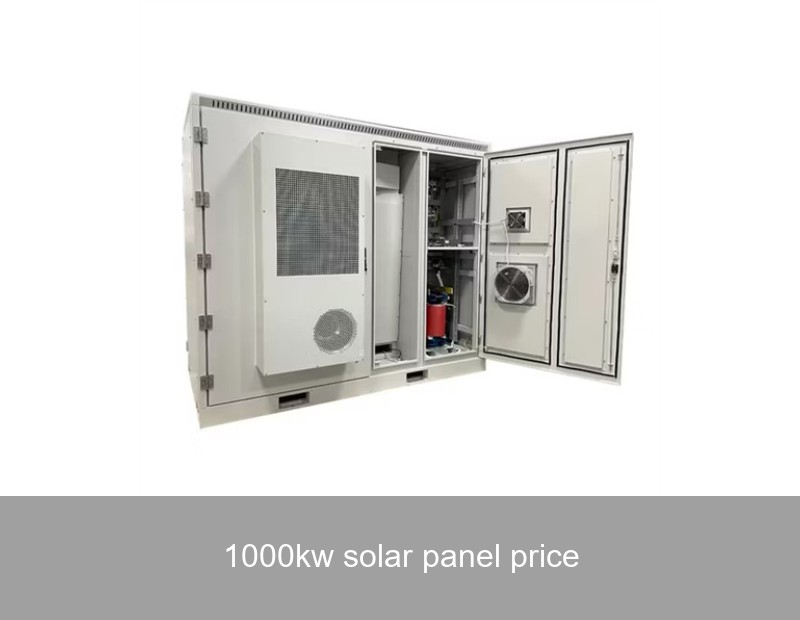
If you're exploring the 1000kW solar panel price, you're likely considering a significant step towards energy independence and sustainability. A 1-megawatt (MW) solar array isn't just a purchase; it's a strategic investment for a commercial, industrial, or large-scale community project. The quoted price tag is just the starting point of a complex equation involving technology, long-term value, and intelligent energy management. In today's landscape, the most forward-thinking projects pair robust solar generation with advanced battery storage systems, creating a resilient and efficient power ecosystem. This is where companies like Highjoule, a global leader in advanced energy storage since 2005, add critical value, transforming raw solar power into a reliable, around-the-clock asset.
Table of Contents
- The Real Cost: More Than Just Panels
- Key Factors Influencing Your 1000kW Solar Investment
- Case Study: Maximizing ROI with a 1MW Solar + Storage System
- The Highjoule Solution: Intelligent Storage for Maximum Solar Value
- Future-Proofing Your Solar Investment
The Real Cost: More Than Just Panels
When we talk about a 1000kW solar panel price, we're actually discussing the total installed cost of a complete photovoltaic (PV) system. As of 2024, the average price range for a commercial-scale 1MW solar installation in markets like the U.S. and Europe typically falls between $800,000 and $1.2 million. This wide range isn't arbitrary. It reflects a bundle of components and services: the solar panels themselves, inverters, mounting structures, electrical systems, labor, engineering, permits, and grid interconnection fees. According to the National Renewable Energy Laboratory (NREL), hardware costs like panels and inverters now make up only about 50% of the total system cost, with "soft costs" like installation labor and customer acquisition representing the other half.

Image Source: Unsplash - A large-scale commercial solar installation, similar to a 1MW project.
Key Factors Influencing Your 1000kW Solar Investment
Let's break down the variables that shape your final quote:
- Panel Technology & Efficiency: Premium high-efficiency monocrystalline panels cost more upfront but produce more power per square foot, which can be crucial if your rooftop or land area is limited.
- System Design & Site Specifics: Is it a simple, ground-mounted system on flat land, or a complex rooftop installation with multiple angles and shading obstacles? Site preparation and structural requirements significantly impact labor and material costs.
- Inverter Strategy: Will you use central string inverters or module-level power electronics (MLPEs) like microinverters? The latter adds cost but enhances performance in shaded conditions and provides detailed monitoring.
- Local Regulations & Incentives: This is a major driver. The U.S. Investment Tax Credit (ITC) and various European Union grants can reduce net cost by 30-40%. Local permitting complexity and utility interconnection fees also vary greatly.
| Component / Cost Category | Estimated Cost Range | Percentage of Total |
|---|---|---|
| Solar Panels & Modules | $280,000 - $400,000 | ~35% |
| Inverters & Power Conversion | $80,000 - $120,000 | ~12% |
| Mounting & Racking System | $60,000 - $100,000 | ~10% |
| Installation Labor & Engineering | $200,000 - $300,000 | ~25% |
| Permits, Interconnection, Soft Costs | $160,000 - $240,000 | ~18% |
| Total Estimated Cost | $780,000 - $1,160,000 | 100% |
Beyond Generation: The Essential Role of Energy Storage
Here's the pivotal insight: a solar array's true value is unlocked not just when the sun shines, but when you can use or monetize that power on demand. Without storage, excess solar energy at midday might be sold back to the grid at low rates, only for you to buy back expensive power in the evening. This is the fundamental limitation a standalone solar investment faces. Integrating a battery energy storage system (BESS) transforms the economics. It allows you to:
- Increase Self-Consumption: Store midday surplus for use during peak evening hours, dramatically reducing your utility bills.
- Provide Backup Power: Ensure critical operations continue during grid outages.
- Participate in Grid Services: In many regions, you can earn revenue by providing frequency regulation or capacity services to the local utility.
Case Study: Maximizing ROI with a 1MW Solar + Storage System
Consider a real-world scenario for a mid-sized manufacturing plant in Germany. The facility installed a 1000kW solar system paired with a 500kW/1000kWh battery storage system. Their goal wasn't just to reduce carbon emissions but to achieve tangible financial savings in a region with high and volatile electricity prices.
- Solar-Only Scenario: The 1MW system covered ~40% of their daytime load. Excess noon-time energy was fed into the grid under Germany's EEG scheme, but the feed-in tariff was significantly lower than the retail price they paid for evening power.
- Solar + Storage Scenario: By adding a large-scale battery, they increased their self-consumption of solar power from 40% to over 80%. The battery was programmed to discharge during the evening peak price period (4 PM - 9 PM), avoiding the highest grid electricity costs.
The Result? The combined system reduced their annual energy costs by 68% compared to the grid-only baseline, and the payback period for the integrated solar-plus-storage solution was nearly 25% shorter than for solar alone, even with the higher initial investment. The battery also provides UPS-grade backup for their sensitive control machinery, preventing costly production halts.
The Highjoule Solution: Intelligent Storage for Maximum Solar Value
This is precisely where Highjoule's expertise becomes indispensable. We understand that the 1000kW solar panel price is the entry ticket, but the storage system is what defines the long-term return. For large-scale applications, our H-Series Commercial & Industrial Battery Energy Storage Systems are engineered to seamlessly integrate with megawatt-scale solar arrays.
Our systems go beyond simple storage. They feature:
- Advanced Energy Management Software (EMS): This intelligent brain predicts solar generation, analyzes consumption patterns, and considers utility rate schedules to autonomously optimize charge/discharge cycles for maximum economic return.
- Scalable & Modular Architecture: Starting from 500kWh, our containerized or skid-mounted solutions can be scaled to match your solar output and load requirements precisely.
- Grid-Forming Capabilities: In microgrid applications, Highjoule systems can "form the grid," providing stable voltage and frequency, allowing your solar-plus-storage island to operate independently from the main utility grid if needed.

Image Source: Unsplash - An engineer inspecting a large-scale battery storage system similar to Highjoule's H-Series.
Highjoule's Integrated Approach
We don't just sell hardware. Our team provides comprehensive feasibility studies, system design, and ongoing performance monitoring. We help you navigate incentive programs like the ITC in the U.S., which now offers an additional 10% bonus for systems using domestic content, or the various EU funding mechanisms for energy independence. By treating the solar array and the storage system as a single, optimized asset, we ensure you extract every possible kilowatt-hour of value from your investment.
Future-Proofing Your Solar Investment
The energy landscape is shifting from static, one-way consumption to dynamic, interactive participation. As noted by the International Energy Agency (IEA), grid-scale storage is the cornerstone of a clean and resilient electricity system. When you evaluate the 1000kW solar panel price, you are really making a decision about your energy strategy for the next 25+ years.
Will your system be a passive generator, or an active, revenue-generating asset? Can it protect your operations from increasing grid instability and price volatility? The answer lies in integration. The most successful projects we see are those where the solar and storage components are co-engineered from the initial design phase, ensuring perfect technical and economic synergy.
Given the rapid evolution of both solar technology and electricity markets, what specific energy challenge is your business looking to solve with a 1MW system, and how can we help you design a solution that turns that challenge into a competitive advantage?
 Inquiry
 Online Chat