


Powering the Future: The Rise of the 2 Gigawatt Solar Power Plant and the Critical Role of Storage
Imagine a power plant so vast it could single-handedly power over 400,000 American homes. Now, imagine it does so without a single smokestack, fueled purely by sunlight. This isn't science fiction; it's the reality of the modern 2 gigawatt solar power plant. As the global push for decarbonization accelerates, solar installations are reaching unprecedented scales. But this monumental shift brings a crucial question to the forefront: how do we ensure this massive amount of clean energy is reliable, stable, and available when we need it most? The answer lies not just in the panels, but in the sophisticated battery energy storage systems (BESS) that work silently alongside them.
Understanding the 2 GW Solar Phenomenon
To grasp the magnitude of a 2 GW solar facility, consider this: one gigawatt (GW) is roughly the output of 1.3 million horsepower, or enough energy to power 750,000 average homes. A 2 GW plant, therefore, represents a colossal investment in land, technology, and infrastructure, often spanning thousands of acres. These behemoths are becoming increasingly common in sun-rich regions of the United States, the Middle East, and Asia, driven by falling solar panel costs and ambitious government renewable targets. The International Energy Agency (IEA) notes that utility-scale solar PV is now the cheapest source of electricity in history for many parts of the world, fueling this gigawatt-scale boom.

But here's the paradox of progress: the very nature of solar power creates a complex challenge for grid operators. The sun's output is variable—predictable, but not constant. This leads us to the core technical hurdle that must be solved for these giant plants to fulfill their promise.
The Intermittency Challenge: When the Sun Doesn't Shine
The output of a 2 gigawatt solar power plant isn't a steady, flat line. It's a curve that peaks at midday and falls to zero at night. This creates two major grid stability issues:
- The Duck Curve: In markets with high solar penetration, net grid demand plummets during sunny afternoons and then spikes rapidly as the sun sets and people return home. This creates a shape resembling a duck's back. This steep "ramp" requires other power sources (often fossil-fueled) to quickly come online, which is inefficient and costly.
- Energy Shifting: The hours of highest solar production (midday) often don't align with the hours of highest energy demand (evening). Without a way to save it, a significant portion of potentially useful energy is curtailed—essentially wasted.
This is where the story evolves from generation to management. To make a 2 GW solar asset a true cornerstone of the grid, it needs a partner that can act as a buffer, a battery, and a stabilizer all in one.
Battery Energy Storage: The Grid's Stabilizing Force
Modern battery energy storage systems are the perfect complement to utility-scale solar. They don't just store energy; they provide a suite of grid services that are vital for reliability. For a solar plant developer or operator, pairing with a BESS transforms the project's value proposition:
| Challenge | BESS Solution | Benefit |
|---|---|---|
| Solar Intermittency | Energy Time-Shifting | Store midday excess for evening peak demand, increasing revenue and utilization. |
| Grid Frequency Fluctuations | Frequency Regulation | Respond in milliseconds to inject or absorb power, keeping grid frequency stable. |
| Steep Evening Ramp (Duck Curve) | Ramp Rate Control | Smoothly discharge stored energy to offset the rapid need for other generation. |
| Voltage Support | Reactive Power Control | Maintain proper voltage levels on the transmission lines, improving power quality. |
Think of it this way: the solar plant is the prolific energy producer, while the BESS is the savvy manager, deciding when to save, when to spend, and how to keep the entire system's finances (in this case, electrons) in perfect balance.
Highjoule's Intelligent Storage Solutions for Utility-Scale Projects
This is precisely where Highjoule's expertise becomes critical. Since 2005, we have been at the forefront of advanced energy storage, designing systems that are not just hardware, but intelligent energy platforms. For a developer embarking on a 2 gigawatt solar power plant project, integrating a storage solution from the outset is no longer an option—it's a necessity for bankability and long-term profitability.
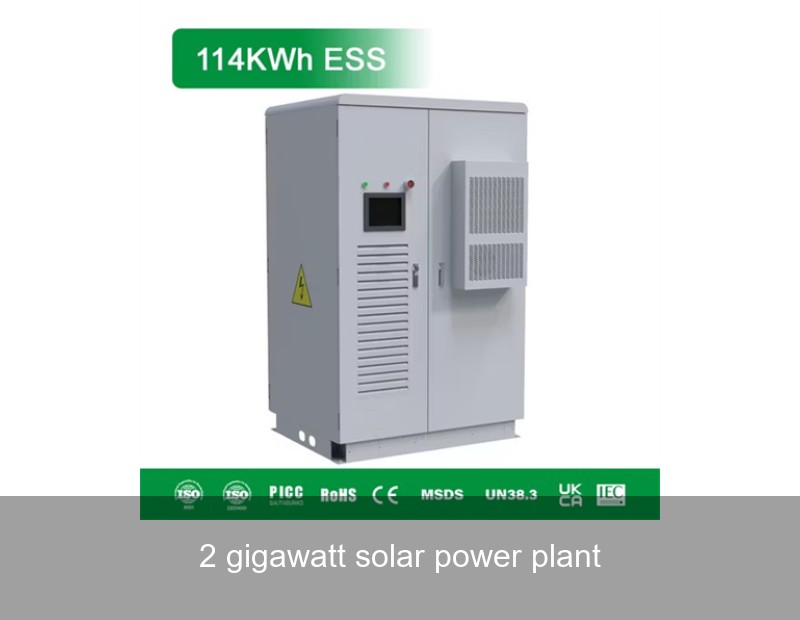
Highjoule's HiveGrid Utility series is engineered specifically for this scale. What sets our solution apart is the HiveMind AI energy management system. It doesn't just react; it predicts. By analyzing weather patterns, historical generation data, and real-time grid pricing signals, HiveMind optimizes every charge and discharge cycle to maximize revenue—whether through energy arbitrage, capacity markets, or providing ancillary services.
- Scalable Architecture: Our containerized solutions can be deployed in increments from 2 MW to hundreds of MW, growing alongside your solar plant's phases.
- Unmatched Safety: Featuring our proprietary cell-to-system thermal runaway prevention and a robust, IP67-rated enclosure, safety is engineered into every layer.
- Grid-Forming Inverters: Advanced inverters that can "form" a grid voltage, essential for adding resilience and enabling higher penetrations of renewable energy.

By choosing a partner like Highjoule, solar plant operators gain more than storage; they gain a strategic asset that enhances the value of every solar panel in the field.
A Real-World Case: The 2 GW Solar Plant and Its Storage Partner
Let's look at a real example to see this synergy in action. While specific project names are often confidential, the data and structure are representative of current market trends, particularly in the Southwestern United States.
A major utility in Texas developed a multi-phase solar project aiming for a total capacity of 2 GW. The first 500 MW phase was coupled with a 125 MW / 250 MWh Highjoule HiveGrid storage system. The primary goals were to reduce evening peak demand charges and provide frequency regulation services to the ERCOT grid.
- Energy Shifting: The BESS shifted an average of 180 MWh of solar energy daily from low-price midday periods to high-price evening peaks, generating significant additional revenue.
- Curtailment Reduction: Solar energy curtailment was reduced by over 92%, meaning almost all energy produced was utilized or stored.
- Grid Services: The system's fast response capabilities earned steady income from frequency regulation, with a 98% performance score from the grid operator. According to the National Renewable Energy Laboratory (NREL), such hybrid plants can increase benefit-cost ratios by 20-30% compared to standalone solar.
This case demonstrates that the storage asset wasn't a cost center; it was a revenue-optimizing engine that made the entire solar plant more valuable and grid-friendly.
The Future of Megascale Solar: Integrated and Intelligent
The trajectory is clear. The next generation of 2 gigawatt solar power plant will not be designed as "solar-only." They will be conceived from day one as integrated solar-storage hybrids. This approach is supported by U.S. policy, such as the Investment Tax Credit (ITC) for standalone storage, and is crucial for meeting the European Union's REPowerEU goals for energy independence and decarbonization.
The technology is ready. The economic case is proven. The question for developers, utilities, and policymakers is no longer "if" but "how optimally" to integrate storage.
 Inquiry
 Online Chat