


Understanding the Factors Behind a 2 MW Energy Storage Cabinet Price
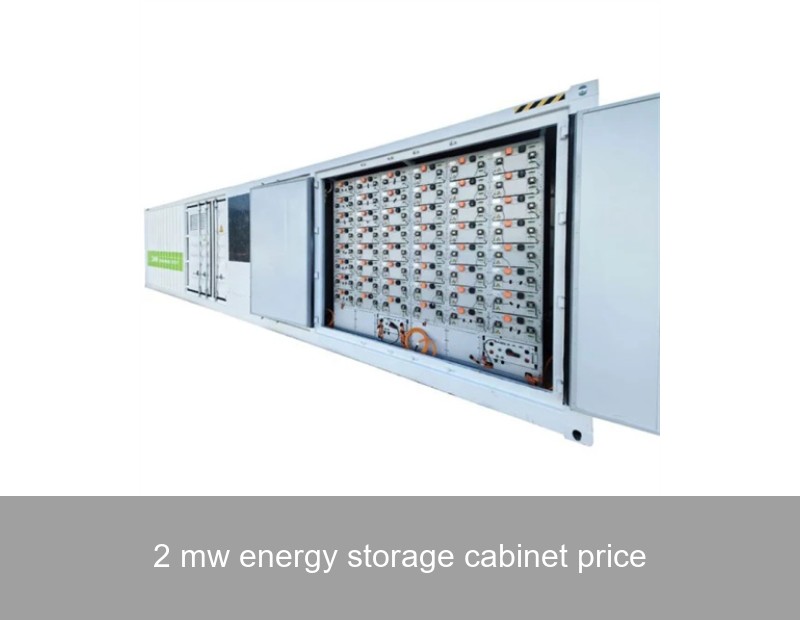
As businesses and utilities across Europe and the U.S. aggressively pursue energy independence and grid stability, the question of scale becomes paramount. You're not just looking for a battery; you're planning a strategic power asset. This is where the concept of a 2 MW energy storage cabinet price enters the conversation. But quoting a simple per-cabinet figure is like quoting the price of a house by the square foot alone—it tells a fraction of the story. The true investment is shaped by a matrix of technology, integration, and long-term value. Let's demystify what goes into this critical number and how to evaluate it for your large-scale project.
Table of Contents
- The Phenomenon: The Rush to Megawatt-Scale Storage
- Breaking Down the Costs: More Than Just a Cabinet
- Case Study: A German Manufacturing Plant's Journey
- The Highjoule Approach: Engineering Value Beyond the Price Tag
- Future-Proofing Your Investment
- What's Your Storage Strategy?
The Phenomenon: The Rush to Megawatt-Scale Storage
The energy landscape is shifting from kilowatt-hour thinking to megawatt-hour strategizing. Why? For commercial and industrial (C&I) entities, the drivers are clear and compelling: extreme weather events causing outages, volatile energy prices, and stringent sustainability targets. A 2 MW system isn't just a backup generator; it's a dynamic financial tool. It can perform peak shaving—slicing off expensive demand charges from utility bills—provide frequency regulation services to the grid, and ensure seamless operations during blackouts. The initial inquiry about a 2 MW energy storage cabinet price is, therefore, the starting point for a complex value calculation.

Image: A modern megawatt-scale battery storage installation. Source: Unsplash
Breaking Down the Costs: More Than Just a Cabinet
When you ask for a 2 MW energy storage cabinet price, you're effectively asking for the core power conversion and battery modules. However, the total installed cost of a functional system (the "balance of system" or BOS) typically includes much more. Let's look at the key components:
- Battery Cells & Modules (40-50% of cost): The chemistry (e.g., LFP - Lithium Iron Phosphate) dictates longevity, safety, and cost. LFP, known for its safety and long cycle life, is a dominant choice for stationary storage.
- Power Conversion System (PCS) (15-20%): This includes the inverters that convert DC battery power to AC grid power. Its efficiency and grid-support capabilities are crucial.
- Energy Management System (EMS) & Controls (10-15%): The "brain" of the operation. A sophisticated EMS is what transforms a battery into a revenue-generating asset by automating decisions for arbitrage, peak shaving, and grid services.
- Thermal Management, Safety, and Enclosure (10-15%): Proper cooling (liquid vs. air), fire suppression, and robust cabinet design are non-negotiable for safety and performance.
- Installation, Grid Interconnection, and Soft Costs (15-25%): Permitting, engineering, labor, and utility fees can vary dramatically by region (e.g., California vs. Texas, or Germany vs. Poland).
| Cost Component | Approx. % of Total Project | Key Influence on 2 MW Energy Storage Cabinet Price |
|---|---|---|
| Battery Pack (LFP) | 40-50% | Cell commodity prices, energy density, cycle life warranty. |
| Power Conversion & Integration | 25-35% | Inverter efficiency, bi-directional capability, grid-forming features. |
| Balance of System & Installation | 25-35% | Local labor rates, permit complexity, electrical upgrade needs. |
According to a 2022 report by the National Renewable Energy Laboratory (NREL), the average installed cost for grid-scale battery storage in the U.S. was approximately $1,376/kWh. For a 2 MW/4 MWh system (2 hours duration), this suggests a total project cost in the range of $5.5 million. However, this is a benchmark; actual 2 MW energy storage cabinet price and total project cost can be higher or lower based on the factors above.
Case Study: A German Manufacturing Plant's Strategic Investment
Let's ground this in reality. A mid-sized automotive parts manufacturer in Bavaria, Germany, faced annual electricity costs exceeding €2 million, with nearly 30% attributed to peak demand charges and volatile time-of-use rates. Their goal: reduce operational costs and secure backup power for critical production lines.
They evaluated several solutions and opted for a turnkey 2 MW / 4.3 MWh battery energy storage system. The project, completed in 2023, involved:
- Technology: LFP battery cabinets with integrated liquid cooling.
- Smart EMS: Configured for automated peak shaving and intra-day energy arbitrage based on EPEX SPOT market prices.
- Integration: Seamless connection with their existing rooftop PV array.
- Demand Charge Reduction: 22% savings, translating to over €140,000 annually.
- Energy Arbitrage Revenue: An additional €35,000 from buying low and using stored energy during high-price periods.
- ROI Timeline: Projected full return on investment in under 7 years, well within the system's 10+ year warranty period.
The plant manager noted, "The discussion started with cabinet pricing, but the winning provider showed us a 10-year financial model, not just a equipment quote. That holistic view was decisive."
The Highjoule Approach: Engineering Value Beyond the Price Tag
At Highjoule, with nearly two decades of experience since 2005, we understand that the conversation about a 2 MW energy storage cabinet price is a gateway to discussing total lifetime value. Our products, like the H-Cube Industrial Series, are designed for this scale.
Our cabinets are more than containers; they are pre-integrated, modular power blocks. Each H-Cube cabinet features:
- Ultra-Safe LFP Chemistry: With built-in cell-level fusing and passive propagation resistance.
- Advanced Liquid Cooling: Ensuring consistent performance and extending cycle life, even in demanding environments.
- Grid-Forming Inverter Ready: Allowing the system to support microgrids and provide grid stability, a feature increasingly valued by utilities.
But our service goes deeper. We provide the Highjoule Apex EMS, a proprietary platform that uses AI-driven forecasting to maximize your system's economic return. We don't just sell cabinets; we deliver a guaranteed performance outcome through tailored service agreements. For a U.S.-based data center or a European renewable energy developer, this means the asset is actively managed to meet specific financial or resilience KPIs.

Image: Advanced monitoring and control are key to realizing storage value. Source: Unsplash
Future-Proofing Your Investment
When evaluating quotes, the cheapest 2 MW energy storage cabinet price upfront can lead to higher costs later. Consider these long-term aspects:
- Degradation Warranty: Does the warranty guarantee 70% capacity after 10 years, or 80%? This directly impacts your long-term energy throughput and revenue.
- Software Updates: Can the EMS receive updates to tap into new grid service markets? The regulatory landscape (FERC in the U.S.) is evolving, and your system must adapt.
- Scalability: Can you easily add more cabinets in a few years if your needs grow? Modular design is critical.
Think of it as building a team. You wouldn't hire based on salary cost alone; you'd evaluate skills, growth potential, and cultural fit. Your energy storage system is a long-term member of your operational team.
What's Your Storage Strategy?
The journey to a resilient and profitable energy future begins with the right questions. Now that you understand the layers behind a 2 MW energy storage cabinet price, what specific challenge is driving your exploration? Is it the need to lock in energy costs for your factory, to meet a corporate net-zero mandate, or to provide critical backup for a community microgrid?
We invite you to share your primary objective and the biggest hurdle you see in achieving it. What specific data would you need from a provider to move from a price quote to a project proposal?
 Inquiry
 Online Chat