


Understanding the 5 MW Battery Storage Cost: A Comprehensive Guide for Businesses
If you're a facility manager, energy director, or business owner in Europe or the US looking at large-scale energy solutions, you've likely asked: "What is the real cost of a 5 MW battery storage system?" It's a crucial question, as mid-to-large-scale battery energy storage systems (BESS) are becoming the backbone of modern energy resilience and cost management. The answer isn't a single number but a detailed equation involving hardware, software, and long-term value. This guide will demystify the 5 MW battery storage cost, breaking down the components, presenting real-world data, and showing how leading providers like Highjoule deliver value far beyond the initial price tag.
Table of Contents
The Price Puzzle: More Than Just a Battery
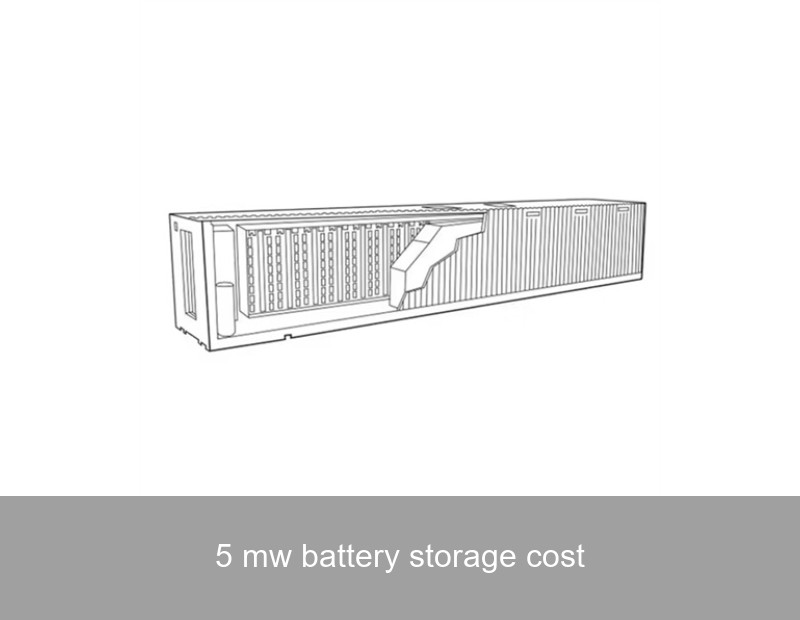
Let's address the elephant in the room first. When you search for "5 MW battery storage cost," you might see figures ranging from $1.5 million to over $3.5 million. Why such a wide range? Think of it like constructing a building. The cost isn't just the bricks; it's the design, the foundation, the electrical systems, the permits, and the ongoing maintenance. A 5 MW/10 MWh system (providing 5 megawatts of power for 2 hours) is a significant infrastructure project. The total installed cost encompasses the battery cells (the core energy storage medium), the sophisticated power conversion systems (PCS), the battery management system (BMS), thermal management, safety systems, civil works, electrical integration, and software intelligence. Furthermore, market dynamics, supply chain factors, and local regulations in the US or Europe heavily influence the final price.

Credit: ThisisEngineering RAEng on Unsplash. A 5 MW BESS project requires careful planning and integration.
The Anatomy of a 5 MW BESS Cost Breakdown
To make an informed decision, you need to understand what you're paying for. Here’s a detailed breakdown of the key cost components for a commercial/industrial 5 MW system.
| Cost Component | Description | Approx. % of Total Cost | Key Considerations |
|---|---|---|---|
| Battery Pack & Modules | The core lithium-ion (or alternative) cells assembled into racks. This is your "energy bank." | 30-40% | Chemistry (LFP preferred for safety), cycle life, degradation rate, manufacturer warranty. |
| Power Conversion System (PCS) | Inverters/converters that change DC battery power to AC grid power and vice versa. | 15-25% | Efficiency rating (e.g., 98.5%), grid-forming capability, reactive power support. |
| Balance of Plant (BoP) | Everything else: HVAC, fire suppression, containerization, switchgear, transformers. | 20-30% | Site-specific, crucial for safety, reliability, and system longevity. |
| Software & Controls | The "brain" - Energy Management System (EMS) for optimization and control. | 5-10% | This is where intelligence and ROI are maximized. Can it perform arbitrage, demand charge management, and grid services? |
| Installation & Integration | Civil works, electrical interconnection, commissioning, and grid permitting. | 10-20% | Highly variable based on site conditions and local utility requirements. |
According to a 2023 report by the National Renewable Energy Laboratory (NREL), the average installed cost for utility-scale battery storage in the US fell significantly, but the "soft costs" like installation and engineering remain a substantial piece of the pie. This underscores the importance of working with an experienced, full-service provider who can manage the entire project efficiently.
Real-World Insight: A 5 MW Project in Action
Let's move from theory to practice. Consider a manufacturing plant in Germany facing high demand charges and seeking to stabilize energy costs. They deployed a 5 MW / 10 MWh battery storage system. The total project cost was approximately €2.8 million. However, look at the financial mechanics:
- Demand Charge Reduction: The system discharges during peak consumption periods, shaving the plant's peak power draw from the grid. This saves over €120,000 annually in demand charges alone.
- Energy Arbitrage: The system charges when electricity prices are low (often at night or during high renewable output) and discharges during high-price periods. This adds roughly €80,000 in annual revenue.
- Grid Services (Primary Control Reserve): In Europe, systems of this scale can participate in frequency regulation markets. This particular system earns an additional €60,000 per year by providing this service to the grid operator.
The Result? A simple payback period of under 9 years on a system with a 15-year warranted lifespan. This doesn't even fully account for the value of backup power during outages, which prevents production losses. The initial 5 MW battery storage cost is thus transformed from a capital expense into a strategic investment with a clear, quantifiable return.
Beyond the Price Tag: The Highjoule Value Proposition
This is where the conversation shifts from cost to value. At Highjoule, with nearly two decades of experience since 2005, we engineer systems where the intelligence built into every layer maximizes your return. Our approach to a 5 MW solution ensures the upfront cost is optimized for a lifetime of performance.
- Highjoule H-Core Battery Technology: We utilize lithium iron phosphate (LFP) chemistry exclusively for its superior safety, longevity (over 6,000 cycles), and stability. This reduces long-term degradation risk, protecting your investment.
- Athena AI-Powered EMS: The true differentiator. Our proprietary Energy Management System doesn't just react; it predicts. Using machine learning and real-time market data, Athena optimizes every charge/discharge cycle across multiple value streams (arbitrage, demand management, grid services) simultaneously to maximize your revenue. It's the financial engine of your storage asset.
- Turnkey Project Delivery: We manage the entire process—from initial site assessment and financial modeling to grid compliance, installation, and commissioning. This reduces your risk, manages the "soft costs" effectively, and ensures a seamless transition to operation.
- Global Support & Performance Guarantee: Our long-term service agreements include remote monitoring, performance guarantees, and proactive maintenance, ensuring your system delivers the projected financial returns year after year.

Credit: American Public Power Association on Unsplash. A modern, containerized BESS unit ready for integration.
The Future of Storage Costs: What to Expect
While battery cell costs have declined dramatically, the trend is now moderating. Future cost reductions for complete 5 MW battery storage projects will come more from standardization, streamlined integration, and software innovation. The focus is shifting from $/kWh of storage to $/value-stream over the system's life. Systems that are more adaptive, software-defined, and capable of participating in evolving grid markets will offer a lower lifetime cost of ownership, even if their upfront price is comparable to less intelligent systems.
Is a 5 MW System the Right Move for Your Operation?
The question is no longer just "What does it cost?" but "What is it worth to my business?" Can you afford the volatility of energy markets without a buffer? What is the financial impact of a two-hour power interruption on your production line? How could stabilizing your energy profile improve your sustainability goals and corporate image?
We invite you to start a conversation with Highjoule's energy experts. Share your latest utility bill and your operational goals, and let us provide a customized feasibility analysis that translates the 5 MW battery storage cost into a clear projection of savings, revenue, and resilience for your specific site. What would you do with a more predictable and controllable energy future?
 Inquiry
 Online Chat