


Abiotic Factors and Your Industrial Battery: The Hidden Forces Shaping Performance
When we think about industrial battery systems powering factories, data centers, or microgrids, the focus is often on chemistry, capacity, and software. But what if the silent, non-living elements of their environment—the abiotic factors—are quietly dictating their lifespan, safety, and return on investment? From the sweltering heat of a Texas summer to the frigid cold of a Scandinavian winter, temperature isn't just a comfort issue; it's a critical performance parameter. This article delves into the world of abiotic factors—specifically temperature, humidity, and vibration—and how they impact your industrial battery investment. More importantly, we'll explore how modern solutions from providers like Highjoule are engineered to not just withstand these forces, but to thrive within them, ensuring reliable, sustainable power for your critical operations.
Table of Contents
- What Are Abiotic Factors in an Industrial Context?
- The Dominant Force: Temperature's Impact on Battery Chemistry
- Humidity & Vibration: The Silent Saboteurs
- Engineering Resilience: How Smart Design Combats Abiotic Stress
- Case Study: A Nordic Logistics Hub's Cold-Weather Challenge
- Future-Proofing Your Investment
What Are Abiotic Factors in an Industrial Context?
In ecology, abiotic factors are the non-living chemical and physical parts of an environment. For an industrial battery system, this concept translates directly. These are the environmental conditions the hardware physically endures, separate from electrical load profiles or software commands. The three most critical abiotic factors are:
- Ambient Temperature: The air temperature surrounding the battery enclosure.
- Relative Humidity: The amount of moisture in the air, which can lead to condensation.
- Vibration & Mechanical Shock: Physical movements transmitted from the environment, like from nearby machinery or forklift traffic.
Ignoring these factors is like building a fortress on sand. The most advanced battery chemistry can be undone by persistent, unmanaged environmental stress.
The Dominant Force: Temperature's Impact on Battery Chemistry
Temperature is the most significant abiotic factor for any battery. It's not an exaggeration to say it governs the internal chemical world of your energy storage asset.
Here’s a simplified breakdown of the effects:
| Condition | Primary Effect on Industrial Battery | Long-Term Consequence |
|---|---|---|
| High Temperature (>30°C / 86°F) | Accelerated chemical reactions, increased internal resistance. | Rapid degradation of electrolyte and electrodes, permanent capacity loss, heightened risk of thermal runaway. |
| Low Temperature (<0°C / 32°F) | Slowed ion mobility, increased electrolyte viscosity. | Sharp reduction in available power (kW) and energy (kWh), potential lithium plating during charging, causing internal shorts. |
| Large Thermal Cycling | Repetitive expansion and contraction of materials. | Mechanical stress on joints and seals, eventual connection failures, accelerated aging. |
Data from the U.S. Department of Energy's National Renewable Energy Laboratory (NREL) underscores this, showing that a battery consistently operated at 35°C can lose nearly double the capacity of one at 25°C over the same period (source: NREL, 2019). This isn't just a technical footnote—it's a direct line to your bottom line.

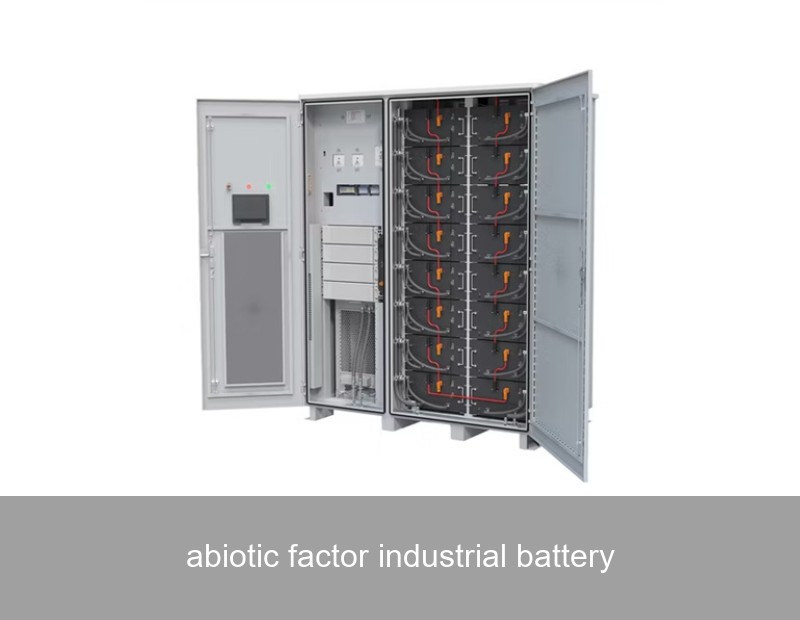
Image: A modern industrial battery system with integrated thermal management. Source: Unsplash (Representative image)
Humidity & Vibration: The Silent Saboteurs
While temperature takes the spotlight, humidity and vibration work in the background.
High humidity can lead to condensation inside battery enclosures, creating paths for leakage currents, corroding electrical contacts, and potentially causing ground faults. Vibration, often overlooked in stationary storage, is a genuine threat in industrial settings. Whether it's from adjacent heavy machinery, facility infrastructure, or even seismic activity, constant vibration can loosen electrical connections, fatigue mounting points, and physically damage cell internals over time.
Engineering Resilience: How Smart Design Combats Abiotic Stress
So, how do you build an industrial battery system that laughs in the face of these environmental challenges? The answer lies in integrated, purpose-driven design from the cell level up. At Highjoule, our approach to mitigating abiotic factors is built into the DNA of our H-Ion C&I Series and GridSynergy Microgrid platforms.
- Adaptive Thermal Management: Our systems don't rely on simple ambient air cooling. They feature closed-loop, liquid-based thermal management that actively heats or cools the battery cells to maintain them within a narrow, optimal temperature band (typically 20-25°C) regardless of external weather. This system operates independently of facility HVAC, drastically reducing the auxiliary load.
- IP-Rated Environmental Sealing: Enclosures are built to IP54 standards or higher, proactively sealing out dust and moisture. This is complemented by positive pressure systems and controlled internal air circulation to prevent condensation—a critical feature for coastal or high-humidity regions in Europe and the Southern US.
- Dynamic Vibration Dampening: Recognizing that one size doesn't fit all, our rack designs incorporate vibration-isolating mounts. For high-risk seismic zones or particularly harsh environments, we offer custom foundation and mounting solutions that decouple the battery from its surroundings.
This isn't just about adding features; it's about a holistic system philosophy where the Battery Management System (BMS) continuously monitors not just cell voltages, but also enclosure temperature, humidity, and shock events, making real-time adjustments to prolong life.
Case Study: A Nordic Logistics Hub's Cold-Weather Challenge
Let's make this real with a story from Northern Sweden. A major automated logistics center, operating 24/7, installed a large battery energy storage system (BESS) for peak shaving and backup power. Their primary abiotic factor challenge was extreme cold, with warehouse sections routinely at -5°C to -10°C in winter.
The Problem: Their first-generation battery system suffered severe winter performance loss. Available power for forklift charging plummeted by over 40% on cold mornings, and the system's self-heating function was so energy-intensive it negated nearly 30% of the daily cost savings. They were, in effect, heating the battery with expensive grid power.
The Highjoule Solution: We deployed our H-Ion C&I Series with its patented low-auxiliary-load thermal system. The key differentiator was the system's ability to use a fraction of the stored energy, coupled with waste heat recovery from the inverter system, to maintain optimal cell temperature. The BMS was programmed with location-specific weather data to proactively manage temperature cycles.
- Winter available power stabilized at >95% of rated capacity.
- Auxiliary load for temperature management reduced by 70% compared to the previous system.
- Projected cycle life increased by an estimated 15% due to reduced thermal stress, directly impacting total cost of ownership.
This case highlights that understanding and engineering for local abiotic factors isn't a luxury—it's essential for predictable financial and operational outcomes.

Image: Industrial facilities in cold climates face unique battery performance challenges. Source: Unsplash (Representative image)
Future-Proofing Your Investment
As you evaluate industrial battery systems, move beyond spec sheet basics. Your due diligence checklist should include:
- Ask for detailed environmental operating ranges (temperature, humidity, altitude), not just "standards compliant."
- Request thermal management system efficiency data (the auxiliary load as a % of system rating).
- Inquire about the system's monitoring capabilities for environmental data and its adaptive response logic.
- Discuss the provider's experience with installations in climates similar to yours. A provider with a global footprint, like Highjoule, brings tested solutions from diverse environments—from Arizona's deserts to Germany's variable climates.
The right system turns abiotic factors from a threat into a managed variable. It ensures your investment delivers on its promise of resilience and sustainability for decades, not just years.
An Open Question for Your Next Planning Meeting
When your team meets to discuss energy resilience or sustainability goals, are you factoring in the complete physical environment of your proposed battery storage site? What data do you have on the micro-climate of that specific warehouse wall or utility yard, and how will your chosen technology partner use that data to guarantee performance?
 Inquiry
 Online Chat