


AFCI Energy Storage Cabinet: The Critical Guardian for Modern Battery Safety
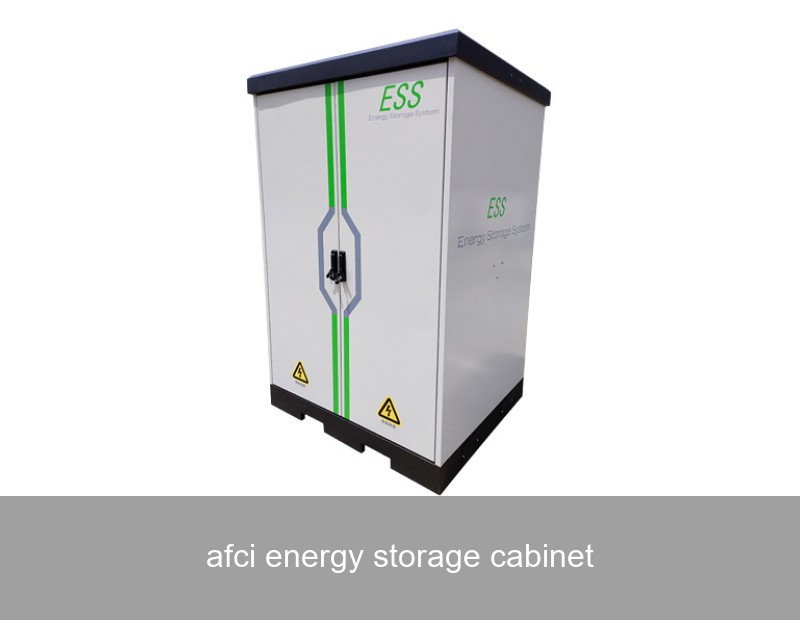
Table of Contents
- The Silent Spark: A Hidden Risk in Your Energy Storage System
- What is an AFCI Energy Storage Cabinet? A Technical Breakdown
- Why AFCI Protection is Non-Negotiable: Data-Driven Insights
- From Theory to Practice: A California Microgrid Case Study
- Highjoule's Integrated Approach: Smart AFCI Cabinets for Peace of Mind
- Choosing the Right AFCI-Protected Energy Storage Solution
- The Future of Safe Storage: Where Do We Go From Here?
You've invested in an energy storage system to gain independence, resilience, and cost savings. But what if a hidden electrical fault, silently arcing within the cabinet, threatened that very investment and the safety of your property? This is where the specialized AFCI energy storage cabinet moves from a technical feature to an essential safeguard. As a product technology expert at Highjoule, I've seen how integrating Arc-Fault Circuit Interruption (AFCI) technology directly into storage cabinet design is revolutionizing safety standards for commercial, industrial, and residential installations across Europe and the US.
The Silent Spark: A Hidden Risk in Your Energy Storage System
Imagine a tiny, erratic spark—an arc fault—dancing between two loose connections inside a battery cabinet. It's not a solid "short circuit" that instantly trips a standard breaker. It's intermittent, often generating intense heat (up to 6,000°C / 10,000°F) without drawing enough current to trigger conventional protection. This phenomenon is a leading cause of electrical fires in systems with dense wiring and high power flow, precisely the environment inside a modern energy storage cabinet.
The risk is amplified by the DC (Direct Current) side of battery systems. DC arcs are notoriously harder to interrupt than AC arcs; they don't have the natural zero-crossing point that AC current does, allowing them to sustain and cause catastrophic damage. This isn't just theoretical. It's a real-world concern that leading safety standards like the US National Electrical Code (NEC) and international standards like IEC 63027 are now urgently addressing.
What is an AFCI Energy Storage Cabinet? A Technical Breakdown
An AFCI energy storage cabinet is not just a metal box holding batteries. It's an intelligent, integrated safety system. At its core, AFCI technology continuously monitors the electrical waveform for unique signatures of dangerous arcing. When it detects the erratic, high-frequency noise characteristic of an arc fault, it disconnects the circuit in milliseconds—far faster than a thermal or standard overcurrent device can react.
Let's break down the key components of a truly safe cabinet:
- Advanced AFCI Detection Module: The "brain" that uses sophisticated algorithms to distinguish between normal operational noise (like inverter switching) and hazardous arc signatures.
- High-Speed Circuit Interruption: Specialized contactors or solid-state switches capable of safely quenching both AC and, more critically, DC arc faults.
- Thermal Runaway Mitigation Design: The cabinet's physical layout, ventilation, and fire-retardant materials work in concert with AFCI to prevent a single fault from cascading.
- Integrated Communication: Seamless integration with the broader Battery Management System (BMS) and energy management platform for instant alerts and remote monitoring.

Image Source: Unsplash (Representative image of a high-quality energy storage cabinet interior)
Why AFCI Protection is Non-Negotiable: Data-Driven Insights
The push for AFCI isn't based on fear; it's grounded in empirical evidence and evolving risk profiles. The energy transition is driving higher battery capacities and more complex system architectures, which in turn modifies the risk landscape.
| Risk Factor | Without Dedicated AFCI Protection | With Integrated AFCI Cabinet |
|---|---|---|
| DC Arc Fault from Loose Terminal | High probability of sustained arc, leading to extreme heat, melting, and potential fire ignition. | Arc detected and circuit de-energized within 50-100ms, preventing ignition. |
| Insulation Degradation Over Time | Progressive damage can go unnoticed until a major fault occurs. | Early-stage arcing from worn insulation is detected, allowing for preventive maintenance. |
| Compliance for New Installations | May fail to meet latest NEC (2023) and upcoming EU regulations for DC systems. | Ensures compliance with current and anticipated safety standards in the US and Europe. |
Authoritative bodies are taking note. The National Fire Protection Association (NFPA) has been steadily expanding AFCI requirements. For energy professionals, specifying an AFCI energy storage cabinet is increasingly seen as a fundamental duty of care, not an optional upgrade.
From Theory to Practice: A California Microgrid Case Study
Consider a real-world application: a 500 kW / 1 MWh community microgrid installation in Northern California, designed to provide backup power during Public Safety Power Shutoff (PSPS) events. The system comprised multiple battery cabinets in a dedicated container.
The Situation: During a routine load test, a vibration-induced loose connection on a DC busbar within one cabinet began to sporadically arc. The standard breakers did not trip.
The AFCI Intervention: The cabinet's integrated AFCI detection system identified the arc signature within 80 milliseconds and sent a trip command. The high-speed DC disconnect isolated the faulty cabinet segment. The system controller seamlessly rerouted power through redundant cabinets, maintaining microgrid stability.
The Outcome: The event was logged, and an alert was sent to the maintenance team. They safely tightened the connection during the next scheduled inspection, with zero downtime or damage. Without the AFCI energy storage cabinet, the sustained arc would almost certainly have caused a fire, resulting in hundreds of thousands of dollars in damage, prolonged outage, and severe safety hazards.

Image Source: Unsplash (Representative image of a commercial energy storage installation)
Highjoule's Integrated Approach: Smart AFCI Cabinets for Peace of Mind
At Highjoule, we've engineered AFCI protection not as an afterthought, but as the cornerstone of our energy storage cabinet design philosophy. Our Guardian Series commercial and industrial cabinets are built with this multi-layered safety mindset.
Our solution features a proprietary Solid-State AFCI Interrupter that acts up to 10x faster than mechanical breakers for DC faults. It's fully integrated with our Helios BMS, which means every potential arc event is timestamped, logged, and can be visualized in our customer portal. This provides invaluable data for predictive maintenance, going beyond simple protection to offer operational intelligence. For residential clients, our HomePower Wall series incorporates similar AFCI logic tailored for smaller-scale systems, ensuring that safety is never compromised, regardless of system size.
This holistic approach—where hardware, software, and system design converge—is what sets a true AFCI energy storage cabinet apart from a standard cabinet with an add-on device. It ensures that safety is systemic, reliable, and future-proof.
Choosing the Right AFCI-Protected Energy Storage Solution
As you evaluate vendors for your storage project, the conversation must go beyond $/kWh. Here are critical questions to ask about their AFCI energy storage cabinet:
- Is the AFCI technology certified to relevant standards (e.g., UL 1699B for PV DC arc-faults, or equivalent)?
- Does it protect both the AC and DC sides of the system? (DC side is often more critical).
- What is the claimed interruption time, and is it validated by a third party?
- How is the AFCI system integrated with the BMS for alerts and data logging?
- Can the cabinet design contain a thermal runaway event, working in tandem with the AFCI?
For more on evolving safety standards, the U.S. Department of Energy's Solar Energy Technologies Office funds extensive research into storage safety, whose findings are publicly available.
The Future of Safe Storage: Where Do We Go From Here?
The integration of AFCI into the very heart of the energy storage cabinet represents a paradigm shift from reactive protection to proactive prevention. As battery chemistries evolve and system pressures increase, the intelligence embedded within these cabinets will become even more crucial. We're moving towards systems that can not only interrupt a fault but also predict one by analyzing long-term waveform degradation.
The question for facility managers, solar developers, and homeowners is no longer "Can I afford an AFCI-protected system?" but rather, "Can I afford the risk of not having one?" Given the mission-critical nature of modern energy storage for business continuity and safety, the answer is clear.
What specific operational data from your current energy storage system would give you the greatest confidence in its long-term safety and health?
 Inquiry
 Online Chat