


Understanding Balance of System Equipment: The Unsung Hero of Your Energy Storage Project
So, you've decided to invest in a solar-plus-storage or a standalone battery energy storage system (BESS). You're rightly focused on the stars of the show: the photovoltaic panels or the battery modules themselves. But what about everything else that makes the system work? That's where balance of system equipment comes in. Often overlooked, BoS is the critical backbone that transforms individual components into a safe, efficient, and reliable power solution. In this guide, we'll demystify BoS, explain why it's paramount for your project's success, and show you how choosing the right partner makes all the difference.
Table of Contents
What is Balance of System (BoS) Equipment?
Think of it this way: if the battery cells or solar panels are the engine of a car, the balance of system equipment is the chassis, the electrical wiring, the cooling system, and the dashboard controls. It encompasses all the components needed to build a functional energy system *except* for the primary energy generation or storage units. In both solar and battery storage projects, BoS represents a significant portion of the total cost and, more importantly, is the primary determinant of system performance, safety, and longevity.

Image: The intricate network of cables, conduits, and connections is a core part of BoS. Source: Unsplash (American Public Power Association).
Key Components of a BoS
The exact makeup of BoS varies between solar PV and battery systems, but there's considerable overlap. Here’s a breakdown:
For Solar PV Systems:
- Mounting & Racking: The structural foundation that secures panels to rooftops or the ground.
- Inverters: Convert the DC electricity from panels into usable AC electricity.
- DC/AC Wiring & Cabling: The circulatory system that transports electrical current.
- Combiner Boxes & Disconnects: For consolidating circuits and ensuring safe isolation.
- Monitoring Systems: Software and hardware for tracking performance and energy yield.
For Battery Energy Storage Systems (BESS):
- Battery Management System (BMS): The "brain" that monitors cell voltage, temperature, and state of charge for safety and health.
- Power Conversion System (PCS): Typically a bi-directional inverter that manages AC/DC conversion for charging and discharging.
- Thermal Management (Cooling/Heating): Crucial for maintaining optimal battery temperature, affecting lifespan and safety.
- Safety Systems: Includes fire suppression, containment, and emergency shutdown components.
- Energy Management System (EMS): The high-level controller that dictates when to charge or discharge based on grid signals or economic goals.
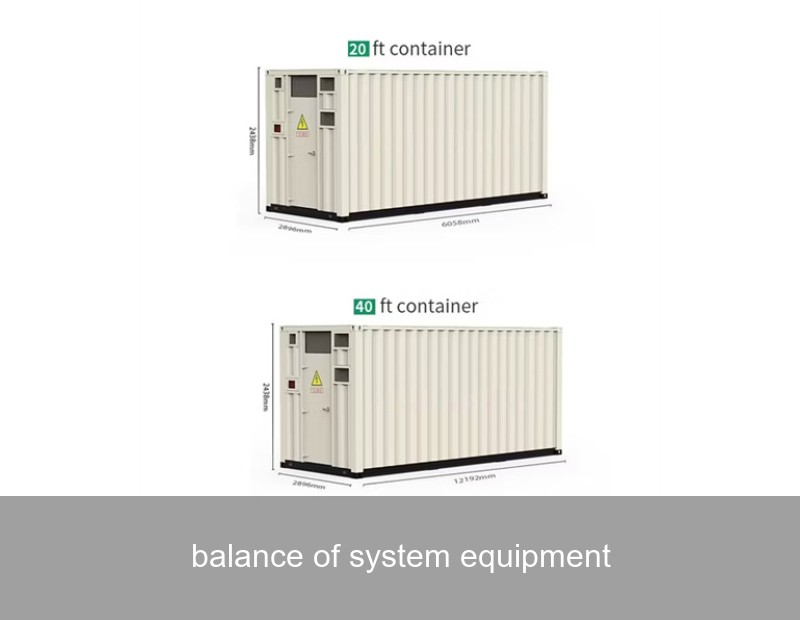
- Enclosures & Integration Hardware: The physical container and internal framework.
Why High-Quality BoS Matters: The Data Doesn't Lie
The phenomenon is clear: system failures are rarely due to the core battery cell or solar panel failing first. Industry data consistently points to balance of system equipment as a leading contributor to downtime and underperformance. A study by the National Renewable Energy Laboratory (NREL) highlighted that inverter and thermal management issues are among the top causes of performance loss in PV systems. Similarly, in energy storage, a subpar BMS can lead to premature cell degradation, while an inadequate PCS can cripple round-trip efficiency.
Let’s talk numbers. A top-tier battery cell might boast a 95% round-trip efficiency on its own. However, if integrated with low-efficiency BoS components (PCS, transformers, cabling), the entire system's efficiency could drop to 88% or lower. Over a 20-year lifespan, that 7% difference represents a massive amount of lost energy and revenue, especially for commercial and industrial applications. The BoS is where reliability is engineered—or compromised.
A Real-World Case: BoS Impact on a Commercial Microgrid
Consider a manufacturing facility in Bavaria, Germany. Their goal was to achieve 70% energy independence using a solar-plus-storage microgrid. They initially selected a low-cost BESS package with a generic, off-the-shelf BoS design.
The Problem: The facility's load profile was highly dynamic, with sharp peaks. The generic PCS and EMS couldn't respond quickly enough, causing lag and inefficient cycling. Furthermore, the passive cooling system was undersized for the containerized battery enclosure during summer peaks, leading to frequent thermal throttling and reduced output.
The Data-Driven Solution: The facility partnered with Highjoule. We conducted a full audit and replaced the core balance of system equipment. We installed our proprietary Adaptive Power Conversion System (A-PCS) with a sub-10ms response time and integrated it with our iEMS (intelligent Energy Management System), which uses predictive algorithms based on production schedules and weather forecasts. We also upgraded to a liquid-cooled thermal management system.
The Result: Within one year:
- System round-trip efficiency increased from 86% to 94%.
- Peak shaving capability improved by 40%, eliminating demand charges during critical periods.
- Battery degradation was reduced, projecting a 5-year extension on the system's useful life.
The Highjoule Approach: Intelligent BoS Integration
At Highjoule, founded in 2005, we view the balance of system equipment not as a collection of parts, but as an integrated, intelligent ecosystem. Our philosophy is that the true potential of a battery or solar array is unlocked through its BoS. For our commercial and industrial clients across Europe and North America, this means:
- Pre-Engineered, Yet Customizable Platforms: Our HiveStack BESS and GridSynergy microgrid platforms come with optimally matched BoS components—from the BMS and PCS to safety systems—that are pre-validated to work seamlessly together, reducing integration risk and commissioning time.
- Intelligence at the Core: Our iEMS doesn't just react; it learns and predicts. It optimizes dispatch not just for today's electricity prices, but for the long-term health of the battery asset, a function directly managed by advanced BoS software.
- Safety by Design: We engineer multiple layers of protection—electrical, thermal, and chemical—into our BoS architecture, ensuring compliance with the strictest international standards (UL, IEC, etc.).

Image: Advanced control systems (EMS/BMS) are the intelligent core of modern BoS. Source: Unsplash (ThisisEngineering).
Future Trends in BoS Technology
The innovation in energy storage isn't slowing down, and much of it is happening in the BoS space. Here’s what to watch:
| Trend | Impact on BoS | Benefit |
|---|---|---|
| Smart Inverters & Grid-Forming PCS | Inverters that can stabilize the grid without fossil fuel generators. | Enables higher renewable penetration and more resilient microgrids. |
| AI-Driven Predictive Maintenance | EMS/BMS using AI to predict component failures before they happen. | Maximizes uptime and reduces operational costs. |
| Standardization & Modularity | Plug-and-play BoS components for faster, cheaper deployment. | Lowers soft costs and makes storage more accessible. |
Companies like Highjoule are at the forefront of these trends, integrating grid-forming capabilities into our PCS and developing AI modules for our iEMS to deliver future-proof solutions to our clients.
Your Next Step
When evaluating your next energy storage or solar project, what questions will you ask your provider about their balance of system equipment strategy? Will you settle for a generic assembly, or will you demand an intelligently integrated system designed for performance, safety, and long-term value? The choice will define your project's success for decades to come.
 Inquiry
 Online Chat