


Batería Solida: How Much Does the Future of Energy Storage Cost?
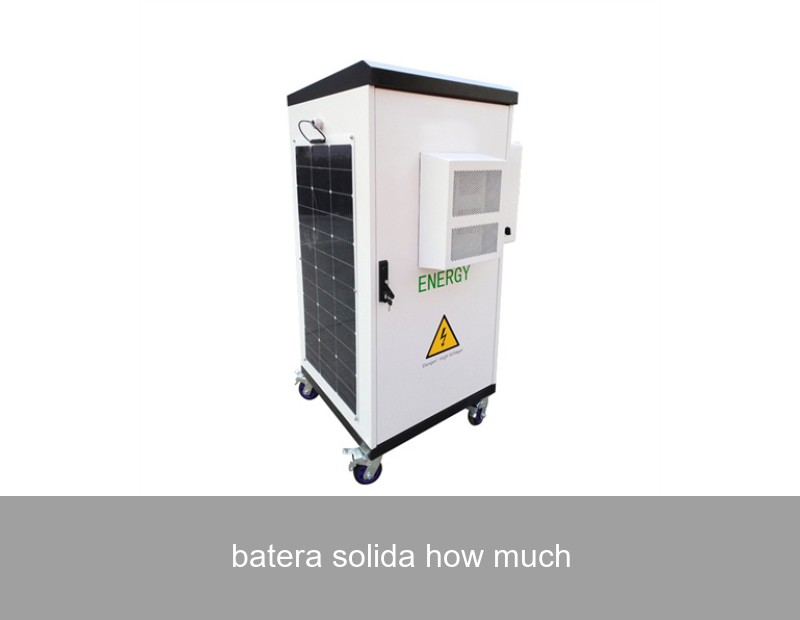
If you're exploring renewable energy solutions, you've likely heard the buzz around solid-state batteries. Touted as the next big leap, they promise greater safety, higher energy density, and longer lifespans than traditional lithium-ion batteries. But the burning question on everyone's mind is: Batería solida how much? The answer isn't a simple figure; it's a journey from cutting-edge lab prototypes to the integrated systems that will power our homes and businesses. Let's demystify the costs, the timeline, and how innovative companies like Highjoule are bridging today's needs with tomorrow's technology.
Table of Contents
- What is a Solid-State Battery (Batería Solida)?
- The Cost Breakdown: Why Are Solid-State Batteries Expensive Now?
- Solid-State vs. Traditional Lithium-Ion: A Cost & Performance Table
- A Real-World Case: Grid Stability in Southern Europe
- The Highjoule Approach: Smart Storage Today, Ready for Tomorrow
- When Will Costs Drop? The Road to Commercial Viability
- What's Your Energy Storage Priority?
What is a Solid-State Battery (Batería Solida)?
Simply put, a solid-state battery replaces the flammable liquid or gel electrolyte found in conventional lithium-ion batteries with a solid compound. This fundamental shift is a game-changer. Imagine the difference between a soggy paper separator and a solid ceramic plate. The latter doesn't leak, is far more stable, and can potentially pack more energy into a smaller space. This translates to batteries that are safer (no thermal runaway fires), potentially longer-lasting, and capable of faster charging. Major automakers and tech giants are investing billions, betting this technology will power everything from next-gen EVs to your home storage system.
The Cost Breakdown: Why Are Solid-State Batteries Expensive Now?
So, batería solida how much are we talking about currently? Industry estimates suggest prototype-level solid-state batteries can cost 5 to 8 times more per kilowatt-hour (kWh) than mass-produced lithium-ion batteries. Let's break down the reasons:
- Material Costs: Many prototypes rely on expensive, scarce materials like lithium metal anodes and specialized solid electrolytes (e.g., sulfides, ceramics). The supply chain for these is in its infancy.
- Manufacturing Complexity: Producing ultra-thin, defect-free solid layers at scale is incredibly challenging. The processes (like vapor deposition) are slow, energy-intensive, and borrowed from the semiconductor industry, not the high-speed roll-to-roll production of today's batteries.
- Low Production Volumes: There are no gigafactories for solid-state batteries yet. Without mass production, economies of scale cannot kick in to drive costs down.
As a point of reference, the U.S. Department of Energy's Battery Supply Chain Analysis highlights the critical need for material innovation and scaled manufacturing to reduce costs for advanced batteries.
Solid-State vs. Traditional Lithium-Ion: A Cost & Performance Table
To understand the value proposition, we must look beyond today's price tag. The following table compares key metrics, illustrating why the investment is being made.
| Feature | Traditional Lithium-Ion (LFP/NMC) | Solid-State Battery (Projected) |
|---|---|---|
| Estimated Cost per kWh (2024) | $80 - $130 (commoditized) | $400 - $800+ (prototype/early production) |
| Energy Density | 150 - 250 Wh/kg | 350 - 500+ Wh/kg (potential) |
| Safety | Requires complex BMS & thermal controls | Inherently higher; no flammable liquid |
| Cycle Life (to 80% capacity) | 3,000 - 6,000 cycles | 5,000 - 10,000+ cycles (target) |
| Commercial Availability | Widely available now | Limited, niche applications; mass market post-2027 |
A Real-World Case: Grid Stability in Southern Europe
Let's ground this in a real scenario. A utility provider in Southern Spain faced increasing grid instability due to variable solar generation and peak evening demand. They needed a storage solution that was not only cost-effective but also extremely safe and durable to operate in high ambient temperatures.
The Data & Solution: A 2022 pilot project deployed a 2 MWh advanced lithium-ion (LFP) battery storage system. The data over 18 months was impressive: it provided 98% availability, shaved 15% off peak demand charges, and integrated seamlessly with their solar farm. However, the operators noted that while the system was effective, they were keenly watching solid-state development for its potential to double the storage capacity in the same footprint and further reduce long-term maintenance risks.
This case, echoed in reports from the International Renewable Energy Agency (IRENA), shows that today's smart lithium-ion solutions are the workhorses enabling the energy transition, while the industry actively prepares for next-generation chemistry.

Image Source: Unsplash - A utility-scale solar and storage installation, similar to modern grid stability projects.
The Highjoule Approach: Smart Storage Today, Ready for Tomorrow
At Highjoule, with nearly two decades of experience since 2005, we believe in delivering reliable, high-performance storage today while future-proofing your investment. Our H-Series Commercial & Industrial (C&I) Energy Storage Systems are built with a modular, chemistry-agnostic architecture. This means our intelligent battery management and power conversion systems are designed to integrate future battery cells, including solid-state, when they become commercially viable and cost-effective.
For our residential and microgrid clients, the Highjoule HomePower platform emphasizes safety, intelligence, and longevity using proven, stable lithium iron phosphate (LFP) chemistry. We focus on maximizing your self-consumption of solar energy and providing backup power through a system whose software and hardware will remain at the forefront of innovation. We answer "batería solida how much" not just with a future price, but by ensuring the system you install now is a stepping stone, not a dead end.
When Will Costs Drop? The Road to Commercial Viability
Most industry analysts, like those cited in Nature Energy, project a gradual cost decline. We can expect early, premium applications (e.g., specialized EVs, aerospace) by 2025-2027. For broad energy storage applications, cost parity with advanced lithium-ion is unlikely before 2030. The key drivers will be:
- Material Innovation: Finding cheaper, more abundant solid electrolytes.
- Manufacturing Breakthroughs: Developing faster, high-yield production techniques.
- Strategic Investment: Continued funding and partnerships to scale pilot lines to giga-factories.

Image Source: Unsplash - Research and development in advanced battery technology is key to lowering future costs.
What's Your Energy Storage Priority?
The journey to affordable solid-state batteries is underway, but the need for intelligent, sustainable energy storage is here and now. Whether you're a business looking to lock in energy costs, a community designing a resilient microgrid, or a homeowner seeking energy independence, the right solution balances today's performance with tomorrow's potential.
So, instead of waiting for a single technology, what if you could start saving and stabilizing your power today with a system designed to evolve? What specific energy challenge—be it rising utility bills, grid unreliability, or sustainability goals—is most pressing for you to solve right now?
 Inquiry
 Online Chat