


How Much NCM vs. LFP Battery Should Influence Your Energy Storage Choice?
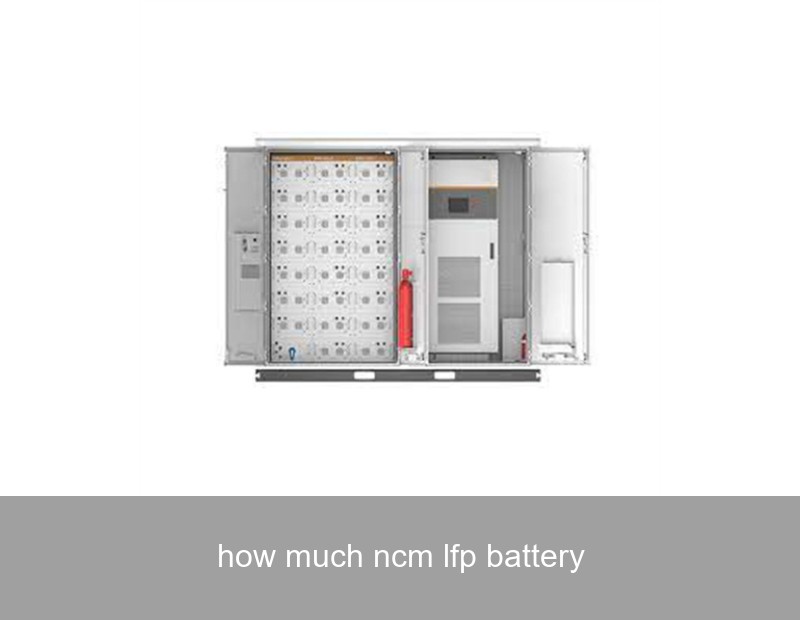
As you plan a solar-plus-storage system or a commercial battery installation, a crucial question emerges: how much NCM or LFP battery technology matters for your specific needs? It's not just a technical detail; it's a decision impacting your project's safety, lifespan, cost, and performance for decades. At Highjoule, a global leader in advanced energy storage since 2005, we guide customers through this exact choice daily. This article cuts through the complexity, offering a clear, data-driven comparison to empower your decision-making for your home or business.
The Core Dilemma: Energy Density vs. Longevity
Imagine you're buying a vehicle. You might choose a sports car for its speed and power (high energy density) or a robust family SUV for its safety and reliability over hundreds of thousands of miles (long cycle life). The battery world faces a similar trade-off. Nickel Cobalt Manganese (NCM) batteries are like the performance-oriented option, packing more energy into a smaller space. Lithium Iron Phosphate (LFP) batteries are the endurance champions, prioritizing safety, cycle life, and stability. The question "how much NCM or LFP" you need boils down to your priorities: maximum power in minimal space, or maximum cycles and safety over time?
NCM & LFP Deep Dive: Chemistry, Data, and Real-World Performance
Let's move beyond the analogy and into the specifics. The difference starts at the atomic level in the battery's cathode.
NCM Battery: The High-Performance Contender
NCM batteries use a cathode made of Nickel, Cobalt, and Manganese. The high nickel content is key to its high energy density.
- Higher Energy Density: Typically ranges from 150-220 Wh/kg. This means for the same physical size, an NCM battery can store more energy than an LFP battery. This is historically why it dominated electric vehicles seeking longer range.
- Performance in Cold Climates: NCM generally retains a slightly better performance at very low temperatures compared to standard LFP.
- The Trade-offs: The use of cobalt raises concerns about supply chain ethics and cost volatility. Furthermore, NCM chemistry is more thermally unstable, requiring sophisticated Battery Management Systems (BMS) for safety. Its cycle life is typically lower, often rated between 2,000 to 3,000 cycles to 80% capacity.

Image Source: Unsplash (Representative image of battery technology)
LFP Battery: The Safety & Longevity Champion
LFP batteries use a cathode made of Lithium Iron Phosphate. This chemistry is inherently more stable.
- Exceptional Safety & Stability: The phosphate-based bond is strong, making LFP cells far more resistant to thermal runaway (a major fire risk). This is a paramount concern for residential and crowded commercial installations.
- Superior Cycle Life: This is LFP's standout feature. Modern Highjoule LFP batteries are rated for 6,000 to 10,000 cycles, effectively doubling or tripling the operational lifespan compared to many NCM alternatives. Think 15+ years of daily use.
- Cost & Ethics: With no cobalt or nickel, LFP batteries use abundant, low-cost materials, leading to a more stable and ethical supply chain. While energy density was once a weakness, innovations like cell-to-pack (CTP) designs have closed the gap significantly.
- Depth of Discharge: LFP batteries can be regularly discharged to 90-100% of their capacity without significant degradation, whereas NCM is often limited to 80-90% for optimal lifespan. This means you can use more of the stored energy you paid for.
Side-by-Side: NCM vs. LFP Battery Comparison Table
| Feature | NCM (Nickel Cobalt Manganese) | LFP (Lithium Iron Phosphate) |
|---|---|---|
| Energy Density | High (150-220 Wh/kg) | Moderate (120-160 Wh/kg)* |
| Cycle Life (to 80% capacity) | 2,000 - 3,500 cycles | 6,000 - 10,000+ cycles |
| Thermal & Safety Profile | Moderate; requires complex BMS | Excellent; inherently stable |
| Key Materials | Nickel, Cobalt, Manganese | Iron, Phosphate (Cobalt/Nickel-free) |
| Cost Trend | Higher, volatile (cobalt-dependent) | Lower, stable |
| Ideal Application | EVs (where space is premium), short-duration high-power needs | Stationary Storage (Home, Commercial, Utility), applications prioritizing lifespan & safety |
*Note: Advanced LFP designs, like those used by Highjoule, achieve system-level energy densities that minimize this gap for stationary storage applications.
Real-World Application: A European Microgrid Case Study
Let's look at data from a real project. A dairy farm cooperative in Northern Germany sought energy independence and cost stability. Their needs were clear: maximize daily cycling (charging from their large rooftop solar array and discharging nightly), ensure absolute fire safety near livestock and feed storage, and guarantee a 20-year minimum system life with minimal maintenance.
The choice was clear: an LFP-based system. A Highjoule industrial microgrid solution with 500 kWh of LFP storage was deployed. The system performs over 400 full cycles per year. An equivalent NCM system rated for 3,000 cycles would be approaching end-of-life in 7-8 years. The LFP system, with a warranted cycle life of 8,000 cycles, projects a lifespan exceeding 20 years, effectively cutting the long-term levelized cost of storage (LCOS) by more than half. The inherent safety of LFP also allowed for a simpler, less expensive thermal management system and lower insurance premiums—a critical factor often overlooked in the "how much NCM LFP battery" calculation. You can explore more on the importance of cycle life in LCOS calculations from the National Renewable Energy Laboratory (NREL).
Making the Choice: Aligning Battery Chemistry with Your Application
So, how much should NCM or LFP influence your decision? Here’s a simple guide:
- Choose LFP if your priority is: Longevity (10+ years), Safety (residential, crowded commercial spaces), Total Cost of Ownership, High Daily Cycling (solar self-consumption), and Ethical/Stable Supply Chain.
- Consider NCM if your absolute constraint is: Minimal physical footprint where every kWh of storage space is critical, or for applications requiring very high power bursts for very short durations. However, for the vast majority of stationary storage applications—from homes to factories—the industry is decisively shifting toward LFP.

Image Source: Unsplash (Representative image of industrial energy storage monitoring)
The Highjoule Approach: Tailored Solutions with Superior LFP Technology
At Highjoule, after nearly two decades of innovation, we have strategically focused on advancing LFP technology for stationary storage. Why? Because for our customers in Europe and North America seeking reliable, safe, and sustainable power for their homes, businesses, and communities, LFP's advantages are overwhelming.
Our HPS (Highjoule PowerStack) series for commercial and industrial applications and our HRS (Highjoule Residential Solution) line are built on proprietary LFP cell architecture and an intelligent, adaptive BMS. This isn't just an off-the-shelf battery pack. We engineer our systems to extract the maximum life and performance from the superior LFP chemistry, offering warranties that reflect our confidence—up to 15 years with unlimited cycles. Our systems are designed for seamless integration with solar and grid services, ensuring you not only save money but also contribute to grid resilience. For a deeper look at the global shift in battery chemistry, analysts at BloombergNEF provide excellent market insights.
The question isn't just "how much NCM or LFP battery," but "how much value, safety, and peace of mind do I want over the life of my investment?"
 Inquiry
 Online Chat