


Bateria con Cargador Solar: Your Complete Guide to Solar Battery Systems
Have you ever watched your solar panels generate abundant energy on a sunny afternoon, only to think about the grid power you'll need to buy back after sunset? This common experience highlights the missing piece for true energy independence: a bateria con cargador solar, or a solar battery system. This technology is transforming how homes and businesses use renewable energy, moving from simply offsetting bills to achieving true self-sufficiency. For nearly two decades, Highjoule has been at the forefront of this shift, engineering smart storage solutions that capture every ray of sunshine for use anytime.
Table of Contents
What Exactly is a "Bateria con Cargador Solar"?
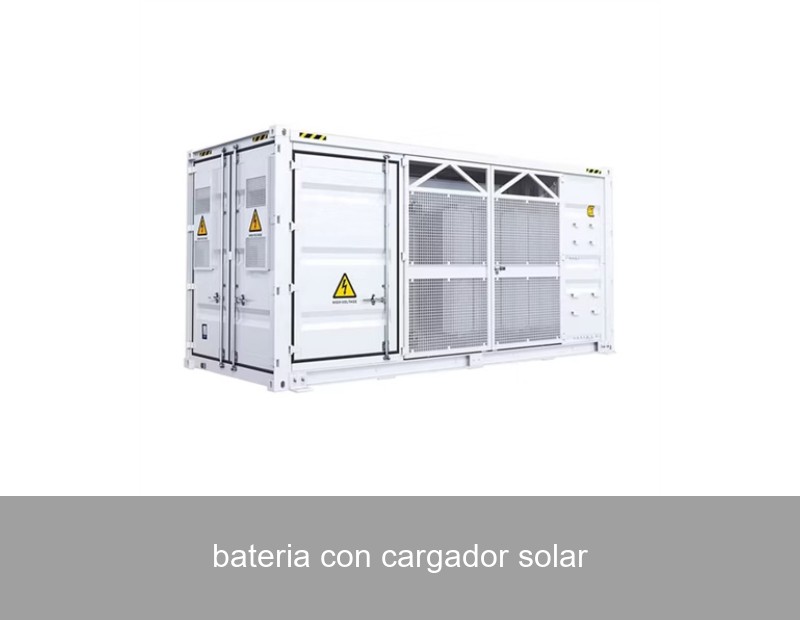
At its core, a bateria con cargador solar is an integrated system comprising a battery storage unit and the necessary components to charge it directly from solar panels. Unlike a simple battery, it's an intelligent ecosystem. The "cargador" isn't a separate plug-in device; it's typically a hybrid inverter or a dedicated charge controller that efficiently manages the flow of solar electricity into the battery, ensuring safe and optimal charging. This system stores the DC (Direct Current) power from your panels, converts it to AC (Alternating Current) for your home, and intelligently decides when to store or discharge energy based on your consumption patterns and utility rates.

Image Source: Unsplash - A modern residential solar and battery setup.
How Does a Solar Battery System Work? A Step-by-Step Journey
Let's follow the path of a sunbeam through your energy system:
- Solar Generation: Your photovoltaic (PV) panels convert sunlight into DC electricity.
- Smart Conversion & Decision-Making: The hybrid inverter or system controller performs a critical dance. It converts DC to usable AC power for your home in real-time. Its intelligence decides: should this power go directly to running your appliances, or should it be sent to charge the battery?
- Efficient Storage: Surplus energy charges your high-capacity battery (like Highjoule's lithium-ion phosphate units), storing it as chemical energy for later.
- On-Demand Discharge: When solar production drops (at night or on cloudy days), the system automatically draws power from the battery to keep your lights on and devices running.
- Grid Interaction (Optional): Advanced systems like Highjoule's GridTetherTM Intelligent Energy Management can interact with the grid, allowing you to draw minimal power during peak expensive times or even sell excess stored energy back if regulations and rates are favorable.
| Time of Day | Solar Production | Household Demand | Battery Action | Grid Interaction |
|---|---|---|---|---|
| Morning (6-10 AM) | Moderate | High | Discharging to supplement | Low or zero import |
| Midday (10 AM-3 PM) | High Peak | Moderate | Charging from surplus | Zero import, possible export |
| Evening Peak (5-9 PM) | Low/None | High Peak | Discharging to cover peak | Zero import, avoiding high tariffs |
| Overnight | None | Low | Discharging for base load | Minimal to zero import |
Key Benefits of Integrating a Solar Battery
Moving to a system with a bateria con cargador solar offers tangible advantages beyond just environmental goodwill.
- Maximized Self-Consumption: Increase the portion of your own solar energy you use from 30-50% to 70% or more, drastically reducing energy bills.
- Backup Power & Resilience: Weather events and grid outages are becoming more common. A battery system provides critical backup power, keeping essential circuits online. Highjoule systems feature seamless Uninterruptible Power Supply (UPS) functionality, switching to battery power in milliseconds.
- Peak Shaving: In regions with Time-of-Use (TOU) rates, electricity is most expensive during evening "peak" hours. Your battery discharges during these periods, shielding you from the highest costs.
- Future-Proofing & Grid Support: As grids modernize, distributed batteries can provide stability. Highjoule's systems are designed to participate in future virtual power plants (VPPs), potentially creating a new revenue stream for owners.
Real-World Impact: A Case Study from Valencia, Spain
Let's look at concrete data. A medium-sized winery in the Valencia region of Spain faced two challenges: high operational energy costs, especially for refrigeration, and occasional grid instability during harvest season. In 2022, they installed a 120 kW solar array paired with a Highjoule H-Stack Commercial 100 kWh battery storage system.
- Energy Self-Sufficiency: Increased from 40% to 92% during summer months.
- Cost Savings: Reduced their annual electricity bill by €18,700, yielding a projected return on investment (ROI) in under 6 years.
- Reliability: The battery provided backup power during two planned grid maintenance outages, preventing spoilage of temperature-controlled inventory.
- Carbon Footprint: Avoided an estimated 42 tonnes of CO2 emissions annually.
This case, documented in part by the International Renewable Energy Agency (IRENA), underscores how commercial entities leverage a robust bateria con cargador solar for both economic and operational resilience.
Choosing the Right System: Capacity, Chemistry, and Intelligence
Not all systems are created equal. Key considerations include:
- Capacity & Power: Capacity (kWh) is your "energy tank size." Power (kW) is how much energy can flow out at once. You need enough power to run key appliances simultaneously and enough capacity to cover your desired backup duration.
- Battery Chemistry: Lithium Iron Phosphate (LFP) is now the industry standard for residential and commercial storage due to its superior safety, longevity (often 6,000+ cycles), and stability compared to older NMC chemistries. All Highjoule residential batteries utilize LFP technology.
- Depth of Discharge (DoD) & Warranty: A 90% DoD means you can use 90% of the battery's rated capacity without harming it. Look for a strong warranty that guarantees both a period (e.g., 10 years) and a remaining capacity (e.g., 70% at end of warranty).
- System Intelligence: This is the true differentiator. Can it learn your habits? Can it integrate with time-based utility rates automatically? Highjoule's EnergyOS platform does exactly this, optimizing every kilowatt-hour for your financial benefit.

Image Source: Unsplash - Lithium Iron Phosphate battery modules, known for safety and longevity.
How Highjoule Powers a Sustainable Future with Advanced Storage
Since 2005, Highjoule has evolved from a pioneer to a global leader in intelligent energy storage. Our philosophy is that a bateria con cargador solar should be more than hardware; it should be an integrated, smart, and reliable energy partner.
For homeowners, our HomeGuardian Series offers scalable LFP storage (from 5 kWh to 30+ kWh) with integrated hybrid inverters and the intuitive EnergyOS app, giving complete control over energy flows. For businesses and industrial applications, our H-Stack Commercial modular systems can scale from 30 kWh to multiple megawatt-hours, providing critical load management, peak shaving, and backup power.
Our systems are designed with a closed-loop ecosystem in mind, compatible with most major solar inverter brands while offering superior performance when paired with our own components. We focus on safety (with multi-layer protection systems), longevity, and providing a seamless user experience that makes managing complex energy simple. Learn more about the science behind LFP safety from the U.S. Department of Energy's Solar Energy Technologies Office.
Beyond the Home: Microgrids and Community Resilience
The principle of the bateria con cargador solar scales beautifully. Highjoule is actively deploying microgrid solutions for remote communities, industrial parks, and critical infrastructure. These systems combine large-scale solar arrays with massive battery storage, often with diesel generator integration, to create self-sustaining energy islands. This not only provides energy access but also fortifies communities against broader grid disruptions—a growing concern noted by grid operators across Europe (ENTSO-E) and North America.
So, as you consider taking control of your energy future, ask yourself: what would true energy independence look like for your home or business, and what's the first step you could take to understand your potential?
 Inquiry
 Online Chat