


Batterie di Accumulo per Fotovoltaico 20 kW: The Complete Guide to Energy Independence
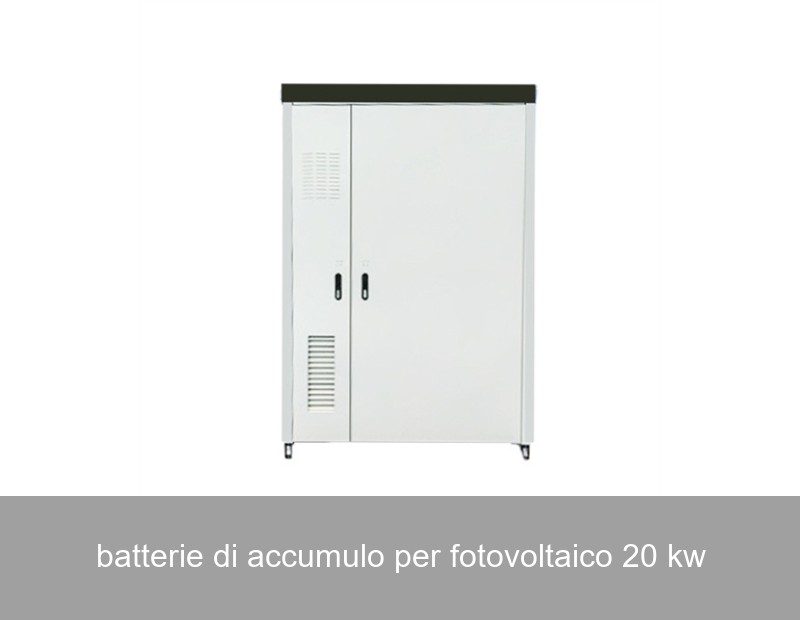
You've made a smart investment: a robust 20 kW photovoltaic (PV) system is now powering your home or business. On bright, sunny days, you're practically swimming in clean energy, potentially even sending excess back to the grid. But what happens when the sun sets, or during those prolonged cloudy periods? That's where the crucial companion comes in: a batteria di accumulo per fotovoltaico 20 kW. This isn't just an add-on; it's the key to transforming your solar array from a daytime supplier into a 24/7 personal power plant. For European and American homeowners and businesses, pairing a 20 kW system with the right storage solution is the definitive step toward true energy resilience and maximizing the return on your green investment.
Table of Contents
Why a 20 kW Solar System Demands Storage
Let's face a common reality: solar production and energy consumption are often out of sync. A 20 kW system, common for larger homes, agricultural operations, or small-to-medium enterprises, can produce over 80 kWh on a perfect summer day. However, your evening energy demand—lighting, appliances, heating/cooling—coincides with zero solar generation. Without storage, you're forced to buy expensive grid electricity at night, undermining your savings.
The economic landscape is also shifting. Feed-in tariffs (FiTs) and net metering schemes, which once made exporting surplus solar power lucrative, are being phased out or reduced in many regions, from parts of the USA to various European countries. This makes self-consumption the new gold standard. By storing your excess daytime production, you can use it when you need it most, dramatically increasing your self-consumption rate from perhaps 30-40% to 70% or more. This directly slashes your electricity bills and accelerates your payback period.
Key Components of a 20 kW Solar Battery System
Understanding the anatomy of your storage system is empowering. It's not just a "box of batteries." A fully integrated batteria di accumulo per fotovoltaico 20 kW solution comprises:
- Battery Modules: The core energy storage units, typically based on lithium-ion chemistry. For a 20 kW system, you'll need a bank with significant capacity, often in the range of 20 kWh to 40 kWh or more.
- Battery Management System (BMS): The brain of the operation. A high-quality BMS monitors cell voltage, temperature, and state of charge, ensuring safety, longevity, and optimal performance.
- Hybrid Inverter or AC Coupling: This device is the maestro. It manages the flow of energy between your PV panels, the battery bank, your home's electrical panel, and the grid. It converts DC from the panels and batteries to AC for your home, and vice-versa for charging.
- Energy Management System (EMS): The strategic planner. This intelligent software learns your consumption patterns, considers weather forecasts, and even integrates with time-of-use electricity rates to decide when to charge, discharge, or export energy for maximum economic benefit.

Image Source: Unsplash - A modern, integrated battery storage installation.
Sizing Your Battery Bank: More Than Just Capacity
A common question is, "What size battery do I need for my 20 kW system?" The answer isn't a simple formula. It depends on your energy goals:
| Primary Goal | Key Consideration | Typical Battery Sizing (for 20 kW PV) |
|---|---|---|
| Load Shifting & Bill Savings | Cover evening/night consumption, avoid peak rates. | 15 kWh - 25 kWh |
| Backup Power (Essential Loads) | Power critical circuits (fridge, lights, comms) during outages. | 10 kWh - 20 kWh |
| Full Energy Independence (Off-Grid) | Handle multiple cloudy days; complete grid disconnection. | 40 kWh+ (often with generator backup) |
As a rule of thumb, analyze your electricity bill to find your average daily consumption, then target a battery that can cover the portion of that usage that occurs after sunset. A professional assessment, like the one Highjoule provides, is essential to model your specific production and consumption curves accurately.
Technology Showdown: Lithium-Ion Chemistries
Not all batteries are created equal. The dominant choice for home and commercial storage is lithium-ion, but there are key subtypes:
- Lithium Iron Phosphate (LFP): The current champion for stationary storage. LFP batteries offer exceptional cycle life (often 6,000+ cycles), superior thermal and chemical stability (enhanced safety), and good performance across a wide temperature range. Their energy density is slightly lower than NMC, but for a fixed installation, this is a minor trade-off for the outstanding longevity and safety. This is the chemistry Highjoule employs in its H-Series residential and commercial products.
- Nickel Manganese Cobalt (NMC): Known for higher energy density (more capacity in a smaller space), making them popular in EVs. They may have a slightly lower cycle life than LFP and require more sophisticated thermal management.
For a batteria di accumulo per fotovoltaico 20 kW meant to last 15+ years, LFP's safety profile and cycle life make it the preferred choice for informed installers and homeowners alike, a fact supported by trends in the global market as noted by the IEA.
Real-World Impact: A Case Study from Emilia-Romagna, Italy
Theory is good, but real data tells the true story. Consider a family-run agritourism business in the Italian region of Emilia-Romagna. They installed a 20 kW PV system in 2020. While summer bills plummeted, they still faced high winter costs and had no protection from grid outages, which impacted their guest experience.
In 2023, they integrated a 24 kWh LFP battery system with a smart hybrid inverter. The results after one year were compelling:
- Self-Consumption Rate: Increased from 35% to 82%.
- Annual Electricity Bill Savings: An additional €2,300 saved on top of solar savings, improving their system payback period by 2.5 years.
- Reliability: The system seamlessly powered essential loads during three grid outages, ensuring guest comfort and business continuity.
- Carbon Footprint: Their reliance on the (still partially fossil-fuel-based) grid dropped by over 70% annually.
This case exemplifies the triple win of a correctly sized and installed storage solution: economic gain, resilience, and sustainability.
The Highjoule Integrated Solution: Engineered for Systems Like Yours
At Highjoule, we understand that a 20 kW system isn't a small project. It requires robust, reliable, and intelligent storage. Our H-Series Commercial energy storage system is engineered specifically for this scale. It's a modular, scalable LFP-based solution that can be configured from 20 kWh to hundreds of kWh, making it a perfect match for your 20 kW PV array.
What sets our solution apart is the Highjoule Energy OS, our proprietary energy management platform. It doesn't just react; it predicts and optimizes. By integrating weather data and real-time grid pricing signals (where available), it automatically chooses the most economical moments to charge from your panels or the grid and discharge to power your property. For businesses, this can mean significant savings by avoiding demand charges—a major component of commercial utility bills in the US and Europe. Our systems are designed for seamless integration, whether you're retrofitting storage to an existing 20 kW array or building a new turnkey system from the ground up.

Image Source: Unsplash - A modern home with integrated solar and battery storage.
Future-Proofing Your Investment
The energy ecosystem is evolving rapidly. When choosing your batteria di accumulo per fotovoltaico 20 kW, think beyond today. Consider vehicle-to-home (V2H) capabilities, where your future electric vehicle could act as a backup battery. Ensure your system's software is updatable to participate in emerging virtual power plant (VPP) programs, where aggregated home batteries provide grid stability services, potentially earning you revenue. Highjoule's platform is designed with this open, upgradeable architecture in mind, protecting your investment against tomorrow's innovations.
So, as you contemplate the final piece to unlock the full potential of your 20 kW solar investment, what specific energy challenge—be it unpredictable bills, the desire for backup power, or a step toward complete energy autonomy—is most critical for you to solve with a tailored storage solution?
 Inquiry
 Online Chat