


Beyond the Blackout: Why a Modern Battery for Battery Backup is Your Key to Energy Resilience
a severe storm knocks out the grid in your neighborhood. While others are left in the dark, your home's lights stay on, your refrigerator keeps humming, and your home office remains fully operational. This isn't magic; it's the power of a modern battery for battery backup. But today's advanced systems are about far more than just emergency lighting. They are intelligent energy hubs that provide resilience, unlock significant savings, and actively support a sustainable grid. As a leader in advanced energy storage since 2005, Highjoule has witnessed this evolution firsthand. Let's explore why the humble backup battery has transformed into the cornerstone of modern energy independence.
The Phenomenon: Why the Surge in Demand Now?
For decades, backup generators were the default solution for power outages. So, what changed? A convergence of factors has propelled the battery for battery backup from a niche product to a mainstream essential. First, climate change is intensifying weather events. From wildfires in California and heatwaves in Europe to intense winter storms across the US, grid disruptions are becoming more frequent and prolonged. The U.S. Energy Information Administration (EIA) notes that customers are experiencing more frequent and longer-lasting power interruptions[1]. Second, the rise of renewable energy, particularly rooftop solar, creates a perfect partnership. A battery stores excess solar energy produced during the day for use at night or during an outage, maximizing self-consumption. Finally, volatile energy prices across Europe and North America make the ability to avoid drawing power from the grid during peak, expensive hours a compelling financial argument.

Image: A modern home energy system combining solar panels and battery storage. Source: Unsplash
The Data: Quantifying the Need for Resilience
Let's move from the general phenomenon to hard numbers. The financial and operational impact of power outages is staggering.
| Impact Area | Data Point / Statistic | Implication |
|---|---|---|
| Grid Reliability (US) | U.S. electricity customers experienced an average of over 7 hours of outages in 2021. | That's nearly a full workday without power, highlighting systemic vulnerability. |
| Business Cost | A single one-hour outage can cost a small commercial business over $1,000 in lost revenue and productivity. | For data centers or manufacturers, this cost can skyrocket to tens of thousands per minute. |
| Residential Value | Homes with solar + storage can achieve 80-100% energy self-sufficiency, drastically reducing grid dependence. | This translates to predictable bills and protection from rate hikes. |
This data paints a clear picture: relying solely on the traditional grid is an increasing risk. A proactive investment in a battery backup system is fundamentally an investment in continuity, security, and financial predictability.
Case Study: A California Winery's Resilience Story
Let's make this concrete with a real-world example from California's Napa Valley. A prestigious winery faced a dual challenge: increasing threats of Public Safety Power Shutoffs (PSPS) to prevent wildfires and the critical need for precise temperature control in its fermentation tanks. A power outage during fermentation could ruin an entire vintage, representing a loss of millions of dollars.
The Solution: The winery partnered with Highjoule to design and install a customized battery for battery backup system integrated with their existing solar array. The system included our Highjoule C&I PowerStack, a modular, high-capacity battery storage solution designed for commercial and industrial applications.
The Results:
- Zero Downtime: During subsequent PSPS events, the winery's critical operations continued uninterrupted for over 48 hours.
- Financial Protection: They safeguarded their valuable fermentation batches, directly protecting their core revenue.
- Energy Cost Savings: By using stored solar energy to power high-load equipment during peak grid rate periods (4-9 pm), they reduced their overall energy costs by an estimated 25% annually.
This case exemplifies the modern battery backup: it's not a dormant asset waiting for a crisis. It's an active, daily contributor to operational efficiency and financial health.
Choosing the Right Battery Backup System: Key Considerations
Not all battery systems are created equal. When evaluating a battery for battery backup, you must look beyond simple kilowatt-hour (kWh) capacity. Here’s a quick guide:
- Power Rating (kW): How much electricity the battery can deliver at once. Can it start your HVAC compressor or only your lights?
- Usable Capacity (kWh): The total amount of energy stored. This determines how long you can run your essential loads.
- Depth of Discharge (DoD): The percentage of the battery's capacity that can be safely used. A higher DoD means more usable energy.
- Battery Chemistry: Lithium Iron Phosphate (LFP) is now the leading choice for stationary storage due to its superior safety, longer lifespan, and stability compared to older NMC chemistries.
- System Intelligence: Can it integrate with solar? Does it have software to optimize for time-of-use rates or grid services?
Highjoule's Smart Solutions for Uninterrupted Power
At Highjoule, we engineer resilience into every system we design. Our approach goes beyond providing just a battery for battery backup; we deliver intelligent, integrated energy solutions tailored to the specific needs of homeowners, businesses, and microgrids.
For residential customers, our Highjoule Home Energy Hub is a seamless, all-in-one unit. Built with safe LFP chemistry, it integrates effortlessly with new or existing solar installations. Its intelligent energy management software allows homeowners to set preferences—prioritizing essential circuits during an outage or automatically shifting to battery power during expensive peak rates, all controllable via a simple smartphone app.
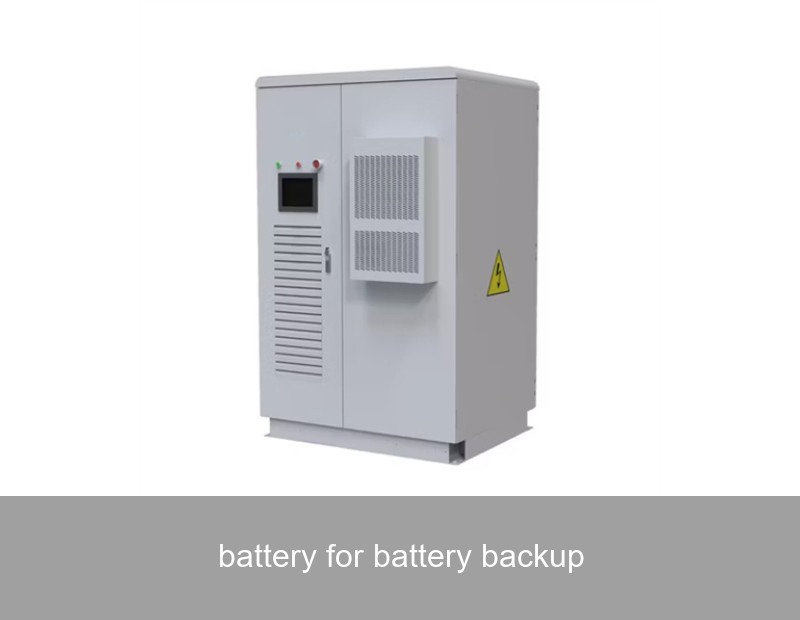
For commercial and industrial applications, like the winery we discussed, our C&I PowerStack series offers scalable, modular power. These systems are engineered for high-cyclability and can be configured for complex load management, demand charge reduction, and even participation in grid-balancing programs, turning an energy cost center into a potential revenue stream.
Our core philosophy is that a battery backup system should be an intelligent investment that works for you every single day, not just during emergencies.

Image: An engineer performing diagnostics on a large-scale commercial battery storage installation. Source: Unsplash
The Future of Energy Independence
The trajectory is clear. As noted by the International Energy Agency (IEA), energy storage is set for "exponential growth" this decade, becoming a central pillar of secure and clean energy transitions worldwide [2]. The battery for battery backup is evolving into a grid-interactive resource. Imagine a future where thousands of distributed home and business batteries form a "virtual power plant," supporting the grid during times of high demand and increasing overall community resilience—a vision Highjoule is actively helping to build today.
So, the question is no longer if you need a backup power solution, but what kind. Are you ready to move from passive vulnerability to active energy control? What would uninterrupted power allow you to protect or achieve in your home or business?
 Inquiry
 Online Chat