


Who Are the Biggest Green Energy Companies Powering Our Future?
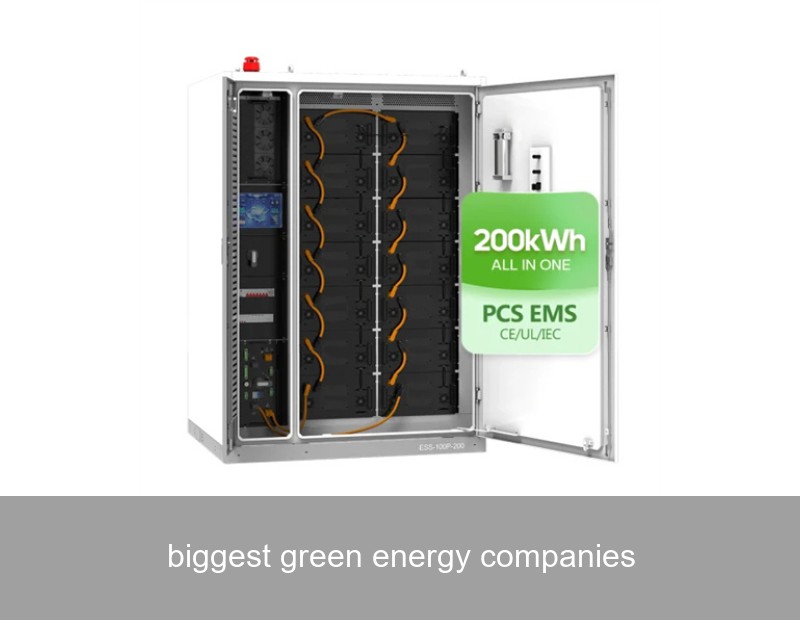
When we talk about the biggest green energy companies, names like Ørsted, NextEra Energy, and Iberdrola often dominate the headlines. These giants are undeniably reshaping our power grids with massive wind and solar farms. But here’s a thought: is sheer generation capacity the only measure of impact? The true revolution in our energy transition is being solidified by another critical player—advanced energy storage. Without it, the sun doesn't always shine, and the wind doesn't always blow. This is where the narrative expands beyond generation to include the architects of reliability, companies like Highjoule, which ensure every green electron is captured, stored, and delivered precisely when needed.
Table of Contents
The Phenomenon: Beyond the Megawatt
For years, the race in green energy was measured in gigawatts installed. It was a volume game. However, grid operators and energy managers from California to Germany are facing a new, more complex challenge: intermittency. You see, having a 500 MW solar plant is fantastic at noon, but what happens at 7 PM when demand peaks but generation plummets? This mismatch creates volatility, strains grid infrastructure, and can ironically lead to curtailment—where renewable energy is wasted because it can't be used. The conversation is shifting from who produces the most green power to who can deliver it most reliably and efficiently. This paradigm shift is elevating companies that master the science of storage and energy management to a stature as crucial as the traditional giants.
The Data: The Storage Imperative
The numbers paint a clear picture. According to the U.S. Energy Information Administration (EIA), renewables like wind and solar are the fastest-growing electricity sources. Yet, the International Energy Agency (IEA) consistently highlights grid flexibility as the cornerstone for higher renewable integration. Let's look at a specific projection: BloombergNEF's 2023 Energy Storage Market Outlook suggests that the global energy storage market will attract over $500 billion in investment by 2030. This isn't a side show; it's the main enabler. The growth in storage capacity is directly correlated with the ability of grids to absorb more renewable generation without compromising stability. In essence, the value of a megawatt-hour of solar energy is now intrinsically linked to the availability of a megawatt-hour of storage capacity nearby.

Image: Modern solar farms are increasingly integrated with on-site battery storage. Source: Unsplash
The Case Study: Stability in Southern Europe
Consider a real-world scenario in Southern Europe, a region with abundant solar resources but also a tourism-driven grid with extreme seasonal demand spikes. A mid-sized industrial park in Spain, home to several manufacturing facilities, aimed to achieve 80% energy independence using its rooftop solar. They partnered with one of the biggest green energy companies for the solar panels. However, they faced a critical issue: their production machinery caused sharp, unpredictable power surges that their solar inverters couldn't smooth out, leading to grid penalties and potential equipment damage.
The solution wasn't more generation; it was intelligent storage. This is where Highjoule was engaged. We deployed a customized Highjoule H-Series Commercial & Industrial Battery Energy Storage System (BESS) with a capacity of 1.2 MWh. The system's advanced power electronics and AI-driven management platform do two key things: First, it provides instantaneous frequency regulation, absorbing and discharging power in milliseconds to smooth the facility's load profile. Second, it performs sophisticated energy arbitrage, storing excess solar power from midday for use during the expensive evening peak.
| Metric | Before Highjoule BESS | After Highjoule BESS (12 Months) |
|---|---|---|
| Grid Dependency During Peak | 95% | 40% |
| Peak Demand Charges | €18,000/month (avg.) | €6,500/month (avg.) |
| Solar Self-Consumption Rate | 55% | 92% |
| Grid Stability Incidents | 3-5 per month | 0 |
This case exemplifies the new layer of the energy ecosystem. The solar provider enabled generation, but Highjoule's storage system enabled true resilience and economic optimization, transforming the site's entire energy profile.
The Insight: The Distributed Future
The legacy model of centralized, one-way power flow is evolving. The future grid is distributed, bidirectional, and intelligent. This means the next tier of biggest green energy companies will be those that provide not just kilowatts, but control, software, and seamless integration. It's about creating a network of resilient microgrids—from a single home to an entire industrial complex—that can operate independently if needed and support the main grid during stress. This vision reduces the need for massive fossil-fueled "peaker" plants, accelerates decarbonization, and democratizes energy security. The companies leading this charge are those with deep expertise in power electronics, battery chemistry, and grid-edge software.

Image: Advanced control systems are the brain of modern energy storage. Source: Unsplash
The Highjoule Solution: Intelligent Storage for Every Scale
Since 2005, Highjoule has been at the forefront of this intelligent storage revolution. We complement the work of renewable generators by making their output more valuable and reliable. Our philosophy is that effective storage must be adaptive, scalable, and inherently safe.
- For Homes & Communities: Our EverHome residential storage system integrates effortlessly with rooftop solar. Its hybrid inverter technology and smart learning algorithm predict household usage patterns and weather to maximize self-consumption, shielding homeowners from volatile energy prices. For communities, our Community Energy Storage solutions allow for shared resilience, a concept gaining rapid traction in the U.S. and Europe.
- For Commerce & Industry: As seen in our case study, the H-Series C&I BESS is a workhorse. It's modular, allowing for capacities from 100 kWh to multi-megawatt hours. Its core strength is the Highjoule Neuron™ Platform, an AI-powered energy management system that can be configured for peak shaving, backup power, frequency response, or a blend of all revenue streams.
- For Utilities & Microgrids: Our Utility-Scale Storage Array provides the grid services essential for a high-renewables future. These systems offer black-start capability, voltage support, and bulk energy time-shifting. For remote or critical operations, Highjoule designs fully integrated microgrids that combine solar, storage, and backup generation into a turnkey resilient power source.
Our technology is built on lithium iron phosphate (LFP) chemistry, known for its long cycle life and superior safety profile—a non-negotiable priority for us. We don't just sell hardware; we provide a long-term partnership with 24/7 monitoring, performance guarantees, and proactive maintenance.
The Technology Behind the Reliability
What truly differentiates a storage provider is the intelligence layer. The Highjoule Neuron™ Platform doesn't just react; it forecasts. By ingesting data from weather APIs, grid price signals (like day-ahead markets in the EU or real-time pricing in the U.S.), and on-site load profiles, it makes predictive decisions to optimize for cost, carbon, or reliability—or a custom blend defined by the user. This is the kind of innovation that places storage-centric companies alongside the traditional titans in terms of systemic importance.
Your Role in the Energy Landscape
The landscape of the biggest green energy companies is no longer a simple list of generators. It's an interconnected web of creators, enablers, and optimizers. As a business leader, homeowner, or community planner, you are now an active participant in this grid. The choice you make in your energy partner determines not just your bill, but your resilience and your contribution to a stable, clean grid. So, we leave you with this question: As you evaluate your path to energy independence, are you looking only at where your power comes from, or are you also planning for how you will control, store, and leverage it every hour of the day?
We invite you to explore what intelligent storage could unlock for your operations. What single energy challenge—be it cost, reliability, or sustainability goals—is most critical for you to solve in the next 18 months?
 Inquiry
 Online Chat