


Buying Solar Panels for Home: Your Ultimate Guide to a Smart Energy Investment
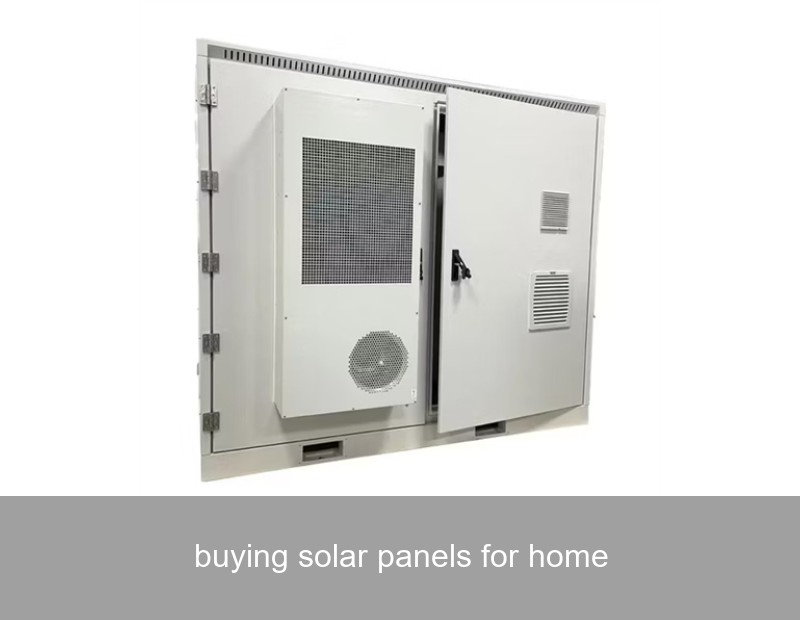
So, you're thinking about buying solar panels for your home. That's a fantastic decision, but let's be honest—it can feel overwhelming. Between the technical jargon, the financial considerations, and the sheer number of products, where do you even start? As energy costs continue their unpredictable dance and the desire for energy independence grows, turning your roof into a personal power plant has never made more sense. This guide will walk you through the entire journey, from understanding the "why" to making the smartest purchase, all while highlighting how integrating a modern battery storage system, like those from Highjoule, transforms a simple solar installation into a complete home energy solution.
Table of Contents
- The "Why" Behind the Shine: More Than Just Lower Bills
- Understanding the Basics: Panels, Inverters, and The Brain
- The Financial Breakdown: Incentives, ROI, and Long-Term Value
- The Storage Game-Changer: Why Solar Alone Isn't Enough
- Case Study: Real Data from a German Household
- Choosing the Right Partner for Your Project
- Key Questions to Ask Before You Buy
The "Why" Behind the Shine: More Than Just Lower Bills
The initial motivation for most homeowners is financial. You see your electricity bill creeping up every year and want to lock in a predictable energy cost. And you're right to do so. According to the U.S. Energy Information Administration (EIA), residential electricity prices have shown a long-term upward trend. But the benefits of buying solar panels for your home extend far beyond savings.
- Energy Independence: Reduce reliance on the volatile grid, especially during peak pricing hours or regional shortages.
- Increased Property Value: Studies consistently show homes with solar installations sell faster and at a premium.
- Carbon Footprint Reduction: Directly contribute to decarbonizing the energy grid with clean, renewable power.
- Resilience: When paired with a battery, your home can maintain power during outages—a feature becoming increasingly valuable.
Understanding the Basics: Panels, Inverters, and The Brain
Let's demystify the core components. A solar system isn't just panels on a roof.
- Solar Panels (Photovoltaic Modules): These are the workhorses, converting sunlight into direct current (DC) electricity. Key metrics are efficiency (what percentage of sunlight is converted) and degradation rate (how much output decreases yearly).
- Inverter: This is the crucial translator. It converts the DC electricity from your panels into the alternating current (AC) that your home appliances use. Microinverters (one per panel) and string inverters are common options.
- Mounting & Racking: The secure foundation that holds everything in place, designed for your specific roof type and local weather conditions.
But here's where modern systems get smart. An Energy Management System (EMS) acts as the brain. It intelligently directs energy—powering your home first, then charging your battery, and finally exporting excess to the grid for credits. This is the core intelligence behind companies like Highjoule, whose systems are built around advanced software that optimizes every kilowatt-hour for maximum self-consumption and savings.
The Financial Breakdown: Incentives, ROI, and Long-Term Value
The economics of solar are bolstered by significant government incentives. In the U.S., the federal Investment Tax Credit (ITC) allows you to deduct a major percentage of your system cost from your taxes. Many states and utilities offer additional rebates. In Europe, schemes like feed-in tariffs or smart export guarantees provide long-term revenue for surplus energy.
A typical payback period in sunnier regions like California or Southern Europe can be 5-8 years, while in Northern Europe or less sunny U.S. states, it might be 8-12 years. Given that premium solar panels often come with 25+ year performance warranties, you're looking at decades of virtually free electricity post-payback.
The Storage Game-Changer: Why Solar Alone Isn't Enough
This is the most critical insight for anyone buying solar panels today: solar without storage is an incomplete solution. Why? Because the sun doesn't shine at night, yet your energy consumption often peaks in the evening. Without a battery, you're exporting excess solar energy at low rates during the day and buying back expensive grid power at night—this is called the "duck curve" challenge.
Integrating a battery storage system like the Highjoule HomePower series changes everything. It stores your daytime surplus for use anytime, dramatically increasing your self-consumption rate from 30-50% (solar only) to 70% or even 90%. This is the key to true energy independence and bill minimization.
Highjoule's systems are designed with this seamless integration in mind. Their Hybrid Inverter-Storage Units combine the inverter and battery management into one sleek, efficient unit, simplifying installation and providing a single point of control via their user-friendly app. You can monitor production, consumption, and storage in real-time, and even set modes to prioritize backup power for essential circuits during a grid outage.

Image Source: Unsplash - A modern home energy setup with solar and EV charging.
Case Study: Real Data from a German Household
Let's look at real numbers. The Müller family in Bavaria, Germany, installed a 9.8 kW solar array in 2022. Initially without storage, their self-consumption was 41%. They were exporting most of their midday production and drawing heavily from the grid in the morning and evening.
In early 2023, they added a Highjoule HomePower 10 battery with a usable capacity of 10.2 kWh. The results over the next 12 months were transformative:
| Metric | Solar Only (2022) | Solar + Highjoule Battery (2023) | Change |
|---|---|---|---|
| Annual Self-Consumption | 41% | 86% | +110% |
| Grid Electricity Purchased | 3,200 kWh | 650 kWh | -80% |
| Annual Energy Cost | €1,150 | €240 | €910 saved |
The system provided uninterrupted power during three minor grid outages, something the family hadn't even considered as a benefit initially. This case exemplifies the European move towards Prosumer households—those that both produce and intelligently manage their own energy.
Choosing the Right Partner for Your Project
Buying solar panels is a significant investment, and the installer you choose is as important as the equipment. Look for certified, experienced installers with strong local references. They should conduct a detailed site assessment (considering roof angle, shading, and structural integrity) and provide a clear, comprehensive quote.
As a global leader with nearly two decades of experience, Highjoule works through a network of certified Highjoule Elite Installers. These professionals are trained not just on the hardware installation, but on designing and optimizing the complete home energy ecosystem. They can provide precise simulations of your potential savings and system performance, ensuring you get a solution tailored to your specific consumption patterns and goals.
Key Questions to Ask Before You Buy
Arm yourself with these questions when speaking with potential installers or evaluating products:
- What is the total estimated annual production of the proposed system?
- What are the panel and inverter warranty terms (performance, product, labor)?
- How will you handle permitting and interconnection with my utility?
- Can you provide a detailed financial analysis showing payback period and lifetime savings?
- How does adding a battery storage system, like Highjoule's, change the financial and functional model of my project?
- What does the monitoring and maintenance support look like post-installation?

Image Source: Unsplash - Homeowner and installer reviewing system performance.
The journey of buying solar panels for your home is ultimately about taking control. It's a step towards a more sustainable, resilient, and financially predictable future. The technology, especially when you consider the integrated storage solutions offered by companies like Highjoule, is mature, reliable, and smarter than ever. It's no longer just about putting panels on your roof; it's about building an intelligent energy asset for your home.
What's the first step you'll take this week to move from considering solar to actively planning your home's energy transformation?
 Inquiry
 Online Chat