


Beyond the Roar: The Silent Revolution of Hospital Backup Generators
a major storm knocks out the grid. In the darkness, a hospital's emergency system kicks in. The familiar, thunderous roar of a diesel generator fires up, ensuring life-saving equipment stays on. This scene has been a healthcare staple for decades. But what if the backup power of the future isn't loud, polluting, and fuel-dependent? What if it's silent, instantaneous, and sustainable? The evolution of hospital backup generators is here, and it's moving from noisy diesel giants to intelligent, hybrid energy storage systems that guarantee resilience while supporting green initiatives.
Table of Contents
- The Problem: Why Traditional Generators Are No Longer Enough
- The Data: Quantifying the Cost of Power Interruptions
- The Solution: Modernizing Hospital Backup Power with BESS
- Highjoule's Role: Intelligent Storage for Critical Care
- Case Study: A European Hospital's Transition
- Future-Proofing Your Hospital's Energy Resilience
The Problem: Why Traditional Generators Are No Longer Enough
For years, the diesel generator has been the undisputed champion of hospital backup power. It's a known entity. However, healthcare administrators and facility managers are increasingly aware of its significant drawbacks:
- The 10-Second Gap: Even the best diesel generators require 8-10 seconds to start, synchronize, and pick up the load. For sensitive digital imaging equipment, robotic surgery suites, and ICUs, this momentary blip can cause data loss, hardware damage, and dangerous operational interruptions.
- Noise and Emissions: The roar of a generator test is a neighborhood nuisance, but more critically, diesel exhaust contains harmful pollutants like nitrogen oxides (NOx) and particulate matter. This directly contradicts the public health mission of a hospital and can conflict with strict local air quality regulations, especially in urban areas of Europe and California.
- Fuel Dependency and Maintenance: Reliance on on-site fuel stores creates vulnerability. Fuel can degrade, supply chains can be disrupted, and regular testing consumes this expensive resource. The maintenance regimen is also rigorous and costly.
- A Single Point of Failure: The traditional model often relies on one or two large units. If a generator fails to start due to mechanical issue or fuel problem, the backup plan evaporates.
In short, while traditional hospital backup generators provide power, they introduce operational, environmental, and financial risks that modern healthcare can no longer afford to ignore.
The Data: Quantifying the Cost of Power Interruptions
The stakes for reliable backup power are astronomically high. Let's look at the numbers. According to a report by the U.S. Department of Energy, power outages cost the U.S. economy an estimated $150 billion annually. For hospitals, the cost is measured in more than dollars.
- A study published in the Journal of the American Medical Informatics Association found that even short, sub-second voltage sags can cause catastrophic data corruption in hospital IT systems.
- The Joint Commission, a key healthcare accreditor in the U.S., mandates strict testing and maintenance standards for emergency power systems (EPSS). Non-compliance risks accreditation—a hospital's license to operate.
- Beyond compliance, patient safety is paramount. Ventilators, dialysis machines, infant warmers, and defibrillators are not optional. A 2019 blackout in New York, while mitigated by generators, highlighted the immense strain on hospital resources during prolonged grid failure.
The data is clear: the need for backup is absolute, but the technology paradigm must shift towards greater speed, intelligence, and sustainability.

Image Source: Unsplash - A modern hospital's operational resilience depends on advanced monitoring and control systems.
The Solution: Modernizing Hospital Backup Power with BESS
Enter the Battery Energy Storage System (BESS). This isn't about replacing diesel generators outright—it's about creating a smarter, hybrid system. Think of it as the ultimate power support team.
A BESS acts as the "first responder" in an outage. Comprised of high-performance lithium-ion battery racks, advanced power conversion systems (PCS), and intelligent energy management software, it provides instantaneous, seamless backup power. Here's how it transforms the emergency power chain:
- Instantaneous Bridge (0-Second Transition): When the grid fails, the BESS takes over critical loads immediately—within milliseconds. This eliminates the dangerous 10-second gap entirely.
- Confident Generator Start: With critical loads stabilized by the battery, the diesel generator can start in a "no-load" or "soft-load" condition. This reduces mechanical stress, improves startup reliability, and allows it to ramp up smoothly.
- Silent, Clean Operation: During short outages (e.g., under 30 minutes), the BESS can often handle the entire event silently and with zero emissions, avoiding unnecessary generator runtime.
- Dual-Purpose Asset: Beyond backup, the BESS can be used for daily "peak shaving"—reducing a hospital's demand charges from the utility—and integrating with on-site solar PV. This turns a cost center (backup) into a revenue-saving asset.
Highjoule's Role: Intelligent Storage for Critical Care
At Highjoule, we've spent nearly two decades perfecting energy storage for the world's most demanding applications. For healthcare institutions, we offer more than just batteries; we provide guaranteed power resilience.
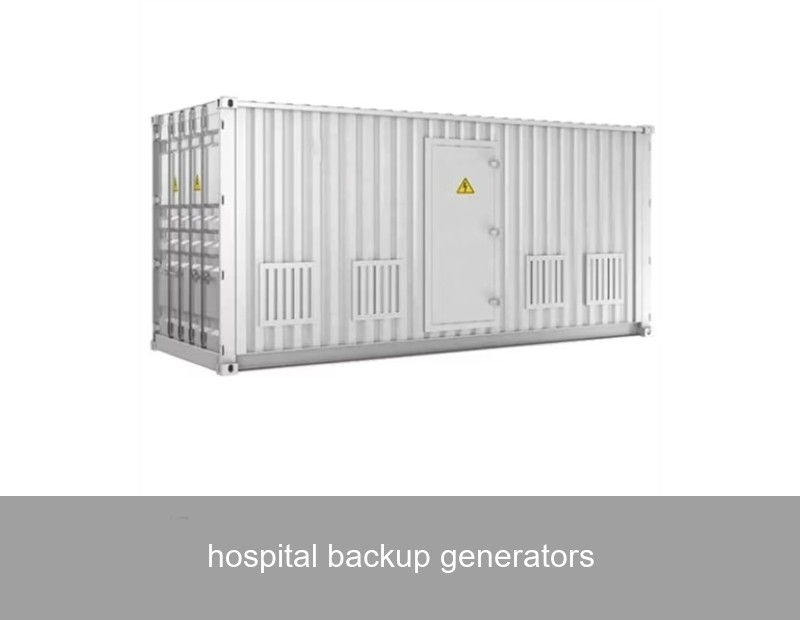
Our HPS (Highjoule PowerStack) Commercial & Industrial Series is engineered for mission-critical environments like hospitals. These modular, containerized or indoor-rated systems feature:
- Ultra-Fast Response: Sub-20 millisecond transition times ensure no break in power for the most sensitive loads.
- N+1 Redundancy Design: Critical components like inverters and battery management systems are built with redundancy, eliminating single points of failure within the storage system itself.
- Advanced Thermal Management: Our proprietary cooling systems ensure optimal battery performance and longevity, even in demanding hospital mechanical rooms.
- Grid-Services Ready Platform: The same system that backs up your MRI suite can be programmed to participate in utility demand response programs, generating income or credits for the facility.
Our approach is consultative. We work with hospital engineering teams to conduct detailed load audits, design a hybrid system that meets specific backup duration requirements (e.g., 30 minutes for generator bridge, 2 hours for full coverage), and ensure seamless integration with existing switchgear and generator controls.
Case Study: A European Hospital's Transition to a Hybrid System
Let's examine a real-world application. A 300-bed regional hospital in Southern Germany faced a mandate to reduce its carbon footprint while upgrading its aging emergency power infrastructure. Their diesel generators were reliable but noisy, emitted high NOx levels, and were due for a major overhaul.
The Challenge: Achieve 99.99% power availability for critical loads, reduce diesel runtime by at least 70% annually, and integrate a new rooftop solar PV array.
The Highjoule Solution: A 1.2 MWh HPS system was installed parallel to two existing 1 MW diesel generators. The BESS was configured to carry the entire critical load block (450 kW) for up to 90 minutes and to act as the instantaneous buffer for all outages.
| Metric | Before Hybrid System | After Hybrid System (12 Months) |
|---|---|---|
| Generator Starts/Runtime | 48 tests + 3 real outages (~55 hrs/yr) | 12 tests + 3 outages (~15 hrs/yr) |
| Diesel Fuel Consumption | 22,000 liters/year | 6,200 liters/year (72% reduction) |
| CO2e Emissions from Backup | ~58 metric tons/year | ~16 metric tons/year |
| Peak Demand Charges | Baseline | 18% reduction via peak shaving |
| Solar PV Self-Consumption | N/A | Increased from 35% to over 80% |
The result? The hospital now has a faster, more reliable backup system that significantly cuts costs, emissions, and noise. The BESS also manages the solar PV output, storing excess daytime energy for use during evening peaks or overnight backup, maximizing their renewable investment. This case exemplifies the modern hospital backup generator paradigm: a silent, smart, hybrid partner.

Image Source: Unsplash - Modular battery systems allow for clean, scalable installation in existing hospital facilities.
Future-Proofing Your Hospital's Energy Resilience
The journey towards a more resilient and sustainable energy infrastructure doesn't have to be a leap into the unknown. It's a strategic evolution. For facility managers, CFOs, and sustainability officers, the question is no longer just "Do we have backup?" but "How intelligent, efficient, and future-ready is our backup?"
Integrating a BESS with your existing generators creates a multi-benefit asset. It protects your most critical operations from any power anomaly, defers future generator capital expenses by reducing their wear, and turns your energy infrastructure into a tool for cost management and sustainability reporting.
As grid instability seems to increase and the push for decarbonization accelerates, hospitals have a unique opportunity to lead. Your energy strategy is directly tied to patient care, community trust, and operational excellence.
What's the first load in your hospital that absolutely cannot tolerate even a one-second power loss, and how are you protecting it today?
We invite you to start that conversation. Highjoule's team of experts is ready to help you analyze your current EPSS and explore a tailored path to modern, hybrid resilience. The future of hospital power isn't just about staying on; it's about moving forward, silently and surely.
 Inquiry
 Online Chat