


Can Electricity Be Stored in the Grid? Unlocking the Future of Power
You flip a switch, and the light comes on instantly. This everyday miracle relies on a delicate, real-time balance: at any given second, the amount of electricity generated must exactly match the amount consumed. For over a century, this meant treating electricity as a perishable commodity. But what if we could change that? What if we could, in essence, store electricity directly in the grid? The answer is not just a theoretical "yes," but a technological revolution already reshaping our energy landscape. As we integrate more variable renewable sources like solar and wind, the question of storage transforms from an engineering curiosity into the cornerstone of a sustainable, resilient, and efficient power system. Let's explore how modern grid-scale energy storage makes this possible.
Table of Contents
The Grid Storage Paradox: Why We Can't Just "Fill Up the Wires"
It's a common misconception: we imagine the grid as a vast network of pipes, thinking we could simply pump extra electricity in and let it sit there until needed. Unfortunately, the physics of alternating current (AC) electricity doesn't work that way. Electrical energy in transmission lines is in a constant state of motion; it's not a static substance like water in a tank. Attempting to "store" it directly in the cables would result in massive losses, voltage instability, and system failure.
For decades, grid operators used a clever workaround: storing energy in other forms. The most common method has been pumped hydro storage. When there's excess electricity (often at night), it's used to pump water uphill to a reservoir. When demand peaks, the water is released downhill through turbines to generate electricity again. It's effective but geographically limited and environmentally intrusive. So, the hunt for a more flexible, scalable solution was on.

Image Source: Unsplash - Renewable energy integration demands advanced grid storage solutions.
The Modern Answer: Battery Energy Storage Systems (BESS)
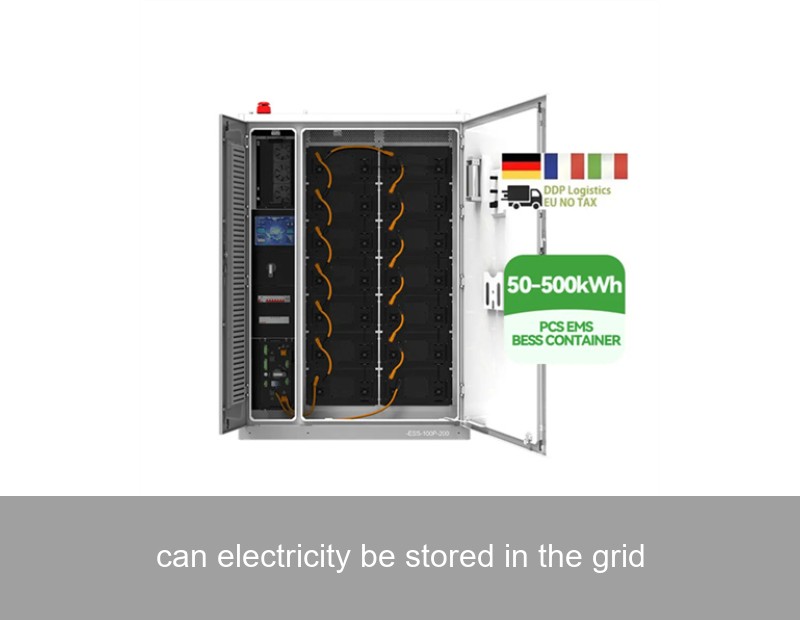
This is where the 21st-century answer emerges. We can store electricity for the grid, not in the wires themselves, but in massive, grid-connected Battery Energy Storage Systems (BESS). Think of them as the grid's "shock absorbers" and "power banks." These systems convert electrical energy into chemical energy during periods of low demand or high renewable generation, store it safely, and then convert it back to electrical energy on command within milliseconds.
Here’s how BESS is revolutionizing grid operations:
- Frequency Regulation: The grid must maintain a constant frequency (e.g., 60 Hz in the US, 50 Hz in Europe). BESS can inject or absorb tiny amounts of power almost instantly to correct frequency deviations, a task traditional power plants are too slow to handle perfectly.
- Renewable Firming & Ramp Control: When a cloud passes over a solar farm, output can drop sharply. BESS can discharge to "fill the gap," smoothing out the power supply and making solar and wind behave more like predictable conventional plants.
- Peak Shaving (Load Shifting): Instead of firing up expensive and polluting "peaker plants" during high-demand evenings, utilities can discharge stored energy from batteries charged by midday solar power.
- Grid Resilience & Black Start: In an outage, BESS can provide critical backup power and even help restart larger power plants, a capability known as black start.
Real-World Impact: A California Case Study in Grid Stability
Let's move from theory to hard data. California, a leader in renewable adoption, faced a well-publicized challenge in the summer of 2020: rolling blackouts during an extreme heatwave. The state's grid operator, CAISO, identified the need for rapid, flexible resources to complement its growing solar fleet.
The response was a historic acceleration of BESS deployment. By the end of 2023, California's grid-scale battery storage capacity had soared to over 7,300 megawatts (MW)—enough to power millions of homes for several hours. During a critical September 2022 heatwave, these batteries played a starring role. On the evening of September 6th, when solar generation dropped and demand remained high, batteries supplied a record 3,360 MW to the grid, effectively acting as the state's second-largest power source during that crucial window and preventing service interruptions. This wasn't just backup power; it was a fundamental, real-time reshaping of the grid's resource mix. You can explore the official data from CAISO on their Today's Outlook page to see live and historical contributions of storage.
Highjoule's Role: Intelligent Storage for a Smarter Grid
At Highjoule, we don't just see batteries as containers; we see them as intelligent nodes in a dynamic energy network. Founded in 2005, our mission has been to provide the smart, efficient hardware and software that turns the concept of grid storage into a reliable, daily reality for utilities, businesses, and communities.
Our GridMAX utility-scale BESS platform is engineered for durability, safety, and maximum cycle life. It's more than a battery; it's a fully integrated solution with advanced thermal management and our proprietary ENERGY OS control software. This software is the true brain, allowing grid operators to seamlessly stack multiple value streams: one minute it can be performing fast frequency response for the national grid, and the next it can be discharging to defer a costly substation upgrade.

Image Source: Unsplash - Intelligent control systems optimize grid storage performance and value.
For commercial and industrial (C&I) applications, our PowerHub solutions enable businesses to take control. By storing electricity when rates are low or when on-site solar is over-producing, companies can drastically reduce their demand charges and protect against outages. This directly answers the core question: yes, electricity can be stored for your specific part of the grid, delivering economic and operational resilience.
Our expertise extends to designing microgrids—self-sufficient energy islands that can disconnect from the main grid. These systems, often combining solar, storage, and backup generation, are the ultimate proof of concept for stored electricity, providing continuous, clean power for campuses, hospitals, and remote communities. Learn more about microgrid technologies from the U.S. Department of Energy here.
The Future of Grid Storage: Beyond the Battery
While lithium-ion batteries dominate today's conversation, the future of grid storage is wonderfully diverse. Each technology answers the "can we store it?" question in a unique way, suited for different durations and scales.
| Technology | Mechanism | Potential Grid Role | Duration Scale |
|---|---|---|---|
| Flow Batteries | Energy stored in liquid electrolytes | Long-duration storage (4-12+ hours), renewable integration | Hours to Days |
| Compressed Air (CAES) | Uses excess power to compress air in underground caverns | Large-scale, long-duration bulk energy management | Hours to Days |
| Green Hydrogen | Electrolysis using renewable power to create hydrogen gas | Seasonal storage, decarbonizing heavy industry & transport | Days to Months |
| Gravity Storage | Using power to lift massive weights, generating power when lowered | Long-duration, low-cost storage with minimal location constraints | Hours |
The innovation frontier is vibrant. For a deep dive into emerging long-duration storage tech, research institutions like NREL provide ongoing analysis.
So, can electricity be stored in the grid? Absolutely. It's no longer a matter of "if" but "how well." The integration of intelligent storage systems is the key to unlocking a grid that is not only cleaner but also more robust and intelligent than ever before. It enables us to truly harness the power of the sun and wind, making their bounty available on demand, day or night.
What specific challenge is your business or community facing—is it volatile energy costs, unreliable power, or a sustainability target that seems just out of reach? The solution likely starts with asking how stored electricity could work for you.
 Inquiry
 Online Chat