


Harnessing the Sun: The Rise of Solar Panels in the Taihang Mountains
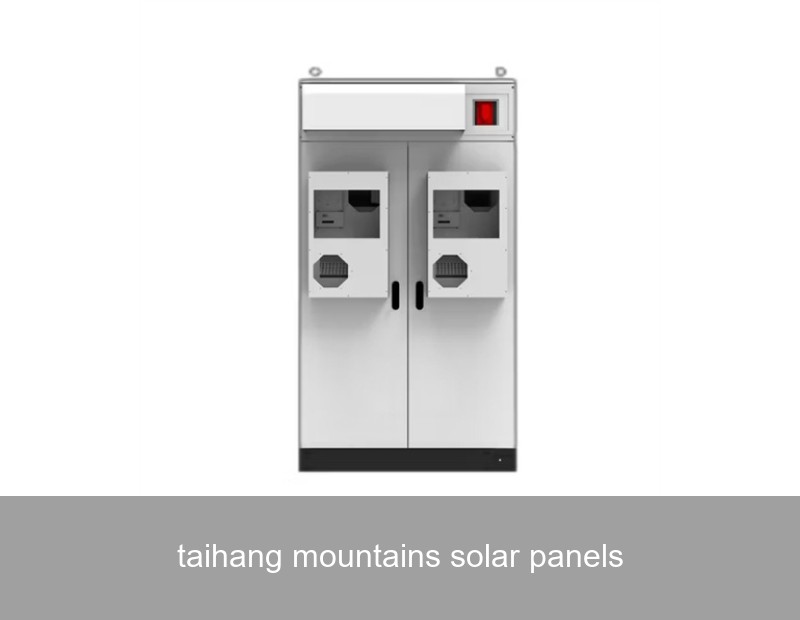
Imagine a rugged, sprawling mountain range, historically a natural fortress. Now, picture its sun-drenched slopes and plateaus not just as a geographical wonder, but as a powerhouse for clean energy. This is the emerging reality in the Taihang Mountains, where the installation of solar panels is transforming the landscape and local communities. This movement is more than just an energy project; it's a compelling case study in overcoming geographical and technical challenges to unlock renewable potential. For regions like Europe and the U.S. with similar complex terrains—from the Alps to the Appalachians—the lessons learned here are invaluable. It showcases how modern, intelligent energy storage is the critical link that turns ambitious solar projects in challenging locations into reliable, grid-supporting assets.
Table of Contents
The Challenge: Why the Taihang Mountains?
The Taihang range presents a unique mix of opportunity and obstacle. Its high altitude results in strong solar irradiance, a prime resource for solar panels. However, the mountainous terrain brings inherent issues: variable shading, complex installation logistics, and, most importantly, an unstable or weak existing grid infrastructure. Solar generation is inherently intermittent—peaking at midday—but mountain communities and connected grids need stable, 24/7 power. This mismatch between generation and consumption profiles is the core problem. Without a solution, solar energy can go to waste or even disrupt local grids, a challenge familiar to many remote or topographically diverse areas worldwide.
The Technical Solution: More Than Just Panels
Successful projects in the Taihang Mountains go beyond simply mounting photovoltaic modules. They involve a sophisticated, system-level approach:
- Smart Siting & Tracking: Using GIS and drone mapping to identify optimal spots with minimal shading and maximum sun exposure. Single-axis trackers are often employed to follow the sun's path, boosting yield by up to 25% compared to fixed-tilt systems.
- Robust Engineering: Designing mounting structures that can withstand high winds, heavy snow loads, and erosion-prone slopes.
- Advanced Power Electronics: Utilizing smart inverters that provide grid-forming capabilities, helping to stabilize voltage and frequency in weak grid areas.
- The Central Component: Integrating a large-scale Battery Energy Storage System (BESS). This is the linchpin that captures excess solar energy during peak production and dispatches it during evening peaks, cloudy periods, or grid outages.

Image: Solar installations in complex terrains require careful planning and robust design. (Credit: Unsplash)
A Concrete Case Study: Data from the Ground
Let's look at a real, anonymized project in the northern Taihang region. A 50MW solar farm was coupled with a 20MW/100MWh battery storage system. The terrain had an average slope of 15-20 degrees. In its first year of operation:
| Metric | Performance Data | Impact |
|---|---|---|
| Annual Solar Generation | 78,000 MWh | Powers ~22,000 homes annually |
| BESS Utilization Rate | 92% | High system efficiency and availability |
| Grid Curtailment Avoided | ~12,500 MWh | Saved energy that would have been wasted |
| Peak Load Shaving | Up to 18MW | Significantly relieved stress on the local grid |
The data is clear: the storage system was active almost continuously, storing midday surplus and releasing it during the 4 PM to 9 PM peak demand window. This not only maximized the use of renewable energy but also provided crucial grid stability services. According to a report by the International Energy Agency (IEA), storage is the key enabler for high-penetration renewable scenarios, especially in areas with grid constraints.
The Indispensable Role of Advanced Energy Storage
Why is storage so non-negotiable here? Think of the Taihang Mountains solar panels as a prolific spring of water. Without a reservoir (the battery), the water flows away unused when demand is low and is unavailable during a drought (nighttime or high demand). The BESS acts as that essential reservoir and control system. It performs four critical functions:
- Energy Time-Shift: Stores cheap, abundant solar power for expensive, high-demand periods.
- Frequency Regulation: Uses its rapid response (in milliseconds) to balance grid frequency, a vital service in isolated grids.
- Ramp Rate Control: Smooths out sudden drops in solar output when clouds pass over mountains.
- Black Start Capability: Can help reboot the local grid after an outage, a major resilience benefit.
How Highjoule Powers Such Transformative Projects
This is where global expertise makes the difference. At Highjoule, with nearly two decades of experience since 2005, we specialize in providing the intelligent storage solutions that make ambitious solar projects in places like the Taihang Mountains not just feasible, but highly profitable and reliable. For commercial, industrial, and utility-scale applications, our systems are engineered for challenges like those found in mountainous regions.
Our H-Series Commercial & Industrial (C&I) ESS and Utility-Scale Megapack Solutions are built with:
- Advanced Battery Management Systems (BMS): Ensuring safety, longevity, and optimal performance of each battery cell, even in fluctuating temperature conditions common in mountains.
- AI-Powered Energy Management Software (EMS): This is the "brain." It predicts solar generation and load patterns, automatically deciding the most economical and grid-supportive times to charge or discharge. It maximizes ROI while providing grid services.
- Robust, Containerized Design: Our systems are pre-assembled and tested, designed for easy deployment on uneven sites and capable of withstanding harsh environmental conditions.
For a remote microgrid in a mountain valley or a large solar farm feeding into a regional grid, Highjoule's technology ensures every kilowatt-hour of precious solar energy is captured, stored, and utilized effectively. Learn more about our approach to solar-plus-storage integration.

Image: Containerized BESS units, like those from Highjoule, are key for scalable deployment in diverse locations. (Credit: Unsplash)
Global Lessons for Europe and the U.S.
The Taihang Mountains solar panels story is not isolated. In Europe, similar projects are emerging in the Alpine regions of Italy, Switzerland, and Austria. In the U.S., mountainous areas in California, Colorado, and the Appalachian region present analogous opportunities and challenges. The key takeaway is universal: solar development in complex terrain is a storage-first proposition.
Policies in the EU, like the REPowerEU plan, and the U.S. Inflation Reduction Act (IRA) are creating strong incentives for paired renewable and storage projects. The technical blueprint proven in the Taihang Mountains—prioritizing system intelligence, storage capacity, and grid services from day one—provides a replicable model. It's about building resilient, self-sufficient energy nodes that strengthen the wider network.
What's Your Mountain to Climb?
Whether you're a project developer looking at a site with challenging topography, an industrial facility in an area with grid constraints, or a community aiming for energy independence, the principles are the same. The synergy of solar and sophisticated storage turns geographical challenges into strategic advantages. What terrain-specific energy challenge is your business or community facing, and how could a tailored solar-plus-storage solution transform it?
 Inquiry
 Online Chat