


Perovskita Solar Cells: The Game-Changer for Your Energy Independence?
Imagine a solar panel. You're likely picturing the classic, rigid blue or black silicon rectangle on a rooftop. But what if the future of solar power is thin, lightweight, flexible, and could be printed like newspaper? Enter the perovskite solar cell, a technology creating seismic waves in the renewable energy sector. For homeowners and businesses across Europe and the U.S., this isn't just lab talk; it's the promise of a more accessible, efficient, and integrable solar future. But how does this emerging tech fit into your real-world energy strategy today? Let's demystify the phenomenon, examine the data, and explore what it means for powering your world.
Table of Contents
- What Exactly is a Perovskite Solar Cell?
- Why the Hype? The Staggering Potential
- From Lab to Rooftop: A European Case Study
- The Road Ahead: Stability and Scaling Challenges
- Your Energy System Today: Smart Integration is Key
- Highjoule: Bridging Today's Storage with Tomorrow's Generation
What Exactly is a Perovskite Solar Cell?
Let's break down the name. "Perovskite" refers not to a single material, but to a crystal structure, named after a 19th-century Russian mineralogist. This structure can be formed using abundant, low-cost materials, some even from printing industry processes. The magic lies in how efficiently this thin film converts sunlight into electricity.
Think of it this way: traditional silicon solar cells are like a thick, heavy encyclopedia – highly effective but resource-intensive to produce. A perovskite solar cell is more like a lightweight, ultra-efficient magazine – it can be manufactured with less energy, on flexible surfaces, and its "light-absorbing" layer can be 200 times thinner than a human hair. This opens doors to applications previously unthinkable: solar windows, vehicle-integrated panels, and even portable chargers for backpacks.

Image Source: Unsplash (Representative image of advanced solar materials)
Why the Hype? The Staggering Potential
The excitement in research circles is palpable, and it's backed by hard numbers. In just over a decade, the laboratory efficiency of perovskite solar cells has skyrocketed from around 3% to over 25%, matching the performance of silicon cells that have had 60 years of development. Some tandem cells, which layer perovskite on top of silicon, have breached the 33% efficiency mark in controlled settings.
Here’s a quick comparison of the key advantages:
| Feature | Traditional Silicon (PV) | Perovskite Solar Cell |
|---|---|---|
| Manufacturing Process | Energy-intensive, high-temperature | Potentially low-temperature, solution-based (e.g., printing) |
| Weight & Flexibility | Heavy, rigid | Lightweight, flexible |
| Efficiency Growth Pace | Steady, incremental | Exceptionally rapid |
| Potential Applications | Primarily rooftop & solar farms | Building facades, windows, consumer electronics, vehicles |
This data points to a future with dramatically lower levelized cost of electricity (LCOE) from solar and ubiquitous solar integration. The National Renewable Energy Laboratory (NREL) efficiency chart vividly tracks this unprecedented rise.
From Lab to Rooftop: A European Case Study
While mass commercialization is still underway, pilot projects are proving the concept. A compelling example comes from Oxford PV, a spin-off from the University of Oxford. In 2022, they announced the installation of their perovskite-on-silicon tandem solar panels on a residential home in the Bavarian town of Bischofswiesen, Germany.
The Project & Data: The home was fitted with a standard-sized rooftop array using these next-generation tandem panels. Initial performance data indicated the system achieved a consistent power conversion efficiency significantly higher than the best-in-class pure silicon panels on the market. Over a year, this translated to an estimated 15-20% more energy generation from the same roof area. For the homeowner, this means greater self-consumption of solar power and reduced grid dependence, a critical factor given Europe's energy price volatility.
This case is a tangible signpost. It demonstrates that perovskite-enhanced solar is transitioning from controlled labs to real-world, variable climates, delivering on its promise of higher energy yield. You can read more about such industry advancements from authoritative sources like the Journal of Joule.
The Road Ahead: Stability and Scaling Challenges
Now, let's address the elephant in the room. If perovskites are so great, why aren't they everywhere? The primary hurdles are long-term stability and manufacturing scale-up.
- Stability: Early perovskite materials degraded quickly when exposed to continuous moisture, heat, and light—not ideal for a 25-year rooftop product! However, recent breakthroughs in encapsulation techniques and material engineering have shown dramatic improvements. Research cells now can withstand thousands of hours of accelerated aging tests, inching closer to commercial durability standards.
- Scaling: Printing a small, high-performance cell in a glovebox is one thing. Producing football-field-sized sheets of it with uniform, high quality is another. Companies are now investing in pilot production lines to solve this challenge.
So, should you wait for perovskite panels? For most projects today, the answer is no. The current silicon-based solar market offers proven, reliable, and warrantied technology. The smarter strategy is to build an energy system that is ready for future technological upgrades.
Your Energy System Today: Smart Integration is Key
Whether your solar panels are silicon today or perovskite tomorrow, their true value is unlocked not just by generation, but by intelligent management and storage. The sun doesn't always shine, and peak generation often doesn't match peak consumption. This is where the core expertise of companies like Highjoule becomes critical.
Think of it this way: a more efficient solar panel captures more energy "harvest." But without a proper "granary," that harvest can spoil (be exported to the grid at low value) or go to waste. A smart battery storage system is that granary, and the energy management software is the savvy farm manager.
Highjoule: Bridging Today's Storage with Tomorrow's Generation
At Highjoule, we've been at the forefront of advanced energy storage since 2005. While we eagerly watch the perovskite revolution unfold, our focus is on providing the indispensable backbone for any high-performance solar installation: intelligent, safe, and durable battery storage systems.
Our product philosophy aligns perfectly with the future that perovskite promises. For instance, our H-Joule Quantum Series for residential and commercial use is designed for high energy density and seamless integration. As solar panels become more efficient per square meter, you need a storage system that can efficiently capture and hold that increased yield. Our systems feature:
- Advanced Battery Management Systems (BMS): Ensuring safety and maximizing battery lifespan, crucial for protecting your investment.
- AI-Powered Energy Management: Our software doesn't just store energy; it learns your consumption patterns, weather forecasts, and utility rates to autonomously optimize when to store, use, or sell energy.
- Scalable Architecture: Start with what you need and expand capacity as your energy needs grow or as you add more solar generation in the future—be it silicon or perovskite.

Image Source: Unsplash (Representative image of a modern home energy system)
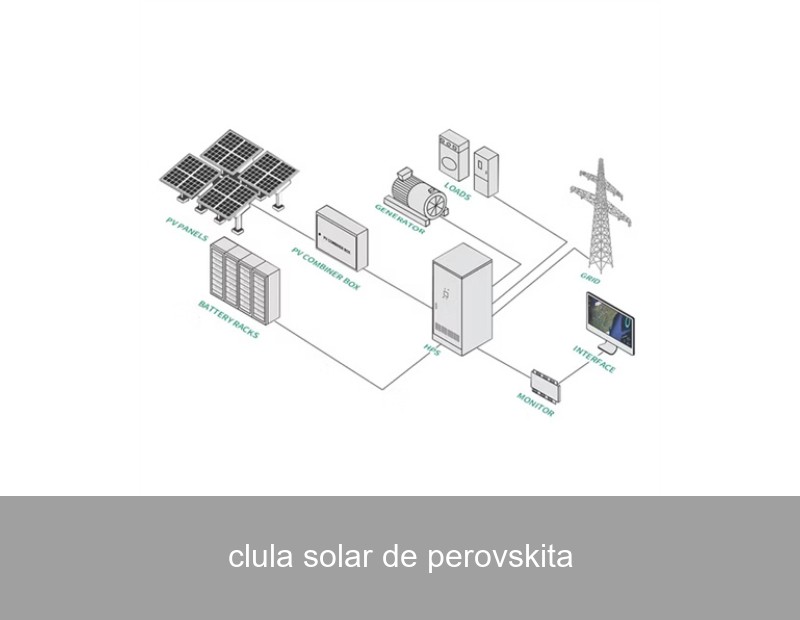
For a large-scale commercial or microgrid application, our H-Joule Matrix Platform takes this further, allowing the orchestration of multiple generation sources (solar, wind, gensets) with massive storage capacity. This creates true energy resilience and independence.
So, while perovskite cells work on capturing every possible photon, Highjoule's technology ensures not a single watt-hour of that captured energy is wasted. We make the most of your solar investment, today and tomorrow.
Looking Forward: Your Role in the Energy Transition
The journey of the perovskite solar cell is a thrilling reminder that energy technology never stands still. It underscores a broader principle: the optimal path to energy independence isn't chasing a single "magic bullet" technology, but building a smart, adaptive, and resilient system.
As you consider solar for your home or business, the key question isn't just "What panels should I choose?" but rather, "How do I build an energy ecosystem that can harness the best of today's technology while being ready to integrate the breakthroughs of tomorrow?"
 Inquiry
 Online Chat