


Beyond Panels: The Essential Components Required for a Solar Power System
So, you're thinking about harnessing the sun's power? That's fantastic. It's a common starting point: envisioning sleek, dark panels on the roof, quietly cutting your energy bills. But here's a little insider truth—the solar panels themselves, while the most visible part, are just one piece of a much larger puzzle. A reliable, efficient, and safe solar installation is an integrated ecosystem of specialized components. Understanding the full list of components required for a solar power system is the difference between just having panels and owning a robust, long-term energy asset. Let's pull back the curtain and explore what truly makes a solar system tick, and how choosing the right parts from the start defines your energy independence for decades.
Image: A complete solar installation involves precise mounting and wiring, not just the panels. Source: Unsplash
The Core Components: Your Solar System's Anatomy
Think of a solar power system like a human body. The panels are the "muscles," capturing raw energy. But they need a "brain" to process it, a "skeleton" to hold them up, and a "nervous system" to distribute the power. Missing any part compromises the whole. Here’s the breakdown of the essential components required for a solar power system.
1. Solar Panels (PV Modules)
These are the iconic components that convert sunlight into direct current (DC) electricity. The market primarily offers three types:
- Monocrystalline: High efficiency (20%+), space-efficient, with a uniform dark look. Ideal for roofs with limited space.
- Polycrystalline: Slightly lower efficiency (15-17%), more affordable, with a blue, speckled appearance.
- Thin-Film: Flexible and lightweight, but lower efficiency. Often used for large commercial roofs or unique applications.
Your choice here impacts not just aesthetics, but the total energy yield and the physical layout of your entire system.
2. Solar Inverters: The System's Brain
This is arguably the most critical component after the panels. Your home and the grid run on alternating current (AC), but panels produce DC. The inverter's job is this crucial conversion. There are three main types:
| Inverter Type | How It Works | Best For |
|---|---|---|
| String Inverter | Connects a series ("string") of panels to one central inverter. | Simple roofs with consistent, unshaded sunlight. |
| Microinverters | A small inverter attached to each individual panel. | Rooms with shading or multiple roof planes; offers panel-level monitoring and optimization. |
| Power Optimizer Systems | Panel-level DC optimization paired with a central inverter. | Similar benefits to microinverters, often with different cost and efficiency trade-offs. |
This decision directly affects your system's efficiency, monitoring capabilities, and resilience. For instance, with a traditional string inverter, shade on one panel can drag down the performance of the entire string—a problem microinverters and optimizers solve.
3. The Critical Role of Racking and Mounting
This is the skeleton. It's not just "metal brackets." A high-quality racking system:
- Securely anchors panels to your roof or the ground, capable of withstanding decades of wind, snow, and weather cycles.
- Allows for precise angle and orientation adjustment to maximize sun exposure.
- Provides crucial airflow under the panels, which prevents overheating and efficiency loss.
Compromising on racking can lead to roof damage, poor performance, or even system failure during extreme weather.
4. The Unsung Hero: DC and AC Electrical Components
This is the nervous system, safely connecting everything. Key parts include:
- DC/AC Disconnects: Safety switches that allow firefighters or technicians to isolate the system.
- Combiner Boxes: Where multiple panel strings are brought together before reaching the inverter.
- Conduit & Wiring: Weatherproof, UV-resistant cabling rated for outdoor use.
- Monitoring System: Hardware and software that lets you track your system's energy production in real-time, often via a smartphone app.
Using subpar electrical components is a significant safety hazard and a common point of failure.
The Game-Changer: Adding Storage to the Mix
Now, let's talk about the modern evolution of the solar system. A traditional "grid-tied" system shuts off during a blackout for safety reasons. To achieve true energy resilience, you need to add one more pivotal component: a battery energy storage system (BESS).
This transforms your setup from a daytime-only generator to a 24/7 personal power plant. When your panels produce more than you use, the excess charges the battery instead of just going to the grid. At night, during outages, or during peak utility rate periods, you draw from your stored energy. This is where integrated system design becomes paramount. The battery must communicate flawlessly with the inverter and the overall energy management system.
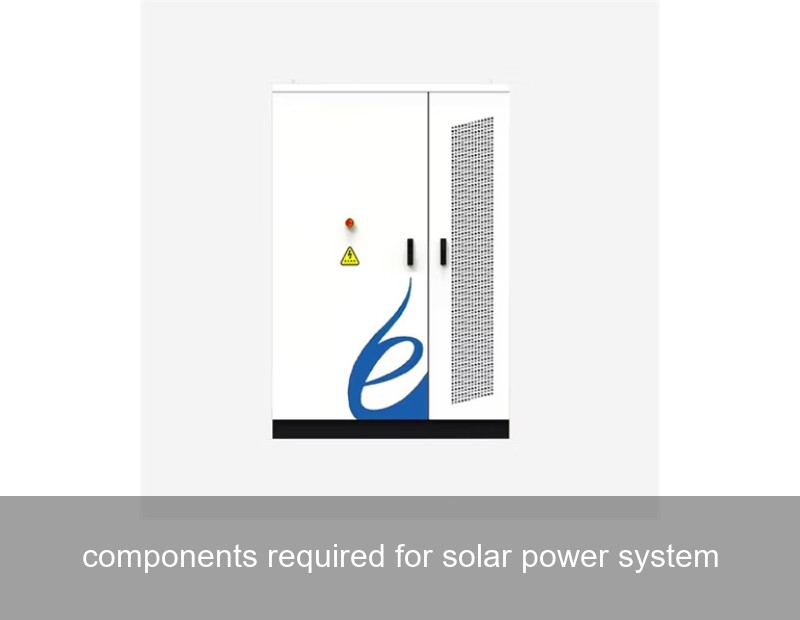
This is a core expertise of Highjoule. As a global leader in advanced energy storage since 2005, we don't just supply batteries; we provide intelligent, integrated storage solutions. Our Highjoule HES Series for residential and commercial applications is designed with this synergy in mind. It features advanced lithium-iron-phosphate (LiFePO4) chemistry for safety and longevity, seamless integration with leading solar inverters, and an intelligent energy management system that learns your usage patterns to maximize self-consumption and savings. For us, the battery isn't an add-on; it's the central component that unlocks the full potential of all the other components required for a solar power system.

Image: A modern home battery storage unit, enabling energy independence. Source: Unsplash
Case Study: From Components to Confidence in California
Let's look at a real-world example where component choice, especially storage, made all the difference. A medium-sized winery in Sonoma County, California, faced two challenges: rising operational costs from grid power and an increasing threat of preemptive power shutoffs (PSPS events) during wildfire season, which could ruin temperature-sensitive fermentation processes.
Their previous solar setup lacked storage, leaving them vulnerable. They partnered with an installer using Highjoule's integrated solution. The system included:
- High-efficiency monocrystalline panels (145 kW).
- A robust commercial string inverter platform with power optimizers to handle partial shading from structures.
- A Highjoule HES Commercial 100 kWh battery storage system.
- An advanced energy management system that prioritized critical loads.
The Result? The system now covers 85% of the winery's annual energy needs. More critically, during a 36-hour grid outage, the battery seamlessly kicked in, keeping the refrigeration, critical lighting, and security systems online without interruption, preventing an estimated $40,000 in product loss. The winery's manager noted, "The solar panels are great for saving money, but the Highjoule battery is what gives us peace of mind. It turned our solar array from a cost-saver into a business continuity asset." (Data on California PSPS events can be referenced via the California Energy Commission).
Choosing Your Components: Quality and Compatibility are Key
As you can see, the magic isn't in any single component, but in how they are engineered to work together harmoniously for 25+ years. When evaluating proposals, look beyond the cost-per-panel. Ask your installer:
- What is the system-level efficiency, not just the panel efficiency?
- How does the inverter technology match my roof's specific conditions (shade, multiple angles)?
- Are the mounting and electrical components from reputable manufacturers with long warranties?
- Is the system "storage-ready" or designed with a future battery in mind?
This is the holistic approach Highjoule advocates for. Our smart storage solutions are designed to be the perfect complement to a high-quality solar ecosystem, ensuring every kilowatt-hour you produce is used intelligently.
Given that the performance of each component relies on the others, what specific question will you ask your solar installer first to ensure your system is designed for both today's savings and tomorrow's resilience?
 Inquiry
 Online Chat