


Finding Truly Cost Effective Solutions: A Guide for Your Energy Transition
As a business leader or project developer, you hear the term "cost effective solutions" constantly. But in the world of energy, especially when integrating renewables and storage, what does it truly mean? Is it just the lowest upfront price, or is it a smarter calculation that considers long-term value, resilience, and total cost of ownership? This article cuts through the noise. We'll explore how a strategic approach to battery energy storage systems (BESS) delivers genuine, long-term cost effectiveness for commercial, industrial, and utility-scale applications, particularly in markets like Europe and the US where energy volatility is a pressing concern.
Table of Contents
- The Real Cost Puzzle: Beyond the Price Tag
- Data Tells the Story: The Financial Mechanics of Modern BESS
- Case Study: Illuminating Savings for a European Industrial Plant
- Highjoule: Architecting Value-Driven, Cost Effective Solutions
- Future-Proofing Your Investment: Key Considerations
The Real Cost Puzzle: Beyond the Price Tag
The initial quote for an energy storage system can be startling. It's easy to see it as a large capital expense. However, this view misses the broader financial picture. A genuinely cost effective solutions strategy transforms that capex into a revenue-generating or cost-avoidance asset. Think about it: are you currently paying for grid connection upgrades due to increased demand? Are you exposed to peak demand charges that skyrocket your monthly bills? Do you have solar PV that's exporting power at low prices, only to buy it back later at a premium? These are the real costs that a well-designed BESS tackles head-on.

For over 18 years, Highjoule has partnered with clients to shift this mindset. We don't just sell battery containers; we deliver intelligent energy platforms that perform multiple value streams simultaneously, turning your energy infrastructure from a cost center into a strategic advantage.
Data Tells the Story: The Financial Mechanics of Modern BESS
Let's get concrete. The economics are driven by software intelligence and hardware reliability. Here’s a breakdown of how a system pays for itself:
- Demand Charge Management: This is often the fastest payback. In many US commercial tariffs, just 15-30 minutes of peak usage sets a "demand charge" for the entire month. A BESS discharges during these short peaks, shaving the maximum demand and slashing that fee, often by 20-40%.
- Energy Arbitrage: Buy low, use high. The system charges from the grid or your solar panels when prices are low (often at night or midday) and discharges when grid prices are high (evening peaks). In markets like the German or UK day-ahead markets, price spreads are widening, making this increasingly lucrative.
- Backup Power & Resilience: The cost of a single outage for a data center, factory, or hospital can be astronomical. A BESS provides seamless transition to backup power, insuring against losses that far exceed the system's cost.
- Grid Services & Revenue: In many regions, system operators pay for frequency regulation, voltage support, and capacity. An aggregated fleet of smart BESS units can participate in these markets, generating direct revenue. According to a 2023 NREL report, value stacking multiple applications is critical to achieving attractive project economics.
When you stack these value streams, the equation flips. The question becomes not "Can we afford this storage system?" but "Can we afford not to have this financial and operational buffer?"
Case Study: Illuminating Savings for a European Industrial Plant
Let's look at a real-world application. A large manufacturing plant in Northern Italy faced a dual challenge: spiraling energy costs and a corporate mandate to reduce carbon footprint. Their existing 2 MW rooftop solar array was underutilized, often facing curtailment during low-price hours.
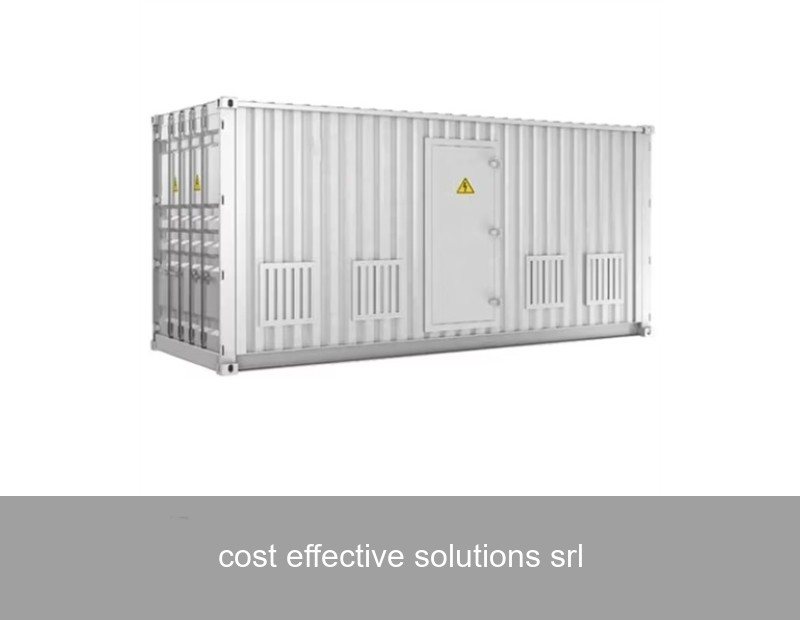
Highjoule implemented a cost effective solutions package centered on our H-Joule Cube, a containerized, all-in-one BESS with integrated energy management system (EMS). The 1.5 MWh / 750 kW system was configured for three primary functions:
- Store excess solar generation for use during evening production shifts.
- Discharge precisely during the 30-minute window each month that determined the plant's peak demand charge.
- Provide scheduled backup for critical process lines.
| Metric | Before Highjoule BESS | After Highjoule BESS Implementation |
|---|---|---|
| Monthly Demand Charge | €18,500 (avg) | €11,200 (avg) - 40% reduction |
| Solar Self-Consumption | ~35% | ~89% |
| Grid Energy Purchase (Peak Hours) | ~25 MWh/month | ~8 MWh/month |
| Estimated Payback Period | N/A | 4.2 years |
The project, financed through a managed service agreement, required minimal upfront capital from the client. The ongoing savings now significantly outweigh the service fee, creating immediate positive cash flow. This is the essence of a true partnership in energy transition.
Highjoule: Architecting Value-Driven, Cost Effective Solutions
At Highjoule, we believe cost effectiveness is engineered from the first design sketch. Our approach is holistic:
- Needs-First Design: We analyze your load profiles, tariff structures, renewable assets, and resilience needs. Our H-Joule Nexus EMS is the brain that optimizes for your specific financial goals, not a generic preset.
- Technology Agnosticism: We select cell chemistry (LFP is our standard for safety and longevity) and system architecture based on your duty cycle and application, ensuring the right tool for the job.
- Full Lifecycle Support: Cost effectiveness degrades if the system fails. Our long-term performance guarantees, remote monitoring, and predictive maintenance ensure your asset delivers for its entire 15+ year lifespan. As noted by the Energy Storage News industry watch, operational excellence is the key to sustained returns.

For microgrids and larger utility-scale projects, our H-Joule GridStack platform offers modular, utility-grade storage that can be scaled seamlessly. Whether it's a C&I facility looking to control costs or a developer building a grid-scale storage park, the principle is the same: maximize lifetime value per dollar invested.
Future-Proofing Your Investment: Key Considerations
Choosing a partner is as crucial as choosing the technology. Here’s what to look for to ensure your solution remains cost effective for decades:
- Software Upgradability: Can the EMS receive updates to participate in new grid markets or adapt to new tariffs?
- Safety Certifications: Does the system carry full UL 9540 (US) or IEC 62933 (EU) certification? This affects insurance and long-term safety.
- Transparent Performance Modeling: Be wary of overly optimistic revenue projections. Ask for conservative, data-backed models using your actual historical data. Resources like the Lazard Levelized Cost of Storage analysis provide good independent benchmarks.
- Partnership Model: Does the provider offer flexible models, from outright purchase to managed services, to fit your financial strategy?
The energy landscape is shifting daily. A static system is a depreciating asset. An intelligent, adaptable platform from Highjoule is an appreciating one.
Ready to Redefine Your Cost Equation?
We've explored how genuine cost effectiveness in energy storage is a multi-layered value proposition, not a simple purchase price. It's about building a resilient, intelligent asset that works tirelessly to reduce your expenses and secure your operations. The data and case studies prove the model works. Now, we're curious: what single energy cost—be it demand charges, volatile wholesale prices, or the risk of outage—keeps you up at night, and how might rethinking your approach to storage change that calculus?
 Inquiry
 Online Chat