


Understanding the True Cost of Solar Panels in Kenya: A Smart Investment Guide
When you think about the cost of solar panels in Kenya, what's the first thing that comes to mind? For many homeowners and business leaders, it's the initial price tag. But the real story is much more exciting. It's about how that investment transforms into long-term energy independence, resilience against power outages, and significant savings. In a nation blessed with abundant sunshine, the conversation is shifting from "Can I afford it?" to "Can I afford not to have it?" Let's break down the real costs, the hidden value, and how pairing solar with intelligent storage is changing the game for Kenyan energy consumers.
Table of Contents
- The Price Puzzle: Breaking Down Upfront Solar Panel Costs in Kenya
- Beyond the Panels: The System Components That Define Your Investment
- The Storage Game-Changer: Why Batteries Are Key to Maximizing ROI
- A Real-World Case: Commercial Solar & Storage in Nairobi
- Calculating Long-Term Value vs. Short-Term Cost
- The Future of Energy in Kenya is Intelligent and Integrated
The Price Puzzle: Breaking Down Upfront Solar Panel Costs in Kenya
So, what are we actually looking at? As of 2024, the upfront cost of a solar panel system in Kenya can vary widely, typically ranging from KES 100,000 to over KES 2 million. Why such a broad range? It hinges on scale, quality, and technology. A simple rooftop system for a rural home might be at the lower end, while a comprehensive commercial or industrial installation with backup power will command a higher investment.
The key components driving this cost include:
- Solar Panels (Photovoltaic Modules): Prices are influenced by panel efficiency and type (monocrystalline is more efficient and slightly more costly than polycrystalline).
- Inverters: The heart of the system, converting DC solar power to usable AC power. Hybrid inverters, which can integrate batteries, are a popular choice for future-proofing.
- Mounting Structure & Cabling: Often overlooked, but crucial for safety, durability, and optimal panel angle to capture that Kenyan sun.
- Installation & Labor: Professional installation by certified technicians ensures system performance and longevity.
It's tempting to choose the lowest quote, but remember: the quality of components and installation directly impacts your system's lifespan and energy yield over 25+ years. A cheaper system that fails prematurely or underperforms is ultimately more expensive.
Beyond the Panels: The System Components That Define Your Investment
Thinking only about panels is like buying a car and only considering the wheels. The true value—and a significant portion of the cost of solar panels in Kenya—lies in the system's brain and brawn: the inverter and, increasingly, the battery storage system.
For regions experiencing grid instability or for businesses that operate into the evening, solar without storage only solves part of the problem. You generate power during the day, but what about at night or during cloudy periods? This is where the equation evolves. Adding a battery storage system allows you to:
- Store excess solar energy for use when the sun isn't shining.
- Provide seamless backup power during grid outages (a critical need in many parts of Kenya).
- Maximize self-consumption, drastically reducing reliance on the utility grid and diesel generators.
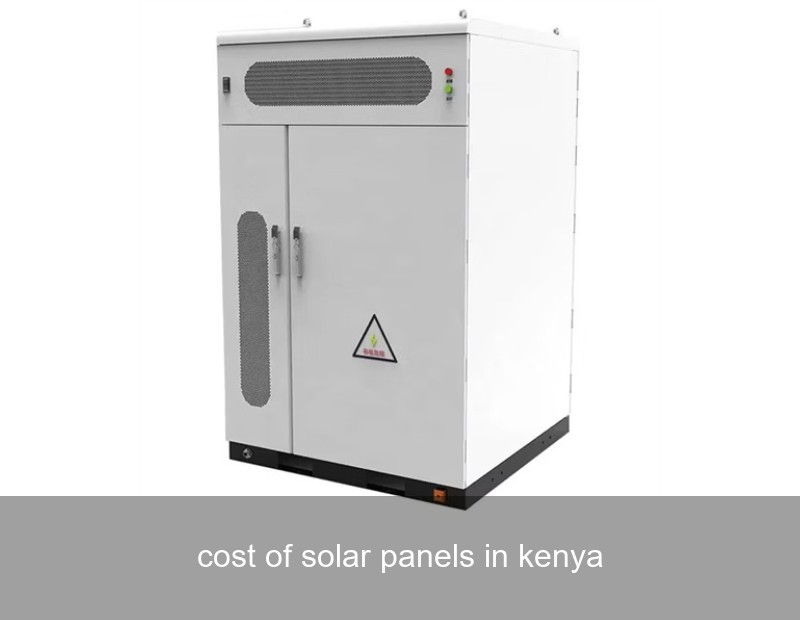
This integrated approach is where companies like Highjoule excel. As a global leader in advanced energy storage since 2005, we don't just sell batteries; we provide intelligent, integrated power solutions. Our Highjoule HPS Series for commercial and industrial applications is engineered for the Kenyan market's demands, offering high cycle life, robust thermal management, and smart software that optimizes energy flow between solar, battery, grid, and load.

Image Source: Unsplash - Representative image of commercial solar installation.
The Storage Game-Changer: Why Batteries Are Key to Maximizing ROI
Let's talk numbers in a different way. The traditional measure is the simple payback period on your solar panels. But with storage, the financial model becomes more powerful. You're not just saving on daytime electricity; you're avoiding the high cost of diesel generation during outages and potentially participating in future energy management schemes.
Modern lithium-ion battery systems, like those developed by Highjoule, are designed for thousands of deep cycles. This means the levelized cost of the stored energy (the cost per kWh over the system's life) becomes very competitive, especially compared to the volatile price of diesel. For a business, uninterrupted power can mean the difference between operational continuity and lost revenue.
Highjoule's Residential Energy Hub offers a similar advantage for homeowners. It seamlessly integrates with new or existing solar installations, providing clean backup power and allowing families to use more of their own solar production, increasing independence from the grid.
A Real-World Case: Commercial Solar & Storage in Nairobi
Let's ground this with a real example. A medium-sized Nairobi-based food processing company was facing two major challenges: high grid electricity costs (averaging KES 25/kWh) and debilitating daily power outages that disrupted refrigeration and production lines, forcing reliance on expensive diesel generators.
In 2023, they installed a 200 kWp solar PV system coupled with a Highjoule HPS-100 battery energy storage system (BESS) with 215 kWh of storage capacity. The results after one year:
| Metric | Result | Impact |
|---|---|---|
| Grid Electricity Consumption | Reduced by 78% | Direct savings on monthly bills |
| Diesel Generator Usage | Reduced by 95% | Savings on fuel & maintenance; lower carbon footprint |
| Power Availability | 24/7 for critical loads | Zero production stoppages due to outages |
| Estimated Payback Period | 4.2 years | Strong return on investment |
This case, documented in part by the International Energy Agency's Kenya outlook, illustrates that the combined cost of solar panels and storage in Kenya is an operational expenditure that pays for itself and then becomes a profit center through savings and reliability.
Calculating Long-Term Value vs. Short-Term Cost
When evaluating the cost of solar panels in Kenya, it's crucial to shift from a Capex (capital expenditure) mindset to a TCO (total cost of ownership) perspective. Consider these factors over a 20-year horizon:
- Rising Grid Tariffs: Utility prices have historically increased. Solar locks in your energy cost at near-zero for decades.
- Diesel Price Volatility: Global fuel markets are unpredictable. Solar and storage provide price certainty.
- System Lifespan & Warranty: High-quality panels have 25+ year performance warranties. Highjoule's BESS comes with a robust 10-year warranty, ensuring long-term performance.
- Environmental & Social Value: Contributing to Kenya's sustainable energy goals and reducing emissions has intrinsic value for brand reputation and compliance.
According to data from the International Renewable Energy Agency (IRENA), the levelized cost of electricity from solar PV in Africa is now among the lowest in the world, often outcompeting fossil fuels.

Image Source: Unsplash - Representative image of a technician inspecting an energy storage system.
The Future of Energy in Kenya is Intelligent and Integrated
The narrative around solar power in Kenya is maturing. It's no longer just an alternative; for many, it's the primary and most rational energy source. The next frontier is intelligent microgrids and virtual power plants, where distributed solar and storage systems, like those provided by Highjoule, can communicate and optimize energy flows across a community or industrial park.
Highjoule's Energy Management System (EMS) software turns a collection of solar panels and batteries into a smart, grid-responsive asset. This technology paves the way for future revenue streams, such as providing grid stabilization services, making the initial cost of solar panels in Kenya an investment into a dynamic energy asset.
So, the question we leave you with is this: When you evaluate your next electricity bill or calculate the cost of your next diesel delivery, what will it take for you to see that number not as an expense, but as the potential down payment on your own clean, reliable, and ultimately cheaper power plant?
 Inquiry
 Online Chat