


Demystifying the True Cost of a Storage Battery for Solar Panels
So, you've got solar panels on your roof, or you're planning to install them. You're generating clean energy, reducing your carbon footprint, and slashing those electricity bills. But there's a catch: the sun doesn't shine 24/7. That excess energy you produce at midday often gets sent back to the grid for a modest feed-in tariff, while you buy expensive power back in the evening. This is where adding a storage battery for solar panels becomes a game-changer. But the first question everyone asks is, "What's the real cost?" Let's move beyond the simple sticker price and explore what you're truly investing in.
Understanding the True Cost of a Storage Battery for Solar Panels
The initial purchase price of a battery system is just the tip of the iceberg. When we talk about the total cost of storage battery for solar panels, we need to consider the entire lifecycle value. Think of it like buying a car. You don't just pay the showroom price; you factor in fuel efficiency, maintenance, insurance, and resale value over 10 years. A cheap battery with a short lifespan and poor efficiency is a money pit, while a higher-quality system might have a greater upfront cost but save you significantly more over its lifetime.

Breaking Down the Cost Components
To make an informed decision, let's dissect the key elements that contribute to the overall expense.
1. Hardware and Installation Costs
- Battery Cells & Chemistry: Lithium-ion (Li-ion) dominates the market, but not all Li-ion is equal. Lithium Iron Phosphate (LFP) batteries, like those used in Highjoule's Residential PowerVault Series, often have a slightly higher upfront cost but offer superior safety, longer cycle life (often over 6,000 cycles), and better thermal stability, leading to a lower lifetime cost.
- Battery Management System (BMS): This is the brain of the system. A sophisticated BMS, such as the one integrated into every Highjoule unit, ensures optimal charging, prevents degradation, and maximizes safety. Skimping here risks premature failure.
- Power Conversion System (Inverter/Charger): You need a hybrid inverter or a separate inverter to convert the DC power from the battery to AC for your home. An integrated, high-efficiency unit minimizes energy losses.
- Installation & Balance of System (BoS): This includes wiring, safety disconnects, mounting, and professional labor. Complexity, local regulations, and your home's existing electrical setup affect this cost.
2. The Hidden "Soft" Costs
- Efficiency Losses: No battery is 100% efficient. A system with 95% round-trip efficiency loses 5% of the energy you put into it. Over 15 years, those losses add up.
- Degradation & Lifespan: A battery's capacity diminishes over time. A product warrantied for 70% capacity after 10 years is fundamentally different from one warrantied for 70% after 15 years. The latter has a lower annualized cost.
- Software & Intelligence: Can your system learn your consumption patterns, respond to time-of-use rates, or participate in grid services? Smart software unlocks additional savings that directly offset the initial cost.
| Cost Factor | Basic System | Advanced System (e.g., Highjoule PowerVault) | Long-Term Impact |
|---|---|---|---|
| Battery Chemistry | Standard NMC Li-ion | Lithium Iron Phosphate (LFP) | LFP offers 2-3x longer cycle life, enhanced safety, lower degradation. |
| Warranty | 10 years / 5,000 cycles | 15 years / 8,000 cycles | More years of guaranteed performance, protecting your investment. |
| System Efficiency | 90-92% round-trip | 96%+ round-trip | Saves more of your self-generated solar energy, reducing grid purchases. |
| Software Intelligence | Basic monitoring | AI-driven energy management, grid service compatibility | Can generate revenue via virtual power plants (VPPs) and optimize for dynamic tariffs. |
The Game-Changing Metric: Levelized Cost of Storage (LCOS)
For a true apples-to-apples comparison, industry experts use Levelized Cost of Storage (LCOS). LCOS accounts for the total cost of owning and operating the storage system over its lifetime, divided by the total useful energy it will discharge. It includes capex, opex, efficiency, degradation, and lifespan. According to a Lazard report, the LCOS for residential storage has fallen dramatically, driven by technology improvements and scale. When evaluating quotes, ask your provider for an LCOS estimate—it reveals the true cost of storage battery for solar panels.
A Real-World Case Study: The German Bakery
Let's look at a concrete example from Bavaria, Germany. A family-run bakery with a 50 kW rooftop solar system faced high evening energy costs for ovens and refrigeration. They were exporting 60% of their solar yield to the grid for €0.08/kWh but buying power back for €0.32/kWh.
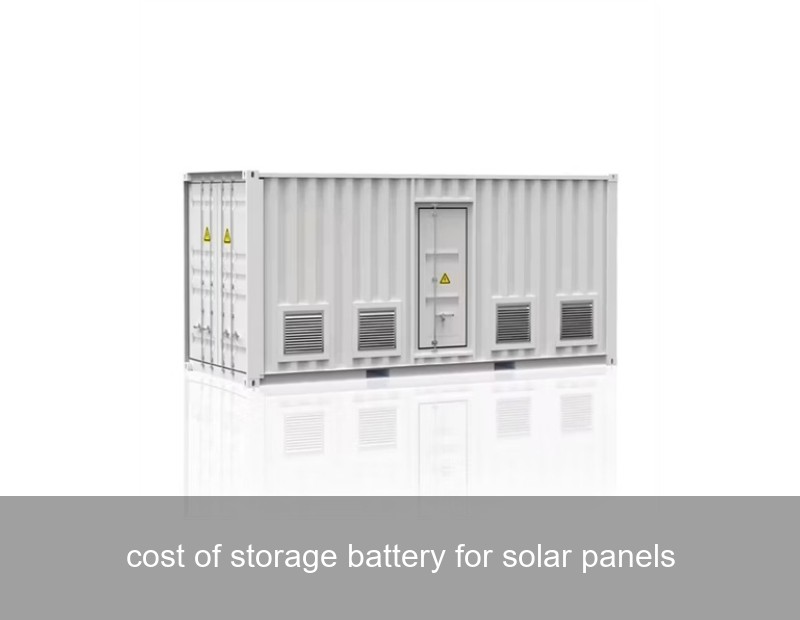
The Solution: In 2022, they installed a Highjoule Commercial Energy Hub, a containerized 120 kWh LFP battery system with integrated smart energy management.
The Data-Driven Outcome (First 12 Months):
- Self-Consumption Rate: Increased from 40% to 92%.
- Grid Energy Purchases: Reduced by 78%.
- Annual Energy Cost Savings: €18,500.
- Additional Revenue: The system participates in Germany's primary control reserve market via a VPP, generating approx. €2,200 annually.
- Payback Period: Projected at 6.2 years, with a system lifespan of 20+ years.
This case shows that the effective cost of storage battery for solar panels wasn't an expense but an investment with a clear, calculable return. The bakery now has predictable energy costs, enhanced resilience against blackouts, and a stronger sustainability profile.

Highjoule's Approach to Optimizing Your Storage Investment
At Highjoule, we engineer our systems to deliver the lowest possible lifetime cost, not just the lowest price tag. Our philosophy is built on three pillars that directly address the core components of the cost of storage battery for solar panels:
1. Superior, Long-Life Technology
Our Residential PowerVault and Commercial Energy Hub lines predominantly use LFP chemistry. We pair this with a proprietary, adaptive Battery Management System that actively manages cell health, pushing the boundaries of longevity and safety. This translates to more cycles and more years of service, dramatically reducing your cost per kilowatt-hour stored.
2. Integrated Intelligence
Our Highjoule Energy OS is the secret sauce. It doesn't just store energy; it optimizes it. The software forecasts solar production and your consumption, automatically deciding when to charge, discharge, or hold based on weather, time-of-use tariffs, and even grid carbon intensity. For our commercial clients, it can seamlessly integrate with microgrid controls or connect to Virtual Power Plants, turning your storage asset into a revenue stream.
3. Full-System Design & Support
We provide more than hardware. Our experts work with certified installers to design a system perfectly sized for your energy profile, avoiding the costly mistake of over- or under-sizing. Our comprehensive 15-year warranty covers both performance and parts, guaranteeing your investment's output for the long haul.
The Future of Storage Costs and Your Next Step
Costs are expected to continue falling, but the value of resilience and energy independence is rising. With volatile energy markets and increasing grid instability in some regions, the ability to keep your lights on and your business running has tangible value. The question is no longer just "What does a battery cost?" but "What is the cost of *not* having one?" in terms of missed savings, vulnerability to outages, and slower progress toward energy autonomy.

Ready to move beyond a simple price quote and calculate the true value of storage for your specific home or business? What would a 70% reduction in your grid electricity purchases do for your annual budget?
 Inquiry
 Online Chat