


Understanding Lithium Battery Price Trends in Myanmar: A Gateway to Energy Independence
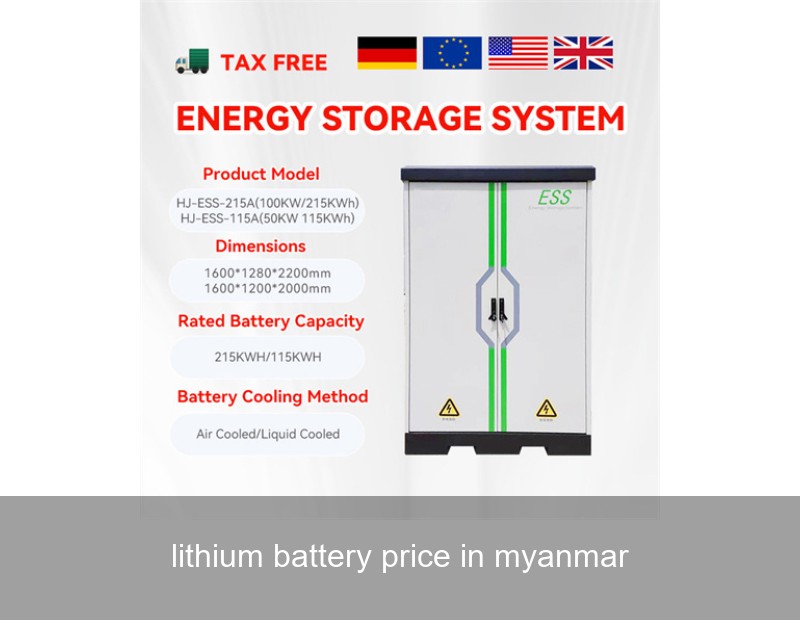
If you're exploring energy solutions for your home or business in Myanmar, you've likely encountered a critical question: what drives the lithium battery price in Myanmar? Beyond the initial cost, this question is fundamentally about achieving reliable, sustainable, and cost-effective power in a dynamic market. As Myanmar navigates its unique energy landscape, lithium-ion battery storage has emerged not just as a product, but as a pivotal technology for bridging power gaps and harnessing renewable energy. This article will demystify the pricing factors and illustrate how smart investment in advanced storage is transforming energy access across the country.
Table of Contents
- The Energy Reality: Why Myanmar is Turning to Battery Storage
- Decoding the Cost: Key Factors Influencing Lithium Battery Prices
- Beyond the Price Tag: Total Cost of Ownership & Value
- A Case Study: Solar + Storage for a Mandalay Industrial Facility
- Highjoule's Tailored Solutions for the Myanmar Market
- Navigating Your Investment: Key Considerations
The Energy Reality: Why Myanmar is Turning to Battery Storage
Myanmar's journey towards electrification is filled with both challenge and opportunity. While grid connectivity is expanding, reliability remains a concern for many businesses and households. Frequent outages can halt production, spoil goods, and disrupt daily life. Concurrently, the abundant solar potential presents a clear alternative. However, solar energy is intermittent—it's not available at night or during heavy monsoons. This is where energy storage systems, particularly lithium-ion batteries, become the indispensable link.
Think of it this way: a solar panel system without a battery is like a rainwater collection system without a tank. You can use the water (or power) only when it's flowing. A battery acts as that storage tank, allowing you to capture excess solar energy during the day and use it whenever you need it. This capability transforms renewable energy from a supplemental source into a primary, reliable power supply. The growing demand for this stability is a primary driver behind the search for efficient and affordable lithium battery solutions in Myanmar.
Decoding the Cost: Key Factors Influencing Lithium Battery Prices
The sticker price of a lithium battery system can vary widely. Understanding the components behind this cost helps in making an informed decision. It's rarely just about the "battery box" itself.
Core Components of a System
- Battery Cells & Chemistry: The heart of the system. Prices differ based on chemistry (e.g., Lithium Iron Phosphate (LFP) vs. NMC). LFP, known for its exceptional safety, long cycle life, and stability, is often the preferred choice for stationary storage, despite potentially different cost dynamics.
- Battery Management System (BMS): The brain. A sophisticated BMS is crucial for safety, performance, and longevity. It monitors cell voltage, temperature, and state of charge. Investing in a high-quality BMS protects your entire investment.
- Inverter/Converter: The translator. This device converts the DC electricity stored in the batteries to the AC electricity used by your appliances and machinery. Hybrid inverters that can integrate solar, grid, and battery are key for versatile systems.
- Installation, Wiring, and Balance of System (BoS): This includes cabling, safety disconnects, enclosures, and labor. Proper installation is non-negotiable for safety and efficiency.
Market & Logistics Factors in Myanmar
In Myanmar, additional factors significantly impact the final lithium battery price:
| Factor | Impact on Price & Selection |
|---|---|
| Import Duties & Logistics | Shipping, customs, and handling add to the landed cost. Partnering with a provider with established supply chains is essential. |
| Local Technical Support | Availability of local engineers for installation, commissioning, and after-sales service affects long-term value. |
| Climate Considerations | Myanmar's heat and humidity demand batteries and components with robust thermal management and high ingress protection (IP) ratings. |
Beyond the Price Tag: Total Cost of Ownership & Value
Focusing solely on the upfront lithium battery price in Myanmar can be misleading. The smarter metric is Total Cost of Ownership (TCO) over the system's 10-15 year lifespan.
- Cycle Life & Warranty: A cheaper battery may only guarantee 3,000 cycles, while a premium one like Highjoule's offerings guarantee 6,000+ cycles. Over time, the cost per cycle of the premium battery is far lower.
- Efficiency: Higher round-trip efficiency (e.g., 97% vs. 90%) means less energy is wasted during charge/discharge. You store more of the solar energy you produce, directly increasing savings.
- Diesel Displacement: For businesses reliant on diesel generators, a battery can reduce runtime by 80% or more. The savings on fuel and generator maintenance often pay for the storage system itself.
As the International Renewable Energy Agency (IRENA) notes, the long-term value of storage extends far beyond hardware, encompassing grid services and enabling higher renewable penetration.

Image: A technician performs maintenance on a commercial battery energy storage system. Source: Unsplash
A Case Study: Solar + Storage for a Mandalay Industrial Facility
Let's look at a real-world application. A medium-sized textile factory in Mandalay faced 4-6 hours of daily grid outages, forcing constant use of diesel generators. Their monthly energy spend was skewed: 40% for expensive diesel, 60% for grid power.
The Solution: A turnkey system comprising a 200kW rooftop solar array coupled with a 500kWh Highjoule H-Ion commercial battery storage system. The system was designed to prioritize solar consumption, store excess solar, and automatically switch to battery power during grid failures, minimizing generator use.
- Denerator Runtime Reduced by 90%: From nearly 180 hours/month to under 20 hours for peak backup only.
- Annual Fuel Savings: $28,000 USD.
- Grid Consumption Down 60%: Further reducing electricity bills.
- Payback Period: Estimated at 4.2 years, with decades of low-cost operation ahead.
This case underscores that the lithium battery price was not an expense, but a capital investment with a clear and rapid return, ensuring uninterrupted production and locking in long-term energy costs.
Highjoule's Tailored Solutions for the Myanmar Market
At Highjoule, with nearly two decades of global experience since 2005, we understand that markets like Myanmar require more than an off-the-shelf product. They require adapted solutions. Our approach is to provide intelligent, durable storage that withstands local conditions and delivers predictable economics.
Our H-Ion Commercial & Industrial (C&I) Series is engineered for resilience. Featuring stable Lithium Iron Phosphate (LFP) chemistry and an advanced, self-learning BMS, these systems are built to perform in challenging climates. We focus on system-level integration, ensuring our batteries work seamlessly with leading solar inverters to create a unified, efficient power plant.
For larger-scale applications, such as microgrids for remote communities or industrial parks, our Containerized Battery Energy Storage Systems (BESS) offer a plug-and-play solution. Pre-assembled and tested in a secure, climate-controlled container, they drastically reduce on-site installation complexity and time, a significant advantage in regions with specialized technical resource constraints.
Our partnership model is key. We work with trusted local distributors and engineering firms, providing them with in-depth training and ongoing technical support. This ensures that every Highjoule system installed in Myanmar is backed by global expertise and local service capability. The U.S. Department of Energy's resources on solar and storage integration affirm the importance of such holistic system design.

Image: Centralized monitoring and control is vital for optimizing energy storage performance. Source: Unsplash
Navigating Your Investment: Key Considerations
As you evaluate options for lithium battery storage, here are essential questions to discuss with potential providers:
- What is the guaranteed cycle life and end-of-warranty capacity of the battery? (e.g., 6,000 cycles to 70% remaining capacity).
- How does the BMS handle Myanmar's high ambient temperatures to prevent overheating and ensure safety?
- Can you provide a detailed simulated financial analysis showing payback period and lifetime savings, specific to my load profile and tariff?
- What is the structure of your after-sales support? Is there local technical expertise for troubleshooting and maintenance?
Data from markets with mature renewable adoption, like those in the IEA's reports on grid-scale storage, consistently show that quality and professional support trump low upfront cost in the long run.
Your Energy Future
The conversation around lithium battery price in Myanmar is ultimately a conversation about energy resilience and economic planning. The right storage solution empowers you to take control, turning the unpredictability of the grid and the volatility of fuel prices into a managed, optimized, and sustainable power strategy.
What specific energy challenge—be it production downtime, soaring diesel costs, or the desire to go green—is most critical for your business to solve in the next 18 months, and how could a reliable power storage system help you address it?
 Inquiry
 Online Chat