


How Much Does a Solar Panel for a House Cost? A Complete Guide to Your Investment
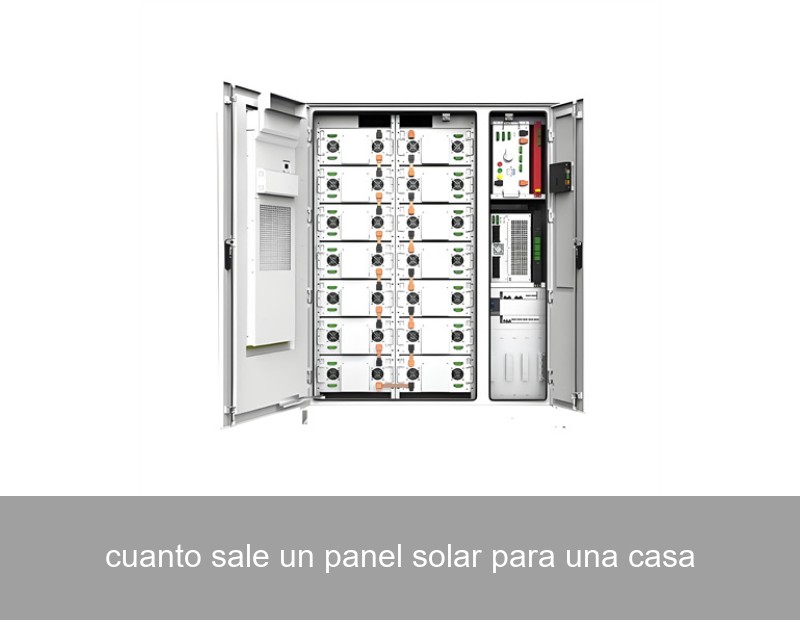
If you're a homeowner considering the switch to clean energy, the question "cuánto sale un panel solar para una casa?" or "how much does a solar panel for a house cost?" is likely top of mind. It's a smart question, as the upfront price tag is just the starting point. The true value lies in understanding the long-term savings, energy independence, and environmental benefits. This guide will break down the costs, factors, and real-world performance of residential solar systems, helping you make an informed decision for your home.
Table of Contents
- Breaking Down the Cost of a Home Solar System
- Key Factors That Influence Your Final Price
- The Real Story: Savings, ROI, and Incentives
- Beyond Panels: Why Energy Storage is a Game-Changer
- A Real Case Study: Solar + Storage in Action
- Highjoule: Your Partner in Intelligent Energy
- Making the Decision: Is Solar Right for You?
Breaking Down the Cost of a Home Solar System
Let's move beyond a simple per-panel quote. In the U.S. and Europe, homeowners typically pay for a complete, installed system. According to the Solar Energy Industries Association (SEIA), the average cost of a residential solar system in the U.S. before incentives ranges from $18,000 to $36,000, with an average system size of 6-10 kilowatts (kW). In Europe, prices vary significantly by country but follow a similar range. This translates to roughly $2.50 to $3.50 per watt installed.
What does this price include?
- Solar Panels (Modules): The most visible component, typically accounting for 15-25% of the system cost.
- Inverters: The "brain" that converts the DC electricity from panels into usable AC for your home. This is a critical component for efficiency.
- Racking/Mounting Hardware: The secure structure that attaches panels to your roof.
- Electrical Components & Wiring: All the necessary safety switches, conduits, and cables.
- Permitting & Installation Labor: Professional design, securing permits, and certified installation.

Image: A professional solar installation is key to long-term performance and safety. (Source: Unsplash)
Key Factors That Influence Your Final Price
Why is there such a range? Your home's specific details play a huge role.
| Factor | Impact on Cost |
|---|---|
| System Size (kW) | Larger systems cost more upfront but often have a lower cost per watt and generate more savings. |
| Roof Type & Complexity | Simple, composite shingle roofs are easiest. Tile, slate, or roofs with multiple angles increase labor time. |
| Panel Efficiency & Brand | High-efficiency panels (e.g., monocrystalline) cost more but produce more power in limited space. |
| Location | Local labor rates, permitting fees, and available sunlight (affecting needed system size) vary by region. |
| Energy Goals | Are you aiming for 100% offset of your bill, or just a partial reduction? |
The Real Story: Savings, ROI, and Incentives
The conversation changes when we look at net cost. Generous incentives can dramatically reduce your initial investment. In the U.S., the federal Investment Tax Credit (ITC) allows you to deduct 30% of the system cost from your federal taxes. Many states and utilities offer additional rebates. In Europe, schemes like feed-in tariffs, tax reductions, or direct grants are common, such as the EU's supportive framework under the Renewable Energy Directive.
Think of it this way: A $30,000 system in the U.S. might have a net cost of $21,000 after the ITC. If that system saves you $1,500 annually on electricity bills (a common figure), your simple payback period is around 14 years. With most high-quality panels guaranteed for 25+ years, the following decade+ of energy is virtually free, protecting you from rising utility rates.
Beyond Panels: Why Energy Storage is a Game-Changer
Here's where the modern energy story gets exciting. Solar panels only produce when the sun shines. What about at night, during a grid outage, or when electricity rates are peak? This is where adding a battery energy storage system (BESS) transforms your solar from a cost-saver to a resilience hub.
By storing excess solar energy produced during the day, you can power your home in the evening, maximize self-consumption, and, in many areas, participate in utility programs that pay you for grid services. While adding storage increases the initial investment, it fundamentally changes your energy independence equation. This is precisely where Highjoule excels.
A Real Case Study: Solar + Storage in Action
Consider the Johnson family in California. They installed an 8.5 kW solar array in 2022 for a net cost of $19,000. In 2023, they added a Highjoule Horizon Home battery system (13.5 kWh capacity). Their goals were backup power during Public Safety Power Shutoffs (PSPS) and to avoid high Time-of-Use (TOU) rates from 4-9 PM.
Data & Results (First Year with Storage):
- Annual Electricity Bill: Reduced from ~$2,800 to a net credit of $150 (exporting energy during peak grid demand).
- Self-Consumption of Solar: Increased from 35% to 85%.
- Grid Outage Protection: Provided seamless backup for essential loads during 3 outages totaling 32 hours.
- Estimated System Payback: With combined incentives for solar+storage, their projected payback period improved to under 10 years.
This real-world example shows that the combined solution delivers value far beyond simple bill reduction.
Highjoule: Your Partner in Intelligent Energy
As a global leader in advanced energy storage since 2005, Highjoule doesn't just sell batteries; we provide intelligent, integrated power solutions. For homeowners, our Horizon Home series is designed for seamless integration with new or existing solar systems.
What sets Highjoule apart?
- All-in-One Design: Our systems integrate the battery, inverter, and management system into a sleek, compact unit for simpler installation.
- Advanced AI Energy Management: Our software learns your usage patterns and automatically optimizes when to store, use, or export energy to maximize savings and comfort.
- Scalability & Future-Proofing: Start with what you need and easily add more capacity as your needs evolve, like adding an electric vehicle.
- Unmatched Safety & Reliability: Built with lithium iron phosphate (LFP) battery chemistry for superior thermal stability, longevity (10,000+ cycles), and backed by a robust 12-year warranty.

Image: A modern, wall-mounted home battery system like Highjoule's Horizon Home. (Source: Unsplash)
When you ask "cuánto sale un panel solar," considering a partner like Highjoule from the start ensures your system is designed for the future, not just today's electricity prices.
Making the Decision: Is Solar Right for You?
So, how much does a solar panel for a house really cost? The answer is multifaceted: it's an investment that ranges from $15,000 to $40,000+ for a premium solar-plus-storage system, but one with a proven track record of delivering a strong financial return and priceless peace of mind.
The best way to get an accurate picture is to:
- Audit Your Energy Use: Review 12 months of utility bills to understand your consumption patterns.
- Get Multiple Quotes: Seek detailed proposals from certified installers that break down equipment, labor, and projected production.
- Evaluate Total Solutions: Ask about integrated storage options like Highjoule's to understand the full value proposition for resilience and savings.
- Research Local Incentives: Use resources like the Database of State Incentives for Renewables & Efficiency (DSIRE) for the most current programs in your area.
Ready to move from wondering about the cost to calculating your own personalized savings and energy independence plan? What's the first question you'd ask a solar installer about your specific home?
 Inquiry
 Online Chat