


How Many kWh Does a Solar Panel Generate? Your Guide to Solar Output
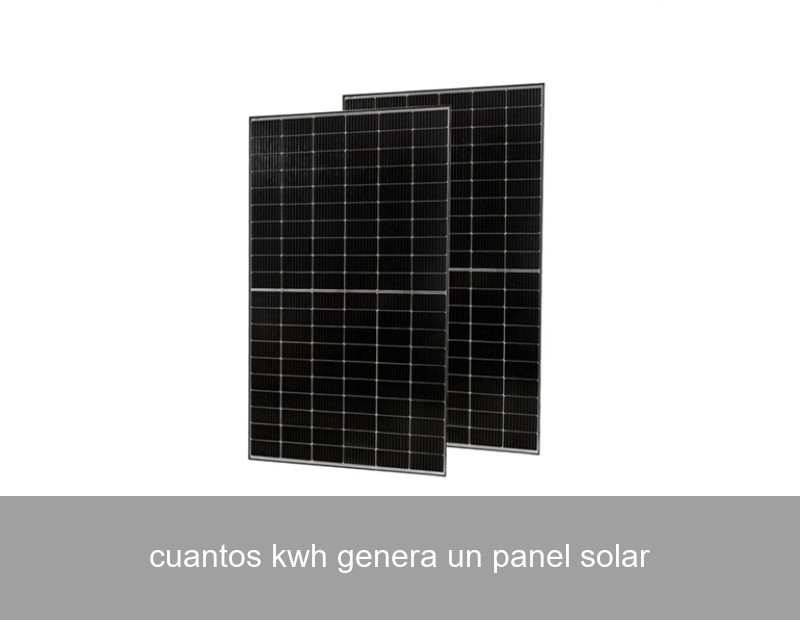
If you're considering solar power for your home or business, one question inevitably rises to the top: cuantos kwh genera un panel solar? Or, in English, how many kilowatt-hours does a solar panel actually produce? The answer isn't a single number. It's a fascinating equation involving technology, environment, and smart energy management. Understanding this output is the first step to unlocking true energy independence and maximizing your return on investment.
Table of Contents
- The Phenomenon: From Sunlight to Socket
- The Data: Crunching the Real Numbers
- The Case Study: A Real-World Example from Spain
- The Insight: It's About the System, Not Just the Panel
- Beyond Generation: Storing Your Solar Power
The Phenomenon: From Sunlight to Socket
Let's start with the basics. A standard residential solar panel, often rated between 350 to 450 watts (W), doesn't generate a constant stream of kilowatt-hours (kWh). Think of the wattage as its maximum potential under ideal laboratory conditions. The actual kWh you get is a product of that panel's power, your local sunlight hours, and a host of real-world factors. It's like a car's top speed versus the distance you actually drive in a day—traffic, road conditions, and driving time all play a part.
For a homeowner in Southern California or a business owner in Italy, the "fuel" is the sun's irradiance. But even in sunny regions, the path from panel to your appliances faces "traffic jams": shading from trees or chimneys, dust on the panels, and especially, the inherent heat of a sunny day (solar panels ironically become less efficient when they get too hot).

Image Source: Unsplash - A modern solar installation. The actual kWh yield depends on panel quality, orientation, and local climate.
The Data: Crunching the Real Numbers
So, let's do some practical math. Suppose you install a 400-watt panel in a location with a solid 4.5 hours of "peak sun" per day (a standard measure, not just daylight). A simple calculation gives: 0.4 kW * 4.5 hours = 1.8 kWh per day per panel. Over a year, that's roughly 657 kWh from that single panel.
But here's where it gets interesting. The National Renewable Energy Laboratory (NREL) tracks the steady improvement in panel efficiency. Today's premium panels can convert over 22% of sunlight into electricity, meaning they can squeeze more kWh out of the same rooftop space compared to the 15%-efficient panels of a decade ago. This technological leap is a key part of the modern solar equation.
To visualize how location dramatically changes the answer to "cuantos kwh genera un panel solar", consider this table:
| City / Region | Average Daily Peak Sun Hours | Annual Output of a 400W Panel (Est.) | Key Climate Factor |
|---|---|---|---|
| Phoenix, USA | ~6.5 | ~949 kWh | High irradiance, low humidity |
| Berlin, Germany | ~2.8 | ~409 kWh | Northern latitude, more cloudy days |
| Seville, Spain | ~5.2 | ~759 kWh | Abundant sunshine, high summer temperatures |
| London, UK | ~2.6 | ~380 kWh | Frequent cloud cover, lower irradiance |
The Case Study: A Real-World Example from Spain
Let's move from theory to practice. A medium-sized winery in the Andalusia region of Spain faced high energy costs for refrigeration and irrigation. They installed a 100 kW solar array using high-efficiency 415W panels. Based on their local insolation data, they expected an annual yield of approximately 155,000 kWh.
However, after the first year, their monitoring system showed a generation of 162,300 kWh—about 4.7% above projections. Why? The key was the system-level optimization. They used advanced inverters that minimized losses during the DC-to-AC conversion, especially during the hot afternoon hours when panel efficiency typically dips. This case highlights a critical insight: the panel's nameplate wattage is just the starting point. The balance of system components—inverters, wiring, and most importantly, energy management—determines the final kWh that powers your operations.
The Insight: It's About the System, Not Just the Panel
The winery's success leads us to the core insight. Obsessing over the theoretical output of a single panel is like buying a powerful engine without considering the transmission, fuel system, and driver. To truly answer "cuantos kwh genera un panel solar," you must ask a better question: How many usable kWh does my entire energy system deliver?
This is where the conversation evolves from simple solar generation to intelligent energy resilience. The sun doesn't shine at night, and grid electricity prices can spike unpredictably. The modern solution integrates three pillars:
- High-Efficiency Generation: Quality panels that perform well in real-world, high-temperature conditions.
- Smart Inversion & Control: Inverters that act as the brain of the system, optimizing flow and providing grid services.
- Advanced Energy Storage: The game-changer that allows you to store surplus daytime generation for use anytime.
Beyond Generation: Storing Your Solar Power
This is where companies like Highjoule transform the solar equation. For nearly two decades, Highjoule has moved beyond being just a component supplier to becoming a provider of integrated, intelligent power solutions. Our expertise lies in designing systems where solar generation, smart inverters, and advanced battery storage work in perfect harmony.
For instance, our Highjoule HES Series commercial and industrial battery energy storage system (BESS) is engineered to capture every possible kWh from your solar array. It doesn't just store energy; it uses predictive algorithms to decide the most economical moment to store or discharge—whether to avoid peak demand charges, provide backup during an outage, or even participate in grid-balancing programs. Imagine your Spanish winery adding such a system: their 162,300 kWh annual solar yield becomes a 24/7 resource, chilling tanks even after sunset and securing their operations against grid instability.

Image Source: Unsplash - A modern Battery Energy Storage System (BESS). Systems like Highjoule's HES Series turn solar kWh into reliable, on-demand power.
For residential users, our approach is similar. The Highjoule Home Energy Hub seamlessly integrates with your solar panels, creating a personal microgrid. It answers the homeowner's question not with a daily kWh figure, but with a tangible result: "Your system will cover 85% of your annual energy needs and keep your lights on for 24 hours during a grid outage." This shift from generation to guaranteed consumption is the future of solar.
The Future of Your Energy
So, while the math of panel output is a great starting point, the real value is measured in energy security, cost savings, and sustainability. The International Energy Agency (IEA) consistently highlights solar as the cornerstone of the future energy mix. But to fully harness its potential, storage is not an optional extra; it's essential.
We began by asking about the output of a single panel. But perhaps the more compelling question for you is: What could you power with not just the sun's rays, but with the full, intelligent control of your own energy ecosystem?
What's the one critical load in your home or business that you wish you could guarantee power for, regardless of the time of day or the state of the grid?
 Inquiry
 Online Chat