


Why Your Business Needs a True Empresa de Energía Renovable Partner, Not Just a Supplier
You've made the decision. The path forward is clean, sustainable, and economically sound. You're investing in solar panels, wind turbines, or perhaps both. You've chosen a supplier, and the installation date is set. But here's a question we at Highjoule encounter often: once the installers pack up and leave, who ensures your shiny new renewable assets deliver their full promised value? The modern transition requires more than hardware; it demands a strategic empresa de energía renovable partner—a collaborator who manages the complex interplay of generation, storage, and consumption to turn green intentions into reliable, maximized returns.
The Grid Challenge: More Than Just Sunshine and Wind
The phenomenon is becoming common across Europe and the U.S.: a business invests heavily in rooftop solar, only to discover a significant portion of their self-generated power is exported to the grid at low, wholesale rates. Then, a few hours later as the sun sets, they're forced to buy back expensive electricity from the utility. This "peak shaving" problem isn't just a billing headache; it's a symptom of a fundamental mismatch. Renewable sources are intermittent, while our energy needs are constant. The grid itself, built for one-way power flow, is straining under the influx of decentralized generation. This creates a critical gap between having renewable generation and truly harnessing its power for resilience and savings.

Image Source: Unsplash - A solar farm, illustrating clean but intermittent generation.
The Data Behind the Storage Imperative
The numbers paint a clear picture. According to the International Energy Agency (IEA), global renewable capacity additions hit a record 510 gigawatts in 2023, with solar PV accounting for three-quarters of this growth. However, the IEA also stresses that the lack of sufficient flexibility in power systems, primarily from storage, is a key barrier to integrating these volumes. Let's look at the financial data. In markets like California (CAISO) or parts of the EU with high renewable penetration, the difference between peak and off-peak electricity prices can regularly exceed $0.20 per kWh. For a medium-sized industrial facility consuming 2 MW during peak hours, that's a cost differential of $400 per hour. Without a buffer—a way to store cheap, self-generated daytime power for use during expensive peak periods—a vast portion of potential savings and energy independence is simply lost.
Case Study: From Solar Farm to Grid Anchor in Southern Spain
Consider the real-world case of a 5 MW agricultural cooperative in Andalucía, Spain. They installed a large-scale solar farm to power irrigation and processing facilities. Initially, they faced the classic curve: overproduction at midday leading to grid congestion and low feed-in tariffs, followed by high evening demand met by the grid. Their goal wasn't just to be a renewable energy generator, but a self-sufficient, resilient operation.
They partnered with a true empresa de energía renovable that provided an integrated solution. The core was a 2.5 MWh/2.5 MW battery energy storage system (BESS) seamlessly coupled with their solar PV. Here's what changed:
- Self-Consumption Optimization: Solar energy stored during the day now powers evening operations, increasing self-consumption from 35% to over 80%.
- Grid Services Revenue: The system's intelligent controller allows the cooperative to participate in the local grid's frequency regulation market, selling small bursts of power to stabilize the grid, creating a new revenue stream.
- Economic Outcome: The project reduced the cooperative's annual energy costs by €140,000 and is projected to generate an additional €25,000 annually from grid services, shortening the payback period significantly.
This transformation was possible because the partner provided not just storage hardware, but the proprietary energy management software (EMS) and ongoing optimization to navigate complex market signals—a hallmark of a full-service partner.
The Highjoule Approach: More Than a Battery, an Intelligent Energy Partner
At Highjoule, founded in 2005, we've evolved from an advanced storage system provider into precisely this type of strategic partner. We understand that the value of an empresa de energía renovable lies in its ability to deliver certainty. Our solutions are built around this core philosophy.
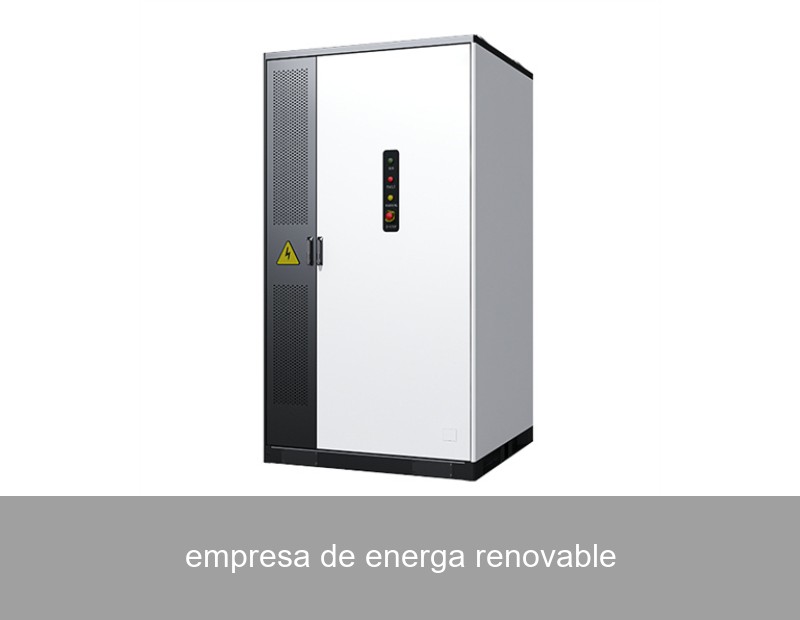
For commercial and industrial clients, our IntelliBESS Platform is the cornerstone. It's a fully integrated, containerized battery storage system that comes with our AI-driven Helios EMS. Think of Helios as the brain of your energy ecosystem. It doesn't just charge and discharge batteries; it continuously analyzes weather forecasts, your consumption patterns, real-time electricity prices, and even grid stability needs to make millisecond decisions that maximize your financial return and operational resilience.
| Challenge | Traditional Supplier Response | Highjoule Partner Response |
|---|---|---|
| High Peak Demand Charges | Suggest load shifting or generator. | Deploys IntelliBESS with peak-shaving algorithms, guaranteeing demand reduction and providing a performance warranty. |
| Solar Self-Consumption Too Low | Recommend adding more solar panels. | Integrates storage with existing PV, using EMS to optimize charge/discharge cycles, typically boosting self-use to 70-90%. |
| Need for Backup Power | Install a diesel generator. | Configures the BESS for seamless islanding during outages, providing silent, instant, and zero-emission backup for critical loads. |
For utility-scale and microgrid applications, our expertise scales. We design systems that can black start a grid, integrate diverse renewable sources, and provide essential grid services like voltage support and frequency response, turning a renewable project into a reliable grid asset.

Image Source: Unsplash - An engineer monitoring advanced energy management systems.
Choosing Your Renewable Energy Partner: Key Considerations
So, how do you identify a true partner? Look beyond the price-per-kWh of storage and ask these questions:
- Software & Intelligence: Do they offer a proprietary, adaptive EMS, or are they relying on a generic third-party system?
- Performance Guarantees: Do they offer contractual guarantees on system throughput, degradation, or financial savings?
- Lifecycle Support: What is their long-term service and maintenance model? A partner is invested in your system's performance for its 15-20 year lifespan.
- Grid Integration Expertise: Can they navigate interconnection agreements and market rules to unlock additional revenue streams for you?
The Future is Integrated, Not Just Installed
The energy landscape is shifting from a simple "buy power" model to a complex "manage your own micro-energy ecosystem" reality. The businesses and communities that will thrive are those that view their energy infrastructure as a dynamic, value-generating asset. This requires a collaborator who brings deep expertise in both the physics of storage and the economics of energy markets.
Is your current renewable strategy simply covering your roof with panels, or is it architecting a resilient, cost-positive energy future? What would be possible if your renewable assets could communicate, predict, and respond to both your needs and the grid's demands in real time?
 Inquiry
 Online Chat