


Unlocking Grid Stability and Energy Independence: The Power of the 1MW 3-Phase Energy Storage Cabinet
Imagine a world where a factory's power never flickers during a storm, a shopping center seamlessly rides through peak pricing periods, and a community microgrid stays resilient even when the main grid falters. This isn't a distant future—it's the reality being built today with a critical piece of technology: the 1MW 3-phase energy storage cabinet. For commercial and industrial (C&I) energy managers, facility owners, and sustainability directors, this system represents more than just backup power; it's a strategic asset for financial savings, operational resilience, and clean energy integration. Let's explore why this specific configuration is becoming the cornerstone of modern energy management.
Table of Contents
- What is a 1MW 3-Phase Energy Storage Cabinet?
- Why a 1MW 3-Phase System? The Data-Driven Advantages
- A Real-World Case: From Peak Shaving to Grid Services in Germany
- Key Components of a High-Performance System
- The Future of Your Energy Footprint: A Question to Consider
What is a 1MW 3-Phase Energy Storage Cabinet?
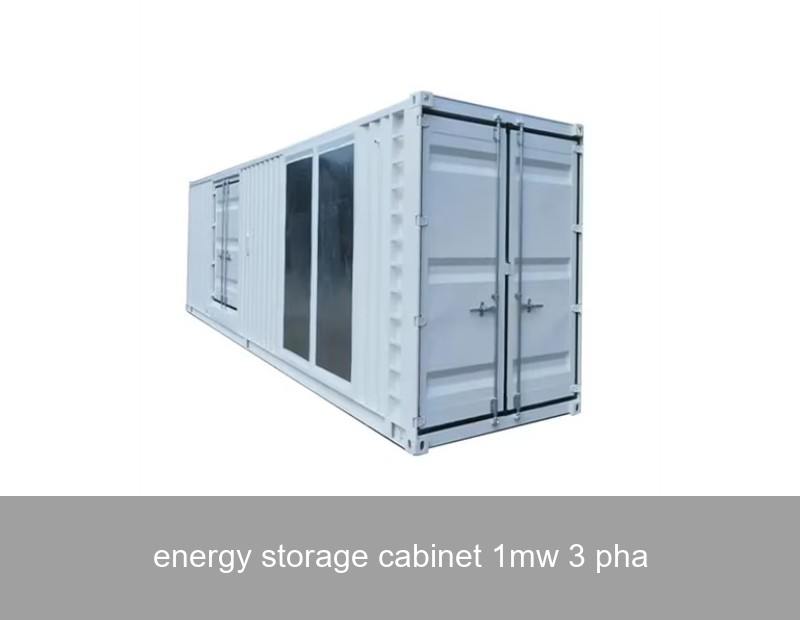
At its core, a 1MW 3-phase energy storage cabinet is a fully integrated, containerized system designed to store electrical energy—typically from renewable sources like solar or the grid—and dispatch it on demand. The specifications tell a clear story:
- 1MW (Megawatt): This denotes power capacity—the rate at which energy can be instantly delivered or absorbed. A 1MW system can supply a substantial load, equivalent to powering hundreds of homes or supporting critical industrial processes.
- 3-Phase: This refers to the type of alternating current (AC) power output. Almost all commercial, industrial, and larger residential buildings run on 3-phase power because it's far more efficient for running heavy machinery, HVAC systems, and large-scale lighting. A 3-phase cabinet integrates directly with this electrical infrastructure.
- Energy Storage Cabinet: This is the physical unit housing the batteries (often lithium-ion, like LFP for safety and longevity), the power conversion system (PCS), thermal management, fire suppression, and sophisticated control software. Think of it as a "power plant in a box."
Companies like Highjoule have refined this concept into turnkey solutions. Our HPC Series Industrial Power Cube is a prime example of a scalable, all-in-one 1MW 3-phase energy storage cabinet. Engineered for durability and intelligence, it combines high-density LFP battery cells with a bi-directional inverter and Highjoule's proprietary Adaptive Grid OS software, allowing it to perform multiple revenue-generating and cost-saving functions autonomously.
Why a 1MW 3-Phase System? The Data-Driven Advantages
The adoption of C&I energy storage isn't just a trend; it's a response to clear economic and grid challenges. Here’s the logic ladder from problem to solution:
Phenomenon: Volatile energy markets and an aging grid lead to high demand charges, frequent power quality issues, and uncertainty.
Data: For many businesses, "demand charges"—fees based on the highest 15-30 minutes of power use in a billing cycle—can constitute 30-70% of their total electricity bill. Meanwhile, the U.S. Department of Energy highlights that power interruptions cost the U.S. economy billions annually. Furthermore, grid operators increasingly pay for fast-responding frequency regulation services to maintain stability.
Insight: A 1MW 3-phase energy storage cabinet directly addresses these pain points. Its scale is ideal for meaningful peak shaving (cutting that expensive power spike), providing uninterruptible power for critical operations, and even participating in grid service programs like frequency response. The 3-phase design ensures it can handle the complex, high-power loads of a factory or commercial campus without requiring expensive phase balancing equipment.

Image Source: Unsplash - Representative image of a large-scale battery energy storage installation.
A Real-World Case: From Peak Shaving to Grid Services in Germany
Let's move from theory to practice. A compelling case comes from a large automotive parts manufacturing plant in Bavaria, Germany. Facing steep “Netzentgelte” (grid fees) based on peak demand and committed to carbon neutrality, the plant sought a multi-functional solution.
The Solution: The facility partnered with Highjoule to deploy a bank of our HPC Series cabinets, creating a 2.5 MW / 5 MWh storage system. This system was integrated with their existing rooftop solar PV and connected to the German grid operator's primary control reserve market.
| Metric | Outcome (Annual) |
|---|---|
| Peak Demand Reduction | 22% decrease, saving over €180,000 in grid fees |
| Solar Self-Consumption | Increased from 35% to 68%, reducing energy procurement costs |
| Revenue from Grid Services | Approx. €95,000 from providing automatic frequency restoration reserve (aFRR) |
| CO2 Emission Reduction | Estimated 740 metric tons |
The system's 3-phase capability ensured seamless integration with the plant's heavy machinery, while the 1MW-per-cabinet modular design allowed for precise scaling. The Highjoule Adaptive Grid OS continuously prioritizes between these value streams, maximizing economic return. This case exemplifies the 1MW 3-phase energy storage cabinet as not just a cost center, but a profitable, multi-talented grid citizen.
Key Components of a High-Performance System
Not all cabinets are created equal. When evaluating a 1MW 3-phase energy storage cabinet, look for these critical components:
- Battery Chemistry (LFP is Standard): Lithium Iron Phosphate (LFP) batteries are now the preferred choice for C&I storage due to their superior safety (thermal runaway resistance), long cycle life (often 6,000+ cycles), and stability. Highjoule uses only top-tier, UL-certified LFP cells.
- Intelligent Power Conversion System (PCS): This is the brain of the power flow. A high-efficiency (>98%) bi-directional inverter that can swiftly switch between charging and discharging is crucial for grid services and peak shaving.
- Advanced Thermal Management: Consistent performance and longevity depend on precise temperature control. Liquid cooling systems, like those in the Highjoule HPC Series, are becoming standard for high-power density cabinets, ensuring optimal operation from -20°C to 50°C.
- Grid-Forming Capability (The Next Frontier): Advanced systems can "form" a grid independently, a vital feature for microgrids. This technology, highlighted by NREL, allows renewables and storage to restart the grid after a blackout—a game-changer for resilience.
Choosing the Right Technology Partner
Selecting a 1MW 3-phase energy storage cabinet is a major capital decision. The technology itself is only part of the equation. You need a partner with proven expertise in system integration, long-term performance guarantees, and sophisticated software. This is where Highjoule's 18+ years of specialization pays dividends for our clients.
Our service extends far beyond delivery. We provide:
- Feasibility & Financial Modeling: We analyze your load profiles, utility rates, and local incentives to model the precise ROI.
- Turnkey Integration: From design and grid connection permits to installation and commissioning, we manage the entire process.
- Performance Monitoring & Optimization: Our cloud-based platform gives you 24/7 visibility into your system's performance and financial savings, with remote software updates to continuously improve algorithms.
- Comprehensive Warranty & Support: We stand behind our systems with industry-leading warranties and a global service network.
In essence, you're investing in a long-term energy partnership, not just hardware.

Image Source: Unsplash - Representative image of energy system monitoring and control.
The Future of Your Energy Footprint: A Question to Consider
The transition to a resilient, low-cost, and sustainable energy future is underway. The 1MW 3-phase energy storage cabinet is the workhorse enabling this transition for businesses and communities worldwide. It transforms energy from a volatile commodity into a manageable, strategic asset.
As you look at your facility's next quarterly energy bill or your organization's sustainability roadmap, ask yourself this: What could you achieve if you could control your power peaks, ensure operational continuity through outages, and turn your energy infrastructure into a source of revenue?
The conversation about energy resilience and independence starts with understanding the tools available. We're here to have that conversation.
 Inquiry
 Online Chat