


Understanding Solar Energy Price in Bangladesh and Its Global Implications
When we discuss the global energy transition, conversations often center on markets like Europe or the United States. But to truly gauge the progress and potential of renewable energy, we must look to emerging economies. The dynamics of solar energy price in Bangladesh present a fascinating, real-world laboratory. Here, the interplay of urgent energy demand, innovative financing, and technological adaptation is writing a playbook for sustainable development worldwide. For global observers and industry experts, Bangladesh's journey offers critical insights into how solar power becomes not just an alternative, but a foundational, cost-effective pillar of a nation's energy security.
The Price Paradox: Why Solar Energy Costs in Bangladesh Matter Globally
Bangladesh, with its high population density and significant economic growth, faces a classic energy dilemma. The demand for reliable electricity is skyrocketing, yet reliance on imported fossil fuels makes the grid vulnerable to price volatility and supply shocks. This is where solar power steps in. The solar energy price in Bangladesh isn't just a local metric; it's a benchmark for viability in challenging environments. If solar can be made cost-competitive and reliable here, it can work anywhere. The initial "sticker price" of a solar panel is just the entry point. The true cost encompasses installation, grid integration (or lack thereof), maintenance, and crucially, how to manage the intermittent nature of sunlight. This last point is where energy storage becomes the game-changer, a lesson that resonates from Dhaka to Dallas.
The Data Dive: Breaking Down Solar Energy Price in Bangladesh
Let's look at the numbers. According to reports from the World Bank, Bangladesh has one of the world's most successful off-grid solar programs, having installed over 6 million solar home systems. The levelized cost of energy (LCOE) for utility-scale solar in the region has fallen dramatically, competing with traditional fuels. However, the raw cost per watt tells only part of the story.
| Cost Component | Challenge in Bangladesh Context | Impact on Final "Price" |
|---|---|---|
| Equipment (Modules, Inverters) | Import duties, supply chain logistics | Higher upfront capital cost |
| Balance of System (Wiring, Mounting) | Local manufacturing vs. import | Variable, often optimized by local innovators |
| Energy Storage | Critical for night-time power & grid stability | Adds cost but multiplies value and ROI |
| Financing & Installation | Microfinancing success, but scale-up needs larger investment | Soft costs can be a significant portion |
As the table shows, the conversation about solar energy price in Bangladesh quickly evolves from panel costs to system costs. The most advanced projects are those that integrate storage from the start, ensuring that the cheap, abundant energy harvested during the day doesn't go to waste when the sun sets.

Image Source: Unsplash (Representative image of commercial solar installation)
A Case Study in Resilience: Solar & Storage Powering a Bangladeshi Factory
Consider a real-world example: a textile factory in Gazipur. This industry is the backbone of Bangladesh's exports, and consistent, high-quality power is non-negotiable for meeting international orders. Faced with frequent grid outages and high diesel generator costs, the factory invested in a 1.2 MW rooftop solar system. But the true innovation was coupling it with a 500 kWh battery energy storage system (BESS).
- Phenomenon: Unreliable grid caused production halts and high operational costs.
- Data: The hybrid solar-storage system now provides over 60% of the facility's daily energy needs. It reduces diesel consumption by approximately 70,000 liters per year, cutting costs and carbon emissions significantly.
- Case Specifics: The BESS does two critical jobs: it stores excess solar energy for use at night, and it provides instantaneous backup during grid failures, preventing costly production stoppages. The payback period was calculated at under 5 years, a compelling business case.
- Insight: This case demonstrates that the effective solar energy price in Bangladesh is a function of system intelligence. The storage component transformed solar from a daytime supplement to a firm, dispatchable power source, unlocking far greater economic value.
Beyond Panels: How Technological Advancements are Shaping Costs
The global decline in lithium-ion battery prices, as tracked by sources like BloombergNEF, is a tailwind for markets like Bangladesh. But it's not just about cheaper batteries. It's about smarter systems. Advanced battery management software, AI-driven energy optimization, and modular, scalable storage designs are making integrated solar-storage solutions more robust and manageable in diverse climates. This technological leap is crucial for ensuring system longevity and performance in Bangladesh's humid, tropical environment, ultimately protecting the investment and improving lifetime value.
The Highjoule Perspective: Intelligent Storage for a Sustainable Future
At Highjoule, with nearly two decades of experience as a global leader in advanced energy storage, we see the narrative in Bangladesh as a powerful validation of our mission. The focus on solar energy price in Bangladesh rightly shifts to total cost of ownership and energy independence. Our role is to provide the intelligent backbone that makes solar power truly reliable and economical.
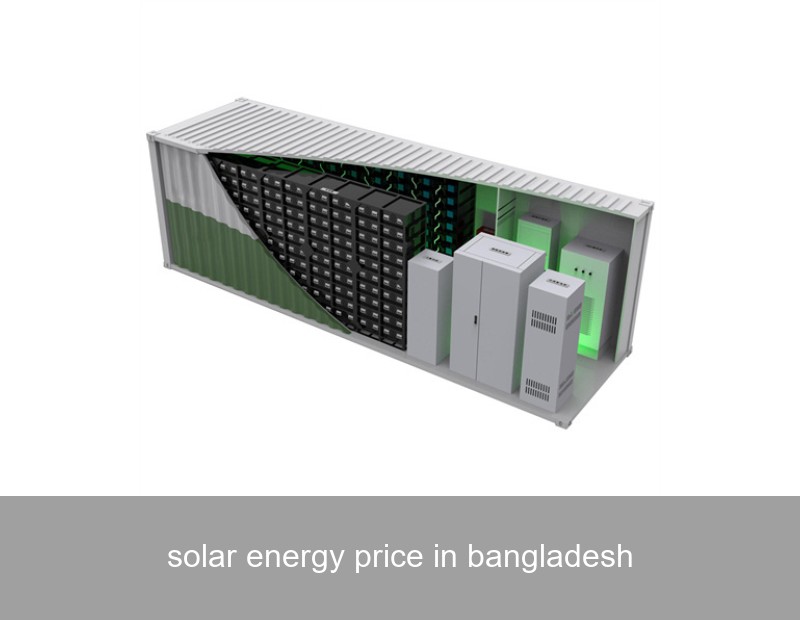
For commercial and industrial (C&I) applications in regions facing similar challenges—be it in Bangladesh, parts of Europe with grid constraints, or the US—Highjoule's IntelliBESS platform offers a solution. It's more than just a battery container. It's an integrated system featuring:
- Advanced Thermal Management: Engineered to maintain peak efficiency and battery life in high ambient temperatures.
- Predictive Energy Analytics: Software that learns energy usage patterns to optimize when to store, when to discharge, and when to draw from the grid, maximizing savings.
- Modular Scalability: Businesses can start with what they need and expand storage capacity as their operations grow, making the initial investment more accessible.
By integrating a solution like IntelliBESS, the effective solar energy price in Bangladesh for a business becomes a value equation: lower lifetime energy costs, guaranteed production uptime, and a hardened resilience against external energy market shocks.

Image Source: Unsplash (Representative image of a containerized BESS unit)
The Future Outlook: What's Next for Solar Affordability?
The trajectory is clear. As technology improves and global supply chains mature, the hardware costs for solar and storage will continue to fall. The next frontier for reducing the solar energy price in Bangladesh and globally lies in financing models and digital integration. Think of "Storage-as-a-Service" for factories, or virtual power plants that aggregate thousands of rooftop solar-plus-storage systems to provide grid stability services. The International Renewable Energy Agency (IRENA) consistently highlights such innovation in business models as key to accelerated adoption.
So, while we analyze the cost per kilowatt-hour today, the more pertinent question for industry leaders and policymakers might be: How do we build energy systems where the price of solar is not just low, but its value—in terms of reliability, sustainability, and economic stimulus—is universally recognized and captured? The answer, as pioneering projects in Bangladesh are showing, lies in thinking in integrated systems from the very beginning.
What energy resilience challenge in your region could be re-framed by looking at the total value of an intelligent solar-storage system, rather than just the initial price tag?
 Inquiry
 Online Chat