


Unlocking Grid Stability: The Rise of Energy Storage Cabinet Based Resources
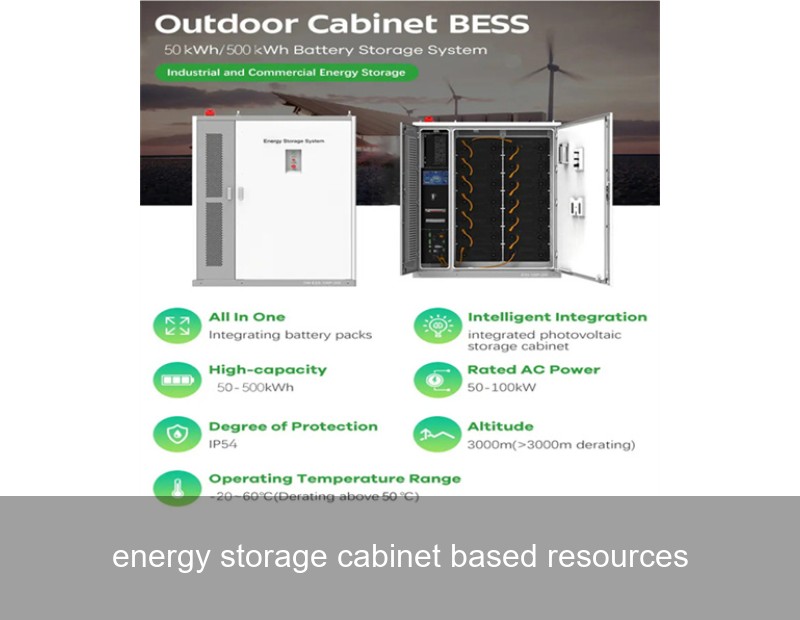
Imagine a world where every solar panel on a rooftop and every wind turbine in a field could reliably power homes and businesses, day and night, regardless of the weather. This vision is closer than ever, thanks to a pivotal innovation: the energy storage cabinet based resource. These aren't just bulky batteries; they are intelligent, modular power hubs that are fundamentally reshaping how we generate, store, and consume electricity. For grid operators, businesses, and communities, these cabinets are becoming the cornerstone of a resilient and sustainable energy future.
Table of Contents
The Phenomenon: From Intermittent to Uninterruptible
Renewable energy sources like solar and wind are inherently variable. The sun sets, and the wind calms. This intermittency poses a significant challenge for grid stability. Traditionally, fossil-fuel-powered "peaker plants" would ramp up to meet demand spikes, but this is costly and carbon-intensive. The modern solution lies in energy storage cabinet based resources. Think of them as the "shock absorbers" for the electrical grid. They seamlessly absorb excess renewable energy when production is high and discharge it precisely when needed, smoothing out the peaks and valleys. This transforms variable generation into a firm, dispatchable asset—a true grid resource.
The Data: Quantifying the Storage Revolution
The growth trajectory is staggering. According to the U.S. Energy Information Administration (EIA), the battery storage capacity in the United States is projected to nearly double in 2024 alone (Source: EIA). In Europe, the European Association for Storage of Energy (EASE) estimates that to meet its 2030 climate targets, the EU needs a tenfold increase in its energy storage capacity. Behind these macro numbers are millions of kilowatt-hours being managed by containerized and cabinet-style systems. These units are scalable, allowing a project to start small and expand modularly, which de-risks investment and accelerates deployment. The data clearly shows we are moving beyond pilot projects to mass adoption.

Image: Modular energy storage cabinets enable scalable deployment. (Photo by American Public Power Association on Unsplash)
Case Study: A German Industrial Park's Transformation
Let's make this concrete with a real-world example. A mid-sized manufacturing park in Bavaria, Germany, faced two major issues: volatile energy costs and a corporate mandate to reduce its carbon footprint. Their existing 2 MW solar array was covering only about 30% of their daytime load, with the excess solar energy often going to the grid at low feed-in tariffs.
Their solution was a turnkey energy storage cabinet based resource from Highjoule. The installation comprised eight of Highjoule's H-Cube 500 cabinets, forming a 4 MWh integrated system. Here’s what happened:
- Self-Consumption Optimization: The system stores midday solar surplus and releases it during evening production hours, increasing on-site renewable consumption from 30% to over 75%.
- Cost Savings: By avoiding peak grid tariffs and reducing capacity charges, the park achieved an annual electricity cost reduction of €180,000.
- Grid Services: The system participates in the German grid's primary control reserve market, generating an additional revenue stream. The intelligent Highjoule Energy Management System (EMS) autonomously optimizes for this dual function.
This case exemplifies how a cabinet-based system is not an expense but a revenue-generating asset that enhances both sustainability and the bottom line.
How Highjoule Engineered the Solution
Highjoule's approach for the Bavarian park was holistic. The H-Cube series cabinets were chosen for their industry-leading energy density and built-in safety features, including active thermal runaway containment. The system's brain, Highjoule's proprietary EMS, uses AI-driven forecasting to predict both solar generation and the park's load patterns, making millisecond-level decisions to maximize economic return. This seamless integration of hardware and intelligence is what defines a true energy storage cabinet based resource.
Inside the Cabinet: Architecture of a Modern Resource
So, what makes these cabinets so effective? It's a sophisticated convergence of components working in harmony.
| Component | Function | Highjoule's Innovation |
|---|---|---|
| Battery Modules (Li-ion NMC or LFP) | The core energy storage medium. LFP chemistry is increasingly favored for its safety and long cycle life. | Highjoule uses automotive-grade, UL-certified LFP cells with a proprietary module design for superior thermal management and longevity. |
| Battery Management System (BMS) | Monitors cell voltage, temperature, and state of charge to ensure safety and performance. | A 3-tiered, redundant BMS that provides cell-level precision and communicates seamlessly with the wider EMS. |
| Power Conversion System (PCS) | The inverter/rectifier. Converts DC battery power to AC for the grid/building and vice versa. | Highjoule integrates bi-directional PCS with >98.5% efficiency, enabling rapid response for grid services. |
| Thermal Management | Critical for safety and efficiency. Maintains optimal operating temperature. | Liquid-cooling systems in the H-Cube Pro line ensure even temperature distribution, extending lifespan by up to 20%. |
| Energy Management System (EMS) | The "brain." Controls charge/discharge cycles based on algorithms and market signals. | Highjoule's cloud-connected EMS offers customizable optimization strategies, from peak shaving to virtual power plant (VPP) participation. |
Beyond Backup: Key Applications for Modern Grids
The versatility of cabinet-based systems is their superpower. They are far more than emergency backup.
- Commercial & Industrial (C&I) Peak Shaving: This is the "killer app" for many businesses. By discharging stored energy during periods of highest grid demand (and highest prices), businesses can dramatically cut their demand charges, a major portion of utility bills. Highjoule's systems are pre-programmed with peak shaving algorithms tailored to local utility rate structures.
- Renewable Firming: As seen in our case study, storage makes solar and wind generation predictable and reliable, turning them into true baseload contenders.
- Microgrids & Community Resilience: In areas prone to outages or for critical facilities, a cluster of energy storage cabinet based resources can form the heart of an independent microgrid. Highjoule has deployed such systems for university campuses and municipal water treatment plants, ensuring continuity during grid disruptions.
- Grid Services (Ancillary Services): On a larger scale, aggregated storage cabinets can provide vital services to the transmission grid, such as frequency regulation and voltage support. This creates a new revenue stream for asset owners. A study by the National Renewable Energy Laboratory (NREL) details the vast potential of these services (Source: NREL PDF).

Image: Energy storage enables energy independence for homes and businesses. (Photo by Andreas Gücklhorn on Unsplash)
The Future Is Modular and Intelligent
The evolution of energy storage cabinet based resources is towards greater intelligence and interoperability. We're moving into an era of Virtual Power Plants (VPPs), where thousands of distributed storage systems, like those from Highjoule, are aggregated and controlled as a single, large-scale power plant. This software-defined grid asset can balance supply and demand more efficiently than any traditional power station. Furthermore, the integration of second-life EV batteries into storage cabinets is emerging as a promising circular economy solution, a field where Highjoule's R&D team is actively innovating.
The technology is ready. The economics are compelling. The question for business leaders, utility planners, and community stakeholders is no longer "if" but "how" to integrate this critical resource. What specific energy challenge—be it cost volatility, sustainability goals, or reliability concerns—could a modular, intelligent storage cabinet solve for your operation?
 Inquiry
 Online Chat