


Energy Storage Community: The Future of Localized, Resilient, and Sustainable Power
Have you ever wondered what happens to the excess solar energy your neighborhood generates on a brilliantly sunny day? Or felt frustrated by grid instability during a heatwave? Across Europe and the US, a powerful answer is emerging: the energy storage community. This isn't just a buzzword; it's a transformative model where groups of homes, businesses, or even entire districts share and manage locally stored electricity. Let's explore how this collective approach is reshaping our energy landscape, turning passive consumers into active prosumers and building true grid resilience from the ground up.
Table of Contents
- The Rise of the Energy Storage Community
- The Data: Why Sharing Storage Makes Economic Sense
- Case Study: A German Housing Cooperative's Success
- How Does an Energy Storage Community Work? The Technology Stack
- Highjoule's Role: Enabling Intelligent Community Storage
The Rise of the Energy Storage Community
We're witnessing a perfect storm driving this trend. First, the volatility of energy prices, starkly highlighted by recent geopolitical events, has made energy independence a financial priority, not just an environmental one. Second, the rapid adoption of rooftop solar has created a new challenge: managing intermittent generation. Third, aging grid infrastructure in many regions struggles with peak demand, leading to higher costs and potential blackouts.
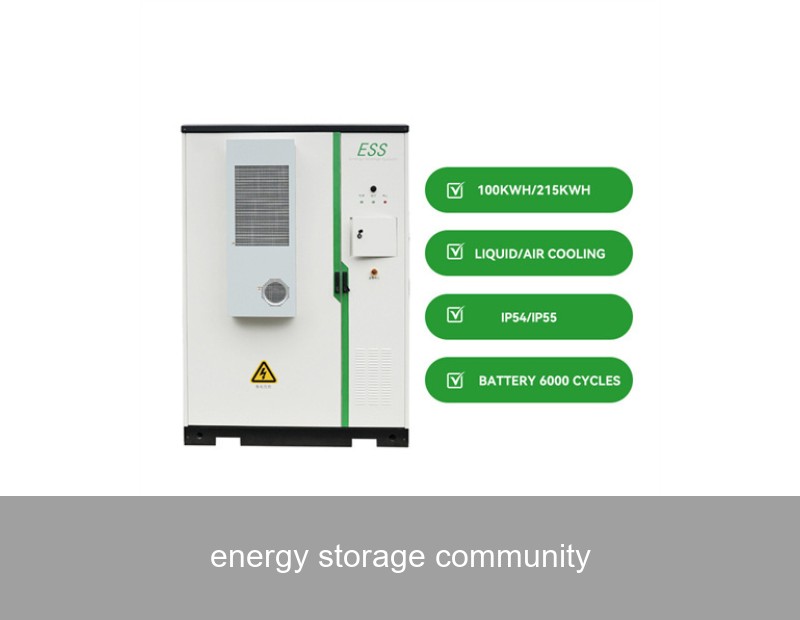
The energy storage community model directly addresses these issues. Instead of individual households investing in separate, oversized battery systems, they pool resources. A central, larger-scale battery storage system—or a network of coordinated smaller units—serves the collective. This community battery stores surplus solar from multiple roofs, dispatches power during evening peaks, and provides critical backup during outages. It's a classic case of the whole being greater than the sum of its parts.

Image: Communities with shared solar generation are ideal candidates for shared storage. (Photo by Unsplash)
The Data: Why Sharing Storage Makes Economic Sense
The financial logic is compelling. A study by the National Renewable Energy Laboratory (NREL) found that shared community storage can reduce the levelized cost of energy by 10-30% compared to isolated household systems. Why? Efficiency through scale. A single, large battery has lower installation and maintenance costs per kilowatt-hour (kWh) than dozens of small units. Optimized utilization. A community battery cycles more consistently—charging from midday solar excess and discharging for evening communal demand—maximizing its return on investment.
Furthermore, these communities can participate in grid services markets. By aggregating their stored capacity, they can offer valuable services like frequency regulation or peak shaving to the local utility, generating a new revenue stream for community members. This transforms the battery from a cost center into a potential income-generating asset.
Case Study: A German Housing Cooperative's Blueprint
Let's look at a real-world example in Freiburg, Germany. A 100-unit housing cooperative, "Sonnenschiff," equipped with extensive rooftop PV, faced a common problem: they were exporting vast amounts of solar energy at low feed-in tariffs during the day and buying expensive grid power at night.
Their Solution: In 2022, they deployed a centralized 800 kWh battery energy storage system (BESS) coupled with an advanced energy management platform. The system intelligently prioritizes self-consumption of solar within the community.
| Metric | Before Community BESS | After Community BESS |
|---|---|---|
| Community Self-Consumption Rate | 35% | 78% |
| Average Electricity Cost for Households | €0.28/kWh | €0.19/kWh |
| Grid Peak Demand Reduction | 0% | 40% during evening peak |
This project, supported by local regulations enabling energy sharing, demonstrates the tangible triple win: lower bills for residents, reduced strain on the public grid, and higher utilization of renewable energy.
How Does an Energy Storage Community Work? The Technology Stack
Building a successful community storage project relies on a sophisticated yet seamless integration of hardware and software.
- Core Hardware: A robust, commercial-grade Battery Energy Storage System (BESS) is the heart. It must be safe, have a long cycle life, and be capable of high-power discharges. Lithium iron phosphate (LFP) chemistry is often preferred for its safety and longevity in such applications.
- The Brain: An Energy Management System (EMS) is crucial. This software platform forecasts local solar generation and community demand, optimizing charge/discharge cycles to maximize economic savings. It ensures fair allocation of costs and benefits to each participant.
- The Interface: User-friendly portals or apps allow community members to see their contribution, savings, and the community's overall energy flow in real-time, fostering engagement and transparency.
- Grid Integration: Secure bi-directional inverters and grid interconnection equipment ensure safe operation and, where permitted, allow for grid service participation.

Image: A commercial-grade BESS forms the physical core of a storage community. (Photo by Unsplash)
Highjoule's Role: Enabling Intelligent Community Storage
This is precisely where Highjoule, with nearly two decades of expertise, steps in. We don't just supply batteries; we provide integrated, intelligent storage solutions designed for collective applications. For an energy storage community, our offering is holistic:
- Highjoule H-Series Commercial BESS: Our scalable, containerized or modular systems, built with LFP cells, offer the perfect foundation. They are engineered for high cycle life and feature built-in safety protocols, making them ideal for unattended operation in residential areas.
- Orion Energy Management Platform: This is the true differentiator. Orion is a cloud-based AI platform that doesn't just manage the battery. It models the entire community's load, generation, and market prices. It can operate in multiple modes: maximizing self-consumption, minimizing costs based on time-of-use tariffs, or even generating revenue by providing grid services, all while ensuring fair settlement among members.
- End-to-End Project Support: From feasibility studies and financial modeling to system design, grid connection approval support, installation, and long-term maintenance, Highjoule acts as a single point of responsibility. We understand the regulatory nuances in different US states and European countries, which is critical for navigating local grid codes and incentive programs.
In essence, Highjoule provides the technology and the expertise to turn the concept of an energy storage community into a reliable, profitable, and sustainable reality.
The Future: From Community to Virtual Power Plant
The logical evolution of interconnected energy storage communities is the Virtual Power Plant (VPP). Imagine hundreds of these community batteries, along with thousands of home systems and commercial storage units, all networked together via a central software platform. During times of extreme grid stress—a heatwave in California or a windless period in the UK—this VPP can dispatch stored energy as a single, reliable power plant would, preventing blackouts and stabilizing the grid for everyone.
This democratizes the energy system. It shifts power (literally and figuratively) from centralized fossil-fuel plants to a resilient, decentralized network of clean energy hubs. The energy storage community is the fundamental building block of this smarter, greener grid.

Image: Interconnected storage communities form the backbone of a future decentralized grid. (Photo by Unsplash)
So, the question isn't really whether the energy storage community model will become mainstream—the economics and grid needs are pushing it inevitably forward. The real question is: Is your neighborhood, your business park, or your municipality ready to explore how it can build its own energy resilience and take control of its energy future? What would be the first step you'd want to take in that conversation?
 Inquiry
 Online Chat