


The Energy Storage Europe Association: Powering a Sustainable Future
Imagine a world where the sun always powers your factory, and the wind's surplus energy is saved for a calm day. This isn't a distant dream; it's the reality being built across Europe today, and a key driver behind this transformation is the collective work of organizations like the Energy Storage Europe association and its members. For businesses and communities, navigating the shift to renewables brings a critical question: how do we ensure the lights stay on when the sun doesn't shine or the wind doesn't blow? The answer lies in advanced energy storage systems (ESS), the indispensable backbone of a decarbonized grid. As a leader in this space, Highjoule is proud to contribute to this European-led energy revolution with intelligent storage solutions that make sustainability not just possible, but practical and profitable.
Table of Contents
- The Phenomenon: Europe's Renewable Surge and the Grid Balancing Act
- The Data: Why Storage is No Longer Optional
- The Case Study: Grid Stability in Northern Germany
- The Insight: More Than Just Batteries - Intelligent Energy Management
- Highjoule's Role: Delivering Trusted Storage Solutions
- Your Energy Future: A Question of Resilience
The Phenomenon: Europe's Renewable Surge and the Grid Balancing Act
Europe has embarked on an ambitious journey. With binding targets like the EU's goal for 42.5% renewable energy by 2030, wind and solar capacity is expanding rapidly. But here's the catch: these are intermittent sources. A cloudy day in Spain or a windless period in the North Sea can create significant gaps in generation. Conversely, a sunny, windy day can produce more power than the grid can immediately absorb, leading to curtailment—essentially, wasting clean energy. This volatility challenges grid stability, the delicate balance between supply and demand that keeps our electrical systems running smoothly. This is precisely the complex puzzle that the Energy Storage Europe association and its ecosystem are solving. They advocate for and demonstrate the technologies that turn renewable energy from a weather-dependent resource into a reliable, dispatchable one.

Think of the grid as a vast lake. Traditionally, large power plants (dams) controlled the water level. Now, we're adding thousands of unpredictable streams (renewables). Without a buffer, the lake risks flooding or drying out. Energy storage acts as a smart reservoir, capturing excess "water" during high generation and releasing it during periods of scarcity.
The Data: Why Storage is No Longer Optional
The numbers speak volumes about the urgency and scale of the storage need. According to the European Association for Storage of Energy (EASE), the EU may need nearly 200 GW of energy storage by 2030 to meet its climate and energy security goals, a massive leap from current levels. The economic argument is equally compelling. A study by BloombergNEF highlights that co-locating storage with new solar and wind projects is now often the lowest-cost option for new electricity capacity in many markets, undercutting fossil fuel alternatives. Let's break down the key value streams storage provides:
- Grid Frequency Regulation: Responding in milliseconds to keep grid frequency at 50 Hz, preventing blackouts.
- Arbitrage: Storing energy when prices are low (e.g., midday solar peak) and discharging when prices are high (evening peak demand).
- Capacity Firming: Smoothing the output of a solar or wind farm, making it behave more like a traditional power plant.
- Deferring Grid Upgrades: Providing local peak power, avoiding costly upgrades to transformers and power lines.
These aren't theoretical benefits. They are quantifiable returns on investment that are driving adoption from industrial facilities to entire municipalities. For a deeper dive into the EU's storage strategy, you can review the European Commission's energy storage factsheet.
The Case Study: Grid Stability in Northern Germany
Let's make this concrete with a real-world example from Northern Germany, a region with one of the world's highest concentrations of wind power. The local grid operator, Tennet, faced a growing challenge: managing grid congestion and frequency instability caused by fluctuating wind input. Their traditional tools were reaching their limits.
The Solution: Tennet partnered with technology providers to deploy a network of large-scale battery storage systems, strategically placed at critical grid nodes. One notable project is the "Dörverden" battery storage facility, a 50 MW / 55 MWh system. This isn't just a simple battery; it's a grid-forming asset that can actively stabilize voltage and frequency.
The Results: The impact has been transformative. The Dörverden system provides primary control reserve (PCR), meaning it automatically injects or absorbs power to balance grid frequency within seconds of a disturbance. In its first year of operation, it successfully responded to thousands of frequency deviations, helping to keep the European grid synchronized. This project exemplifies the core mission of the Energy Storage Europe association: showcasing practical, large-scale applications that prove storage's critical role in grid security. You can explore more operational data on primary control via the ENTSO-E website.

The Insight: More Than Just Batteries - Intelligent Energy Management
The German case reveals a crucial insight: the true value of modern energy storage isn't just in the lithium-ion cells; it's in the intelligence that orchestrates them. A battery without a sophisticated brain is like a powerful computer without an operating system. This is where companies like Highjoule differentiate themselves. Our systems are built on a foundation of advanced software that makes complex decisions in real-time.
Our Highjoule Energy Operating System (EOS) analyzes weather forecasts, electricity price signals, grid conditions, and your facility's consumption patterns. It then autonomously decides the most economical and efficient mode of operation: should the system charge from the solar array, discharge to shave the peak demand charge, or hold reserve for grid services? This multi-stacking of revenue streams is key to maximizing ROI. For a commercial business, this could mean the difference between a storage system that pays for itself in 5 years versus 10.
| Challenge | Traditional Approach | Highjoule Intelligent ESS Approach |
|---|---|---|
| High Evening Energy Costs | Pay high utility rates | Discharge stored solar energy, reducing grid draw during peak tariffs |
| Unpredictable Solar Output | Rely on the grid as backup | EOS uses forecasting to ensure seamless power supply, firming solar output |
| Grid Instability Events | Risk of production downtime | Provide millisecond-response backup power and grid support (where configured) |
Highjoule's Role: Delivering Trusted Storage Solutions
Aligning with the vision championed by the Energy Storage Europe association, Highjoule designs and manufactures integrated storage solutions that bring this intelligence to life. Since 2005, we've focused on making advanced storage safe, reliable, and accessible for commercial, industrial, and microgrid applications.
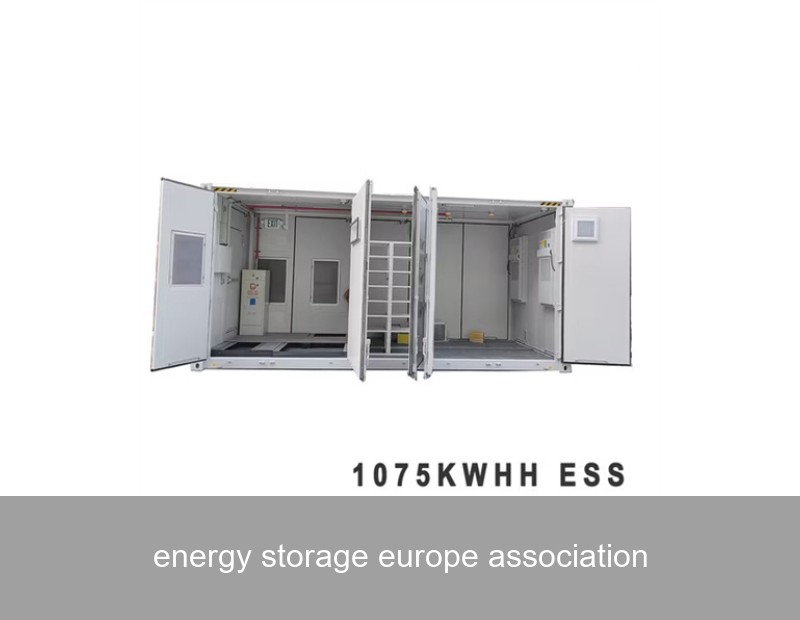
Our flagship product, the Highjoule H-Cube, is a containerized, all-in-one storage solution. It features our proprietary battery management system (BMS), thermal management for optimal performance in diverse European climates, and built-in safety systems that exceed international standards. For larger utility-scale or industrial projects, our modular H-Stack platform allows for scalable deployments from several megawatt-hours to hundreds.
But we go beyond hardware. Our Highjoule Guardian Network offers 24/7 remote monitoring and predictive maintenance. Our team of experts can proactively identify potential issues and optimize system performance, giving our customers peace of mind. Whether it's a manufacturing plant in Poland looking to level its energy costs, a supermarket chain in France aiming for energy independence, or a community microgrid in Italy, Highjoule provides the tailored technology and expertise to build a resilient, low-cost energy foundation.

Your Energy Future: A Question of Resilience
The momentum in Europe and the U.S. is clear. Energy storage, championed by forward-thinking collectives, is moving from the periphery to the core of energy strategy. It's the key to unlocking the full potential of renewables, enhancing national energy security, and providing businesses with a competitive edge through lower, predictable energy costs. The conversation is no longer about *if* storage is needed, but *how* to implement it most effectively.
So, as you look at your organization's energy profile and sustainability goals, what is the first step you will take to assess your own storage potential? Could your operations benefit from the price stability and grid independence that an intelligent system like Highjoule's can provide?
 Inquiry
 Online Chat