


ESS Direct to Solar Panel: Unlocking True Energy Independence for Your Home or Business
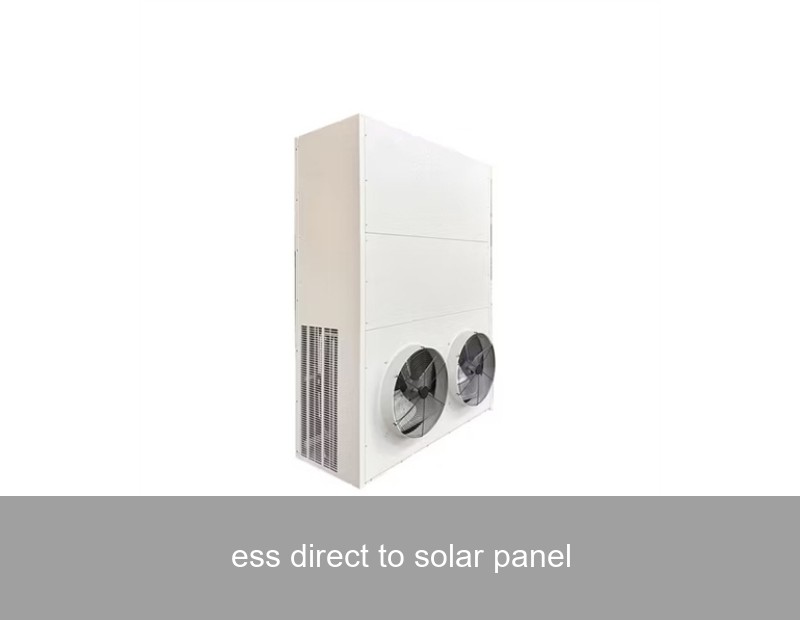
Imagine your solar panels working not just when the sun shines, but exactly as you need them to. This isn't a future dream; it's the reality enabled by a modern ESS direct to solar panel configuration. As a product technology expert at Highjoule, I've seen the evolution from simple grid-tied systems to the intelligent, self-sufficient power hubs of today. The key shift? Moving away from treating batteries as a separate backup component and instead integrating them directly with your solar generation. This approach is transforming how homeowners and businesses think about energy resilience and cost savings. Let's explore why this direct connection is more than just a technical detail—it's the cornerstone of a truly smart and sustainable energy system.
The Grid Reality: A Wasted Opportunity?
For years, the standard solar setup sent excess power straight to the grid, often for minimal credit (through net metering). Meanwhile, the battery system sat idle, waiting for a blackout. This "solar-to-grid, battery-as-backup" model creates a fundamental inefficiency. You're generating clean power but not maximizing its value for your own use. During a grid outage, many traditional hybrid systems shut down entirely for safety, leaving your panels useless—even on a sunny day. This phenomenon frustrates many who invested in solar for independence. The question becomes: how can you capture and utilize every kilowatt-hour your panels produce, especially when the grid is unstable or expensive?
Image Source: Unsplash - A modern home energy system integrating generation and storage.
The Data Advantage: Why Direct Coupling Wins
The technical superiority of a direct-coupled ESS (Energy Storage System) is clear when we look at the data. The core benefit is minimizing conversion losses. In a typical AC-coupled system, solar DC power is converted to AC for the home, then back to DC to charge the battery, and back to AC again to discharge. Each conversion loses 2-5% efficiency. A DC-coupled or optimized direct-to-solar architecture allows a much cleaner path from panels to battery, boosting round-trip efficiency by 3-8%. Over a system's lifetime, this represents a massive amount of recaptured energy.
Consider this table comparing key performance metrics:
| Metric | Traditional AC-Coupled System | Highjoule Direct-to-Solar ESS |
|---|---|---|
| Round-Trip Efficiency | ~88-92% | ~95-97% |
| Solar Self-Consumption | Moderate (30-50%) | High (60-80%+) |
| Grid Outage Performance | Solar often offline | Solar continues charging battery & powering loads |
| Response to Time-of-Use Rates | Slower, less granular | Instantaneous, intelligent arbitrage |
Furthermore, as noted by the National Renewable Energy Laboratory (NREL), DC-coupled systems can reduce balance-of-system costs and are particularly advantageous for new installations aiming for optimal performance. This isn't just theory; it's a proven engineering principle that delivers tangible results.
Key Components of a Direct-to-Solar ESS
- Hybrid Inverter/Charger: The brain of the operation. It manages DC power from both solar arrays and batteries, converting it to clean AC for your home with minimal steps.
- High-Voltage Battery System: Modern lithium-ion batteries (like LiFePO4) that can efficiently interface at higher DC voltages, matching well with solar array output.
- Advanced Energy Management System (EMS): Software intelligence that predicts solar production, learns your consumption patterns, and decides the optimal moment to store or discharge energy.
Real-World Case Study: A California Winery
Let's move from data to a concrete example. A family-owned winery in Sonoma County, California, faced two major challenges: frequent public safety power shutoffs (PSPS) during fire season and exorbitant time-of-use (TOU) electricity rates. Their existing solar system would go dead during outages, risking the entire fermentation process. Their goal was 24/7 clean power for critical cooling and operations.
The Solution: They installed a ESS direct to solar panel system centered on Highjoule's HPS Series Commercial Power Hub. This DC-coupled solution integrated seamlessly with their existing solar PV, adding a 50 kWh battery bank. The Highjoule EMS was programmed with their precise load profiles and TOU rate schedule.
The Results (12-Month Period):
- Energy Bill Reduction: 94% reduction in grid energy demand during peak price periods (5-9 pm).
- Outage Resilience: Survived 14 grid outages totaling over 160 hours with zero operational disruption. The solar panels continued to charge the batteries and power loads during daylight outages.
- Solar Self-Consumption: Increased from 35% to 82%, meaning almost all their solar power was used on-site.
- ROI Timeline: Projected payback period of 5.2 years, factoring in state incentives and energy savings.
This case, documented in our portfolio, exemplifies the transformative power of moving beyond simple backup to an intelligent, direct-coupled energy ecosystem.
The Highjoule Direct-to-Solar Solution: Engineered for Intelligence
At Highjoule, our philosophy is that storage should be an active, intelligent participant in your energy flow, not a passive backup box. Our product lines, like the HPS Series for commercial/industrial use and the HomeVerse system for residences, are built from the ground up for optimal ESS direct to solar panel integration.
What sets our systems apart is the Adaptive Core™ energy management platform. It doesn't just react; it forecasts. By pulling in weather data, it predicts solar yield for the next 48 hours. Combined with your historical usage and real-time electricity pricing (where available), it creates an hourly energy plan. Should clouds roll in, it instantly adjusts, drawing from the battery just enough to avoid the grid, preserving charge. This granular control is only possible with a deeply integrated, direct-coupled architecture.

Image Source: Unsplash - Representative of a modern, wall-mounted home battery system.
For microgrids and larger installations, our systems facilitate peer-to-peer energy sharing and grid services. This means your investment can contribute to community resilience and even generate revenue, a concept gaining traction in both the European Union and U.S. markets, as seen in pioneering programs like those in California.
Service Integration: Beyond the Hardware
Highjoule's expertise extends beyond manufacturing. We provide:
- Feasibility & Design: Our engineers analyze your site, energy data, and goals to design the most efficient direct-coupled system.
- Smart Commissioning: We remotely configure and optimize your system's EMS, tailoring it to your specific patterns.
- Performance Monitoring: Ongoing oversight through our customer portal, offering insights and alerts to ensure your system performs at its peak for decades.
Your Path to Future Energy Independence
The energy landscape is shifting from centralized, fossil-dependent grids to decentralized, renewable-powered networks. In this new landscape, your home or business isn't just a consumer; it can be a self-reliant node. Adopting a sophisticated ESS direct to solar panel strategy is the most effective step to secure your energy costs, ensure operational continuity, and maximize the environmental return on your solar investment.
It's more than just technology; it's about taking control. With volatile energy prices and increasing climate-related grid disruptions, the question is no longer if you should consider storage, but how smartly you can integrate it. Are you ready to explore how a directly coupled solar and storage system can transform your energy profile from a cost center into a pillar of resilience and savings?
What's the first energy-dependent process in your home or business that you would prioritize for 24/7 clean power?
 Inquiry
 Online Chat