


Flüssigbatterie Speicher: The Future of Long-Duration Energy Storage
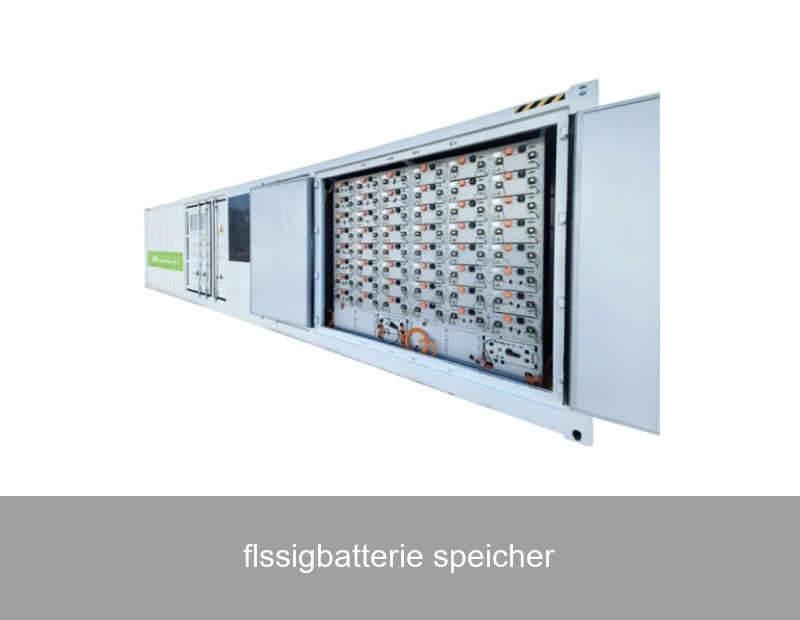
Imagine a battery as big as a shipping container, capable of powering an entire neighborhood for over 10 hours straight, and designed to last for more than 30 years without significant degradation. This isn't science fiction; it's the reality of Flüssigbatterie Speicher, or flow battery storage. As Europe and the U.S. aggressively pursue renewable energy targets, the critical question shifts from how to generate green power to how to store it reliably for when the sun doesn't shine and the wind doesn't blow. Enter flow batteries—a robust, scalable, and long-lasting solution that is redefining grid-scale and industrial energy storage.
What is a Liquid Battery (Flüssigbatterie)?
Unlike the solid electrodes found in your smartphone or electric car battery, a Flüssigbatterie (flow battery) stores energy in liquid electrolyte solutions contained in external tanks. The core principle is electrochemical: two different liquid electrolytes are pumped past a membrane in a central cell stack, where ions are exchanged to charge or discharge the battery. The most mature and commercially proven chemistry is the Vanadium Redox Flow Battery (VRFB), prized for its exceptional stability and longevity.
This unique architecture separates power (determined by the size of the cell stack) from energy (determined by the volume of electrolyte tanks). Want to store more energy? Simply increase the size of the tanks. This makes flow batteries uniquely scalable and cost-effective for long-duration storage needs, from 4 to 12+ hours. For businesses, utilities, and microgrid operators, this means the ability to tailor a storage system precisely to their load profiles and backup requirements.

Image Source: Wikimedia Commons (Creative Commons). Diagram illustrating the flow of electrolytes in a Vanadium Redox Flow Battery.
How Does Flow Battery Technology Work?
Let's break down the operation of a VRFB system into simple steps:
- Storage Tanks: Two large tanks hold liquid electrolytes containing vanadium ions in different states of charge (V2+/V3+ and V4+/V5+).
- Cell Stack: This is the heart where the reaction happens. The two electrolytes are pumped through the stack, separated by an ion-exchange membrane.
- Charge Cycle: When excess renewable energy (e.g., from solar PV) is available, it is fed into the battery. Electrical energy drives a chemical reaction, changing the oxidation states of the vanadium ions in the two tanks, thus storing energy.
- Discharge Cycle: When energy is needed, the process reverses. The ions revert to their original states, releasing electrons back to the grid or facility. The pump speed can regulate the discharge power.
The beauty lies in its simplicity and robustness. With no combustible materials and electrolytes that are inherently stable, flow batteries pose a significantly lower fire risk compared to some other chemistries. Furthermore, the system experiences minimal capacity fade over tens of thousands of cycles because the energy storage medium is liquid and not subject to the physical degradation stresses of solid electrodes.
Liquid Battery vs. Lithium-ion: A Clear Comparison
It's not a matter of one being universally better, but of choosing the right tool for the job. Here’s a practical comparison:
| Feature | Flow Battery (e.g., VRFB) | Lithium-ion Battery |
|---|---|---|
| Duration | Excellent for long-duration (4-12+ hours) | Best for short-duration (1-4 hours) |
| Lifespan | > 20,000 cycles, 20-30+ year calendar life | 3,000-6,000 cycles, 10-15 year calendar life |
| Safety | Non-flammable electrolytes, low fire risk | Requires complex BMS and thermal runaway mitigation |
| Scalability | Energy scaled independently by tank size | Energy and power scaled together in modules |
| Cost Trend | Lower levelized cost for long-duration applications | Higher replacement costs over project lifetime |
As noted by the U.S. Department of Energy's Office of Energy Efficiency & Renewable Energy, flow batteries are a key technology for achieving the grid resilience needed for a high-renewables future.
Real-World Case Study: The Schwerin Energy Park, Germany
Let's look at a concrete example from Europe. The Schwerin Energy Park in northern Germany is a flagship project showcasing the integration of Flüssigbatterie Speicher with wind energy. The site features a 5 MWh / 5 MW vanadium flow battery system installed alongside a wind farm.
- Challenge: Intermittent wind generation causing local grid instability and curtailment of renewable energy during low demand.
- Solution: The large-scale flow battery stores excess wind power during peak generation and feeds it back to the grid during periods of high demand or low wind.
- Results & Data: Since its commissioning, the system has achieved a remarkable round-trip efficiency of over 75%. It provides primary frequency regulation services to the German grid, responding to fluctuations in under a second. Most importantly, it has helped reduce wind curtailment at the site by an estimated 40%, maximizing the use of clean energy. The system is designed to maintain its capacity for over 20,000 full cycles with minimal maintenance.
This case demonstrates the perfect application of flow battery storage: smoothing out the volatile output of utility-scale renewables and providing critical grid services, all while utilizing a safe and long-lasting technology.

Image Source: Flickr (Creative Commons). Example of a containerized flow battery installation similar to large-scale projects.
Highjoule's Advanced Flow Battery Solutions
At Highjoule, we have been at the forefront of intelligent energy storage since 2005. Our experience across commercial, industrial, and microgrid applications has led us to develop our own line of advanced Flüssigbatterie Speicher solutions, engineered for the demanding needs of the European and North American markets.
Our H-Joule FlowTank Series is designed for resilience and value:
- Highjoule H-Joule FlowTank C&I: A containerized, plug-and-play solution for factories, data centers, and large commercial facilities. It provides seamless backup power, peak shaving to reduce demand charges, and the ability to participate in grid service programs. Its 20+ year design life offers a superior total cost of ownership.
- Highjoule H-Joule FlowTank Microgrid: The cornerstone for sustainable microgrids. This system integrates perfectly with solar PV and wind, enabling communities, campuses, or remote industrial sites to achieve high levels of energy independence. Its long-duration storage is key to getting through multiple cloudy or calm days.
- Highjoule Energy Management Platform (HEMP): The brain behind the battery. Our proprietary AI-driven software optimizes every charge and discharge cycle, whether for maximizing self-consumption of solar, executing complex tariff arbitrage, or providing automated frequency response. HEMP ensures our flow batteries deliver not just energy, but maximum financial and operational value.
We don't just sell hardware; we provide a complete Power Purchase Agreement (PPA) or long-term service model, removing upfront capital barriers and guaranteeing performance for our clients.
The Future of Long-Duration Energy Storage
The transition to a net-zero grid is unequivocally a marathon, not a sprint. While lithium-ion batteries are excellent for the first few hours, technologies like Flüssigbatterie Speicher are essential for the long haul—storing energy across days, seasons, and even providing strategic backup for critical infrastructure. Research from institutions like The National Renewable Energy Laboratory (NREL) consistently highlights the critical role of long-duration storage in a cost-effective decarbonized grid.
Innovation continues, with research into new electrolyte chemistries (like iron or organic compounds) aimed at further reducing costs. However, vanadium flow batteries are commercially available and proven today, ready to tackle the growing challenge of renewable intermittency.

Image Source: Unsplash (Free to use). Landscape with wind and solar, representing the renewable energy systems that require long-duration storage.
Is your business or community evaluating energy storage to reduce costs, increase resilience, and meet sustainability goals? Have you considered how the economics change when you plan for storage that lasts not just 10 years, but for the full lifetime of your solar PV system?
 Inquiry
 Online Chat