


Friesland Solar: How Much Energy Can It Really Generate and Save?
If you're a homeowner, business owner, or community leader in Friesland or a region with similar ambitions, you've likely asked the question: "Friesland solar, how much?" How much power can those panels on my roof or in that field actually produce? More importantly, how much can I save on energy bills, and how much can I contribute to a sustainable future? The answer isn't a simple number—it's a fascinating interplay of technology, geography, and smart energy management. As a global leader in advanced energy storage, Highjoule has been partnering with projects across Europe and North America since 2005 to maximize the answer to that very question. Let's dive into the data, the real-world results, and how the right storage system transforms solar potential into reliable power and tangible savings.
Table of Contents
- The Friesland Solar Potential: More Than Just Sunshine
- The Math: Calculating "How Much" for Your Property
- The Storage Game-Changer: From Intermittent to Intelligent
- Case Study: A Dairy Farm in Sneek, Friesland
- How Highjoule's Solutions Maximize Your Solar Investment
- Looking Ahead: Your Energy Independence
The Friesland Solar Potential: More Than Just Sunshine
When evaluating solar, we instinctively look at sun hours. While the Netherlands averages around 1,550 sun hours annually—less than southern Europe—Friesland's flat landscape, minimal shading, and high commitment to sustainability create a uniquely productive environment. Modern high-efficiency photovoltaic (PV) panels perform remarkably well in diffuse light, capturing energy even on cloudy days typical of the North Sea coast.

Image source: Unsplash (Representative image of solar in a flat, green region)
The real question evolves from "how much can I generate" to "how much of what I generate can I actually use?" Without storage, a typical household might consume only 30-50% of its solar energy directly, exporting the rest to the grid at a lower price. This is where the equation shifts fundamentally.
The Math: Calculating "How Much" for Your Property
Let's break down a simplified example for a medium-sized family home in Friesland:
- System Size: A 6 kWp (kilowatt-peak) rooftop system.
- Annual Production: In Friesland, 1 kWp can yield approximately 850-900 kWh. So, 6 kWp generates roughly 5,100 - 5,400 kWh per year.
- Self-Consumption Without Storage: About 35% (1,785 - 1,890 kWh) used directly. The rest is exported.
- Financial Impact: Savings depend on complex tariff structures. With rising grid electricity prices and fluctuating feed-in tariffs, the financial upside is often capped.
This mismatch between production (often midday) and consumption (evening peak) is the core challenge. According to data from the International Renewable Energy Agency (IRENA), maximizing self-consumption is key to improving the economics and grid stability of distributed solar.
The Storage Game-Changer: From Intermittent to Intelligent
Adding a battery energy storage system (BESS) rewrites the rules. It allows you to store excess solar energy for use when you need it most. Suddenly, self-consumption rates can soar to 70% or even 80%+. You're not just generating energy; you're controlling it. This is the cornerstone of Highjoule's philosophy: intelligent, efficient, and sustainable power management.
Case Study: A Dairy Farm in Sneek, Friesland
Let's look at a real application. A dairy farm with substantial refrigeration, milking, and processing loads installed a 50 kWp ground-mounted solar array. Their goal was to reduce operational costs and ensure backup power for critical cooling systems.
- Challenge: High daytime energy use was offset by solar, but evening and early morning operations relied heavily on the grid. Power outages risked spoiling inventory.
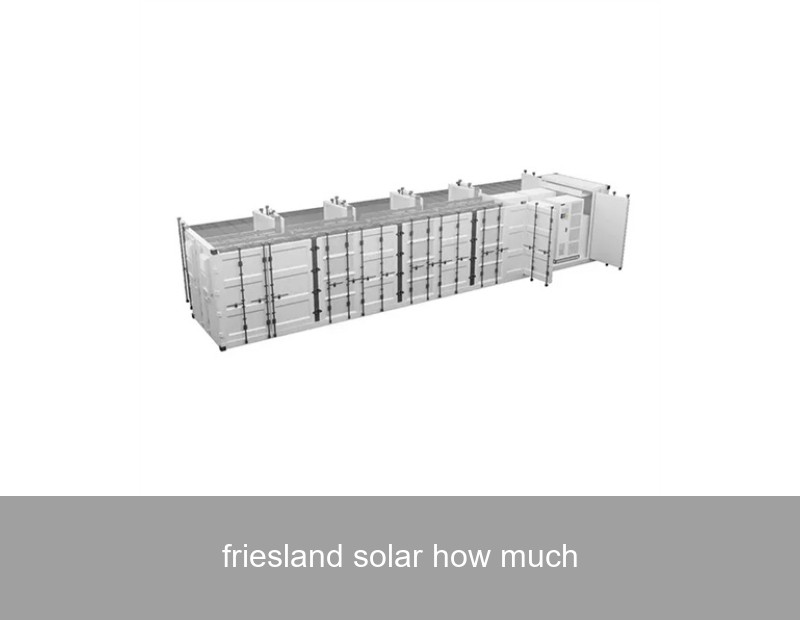
- Solution: Integration of a Highjoule HI-Cube 50 commercial battery storage system (50 kWh capacity) with advanced energy management software.
- Results (12-month period):
Metric Before Storage After Highjoule BESS Solar Self-Consumption 41% 89% Grid Energy Purchased ~32,000 kWh ~8,500 kWh Bill Savings (Estimated) Base €6,800+ annually Backup Power for Critical Loads None Up to 10 hours
The farm now operates as a resilient microgrid. The Highjoule system intelligently "time-shifts" solar energy, provides seamless backup, and even helps stabilize the local grid by not exporting volatile power surges. This practical example from Friesland clearly answers "how much?"—it's a significant boost in efficiency, savings, and security.
How Highjoule's Solutions Maximize Your Solar Investment
Founded in 2005, Highjoule specializes in translating renewable potential into reliable performance. For homeowners and businesses in Friesland and beyond, our products are designed to integrate seamlessly with your solar installation.

Image source: Unsplash (Representative image of a modern home battery system)
- For Homes (HI-Power Home Series): Scalable systems from 5 kWh to 20 kWh that safely store your solar energy. Our AI-driven energy management learns your habits and optimizes charging/discharging, often increasing solar utilization beyond 80%. It prepares you for dynamic electricity pricing and electric vehicle charging.
- For Business & Industry (HI-Cube Series): Modular, containerized solutions for larger-scale needs. They manage demand charges, provide uninterrupted power supply (UPS), and enable participation in grid services. The case study above showcases this capability.
- The Highjoule Difference: It's not just hardware. Our EnergyOS platform is the brain, providing real-time monitoring, predictive analytics, and remote control. You gain insights into every kilowatt-hour, empowering you to make smarter energy decisions. We ensure your system adheres to the latest safety and grid compliance standards, a critical factor as outlined by resources like the U.S. Department of Energy's Solar Integration page.
Looking Ahead: Your Energy Independence
The journey from asking "Friesland solar, how much?" to achieving true energy independence is exciting. With the right storage partner, you're not just installing technology; you're building a resilient, cost-effective, and sustainable energy foundation for your home or business. The landscape of energy is shifting from centralized consumption to decentralized empowerment.
What will your energy profile look like when you can control, store, and use every clean kilowatt-hour you produce? The data from Friesland and similar climates shows the potential is immense, waiting to be unlocked by intelligent storage.
Ready to calculate your specific "how much"? What's the first step you'll take to move from curiosity to a customized energy plan?
 Inquiry
 Online Chat