


Understanding Your 36V Solar Panel Output: A Guide to Sizing and System Performance
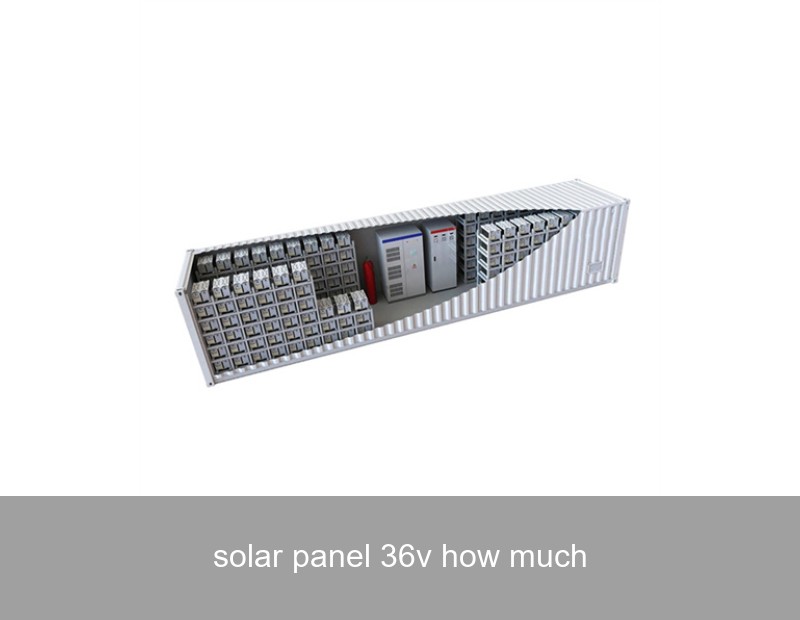
So, you're looking at a solar panel 36v how much power it can really produce. It's a smart question that gets to the heart of any successful solar project. The voltage (36V) is just one part of the equation. The real answer, "how much," depends on a symphony of factors: from the panel's wattage and your local sun hours to the critical component that unlocks its potential—your energy storage system. This article will demystify the numbers and show you how to translate panel specs into reliable, cost-saving power for your home or business.
Table of Contents
- Beyond the Label: What "36V" Really Means for Your Solar Array
- The Real-World Math: Calculating "How Much" Energy You'll Get
- The Storage Imperative: Why Your 36V Panels Need a Smart Battery
- Case Study: Maximizing a 36V Array for a California Winery
- Choosing the Right System: Integration is Everything
Beyond the Label: What "36V" Really Means for Your Solar Array
When you see "36V" on a solar panel, it typically refers to its nominal voltage. This is a standardized category that helps match panels with compatible system components, like charge controllers and batteries. A 36V nominal panel often has an open-circuit voltage (Voc) around 45V and a maximum power voltage (Vmp) around 36-38V under standard test conditions. This higher voltage design is excellent for charging battery banks efficiently, commonly 24V or 36V systems, with less energy loss over wiring distances compared to lower-voltage panels.
But here's the crucial point: voltage isn't power. To answer "solar panel 36v how much," you must look at the wattage (W). A 36V panel could be 300W, 400W, or even 500W. The power output is the product of voltage and current (Amps). So, a 36V, 400W panel will produce different amperage than a 36V, 300W panel, but both are designed to work optimally with similar system voltages.

Image Source: Unsplash (Photographer: American Public Power Association)
The Real-World Math: Calculating "How Much" Energy You'll Get
Let's move from specs to practical energy. Daily energy production in kilowatt-hours (kWh) is what lowers your utility bill. Here's a simplified formula:
Daily Energy (kWh) = Panel Wattage (kW) × Peak Sun Hours × System Efficiency
- Panel Wattage: Convert 400W to 0.4 kW.
- Peak Sun Hours: This isn't just daylight hours. It's the equivalent number of hours per day when sunlight intensity averages 1000W/m². This varies massively by location. Southern California might average 5.5, while Germany might average 2.8. You can find maps from sources like the Global Solar Atlas for accurate data.
- System Efficiency: Rarely is a system 100% efficient. Factor in losses from heat, dirt, wiring, inverter conversion, and battery charging. A conservative, realistic efficiency for a well-designed system is around 75-85%.
| Location | Avg. Peak Sun Hours | Estimated Daily Output (kWh)* |
|---|---|---|
| Phoenix, USA | 6.0 | 0.4kW × 6.0h × 0.80 = ~1.92 kWh |
| Bavaria, Germany | 3.0 | 0.4kW × 3.0h × 0.80 = ~0.96 kWh |
| Florida, USA | 4.5 | 0.4kW × 4.5h × 0.80 = ~1.44 kWh |
*Assuming 80% overall system efficiency.
The Storage Imperative: Why Your 36V Panels Need a Smart Battery
Solar panels generate power when the sun shines. But energy demand is constant—in the evening, on cloudy days. This mismatch is the core challenge that storage solves. A high-quality battery energy storage system (BESS) captures surplus daytime production for use anytime, maximizing your self-consumption and independence.
This is where simply asking "solar panel 36v how much" evolves into a more strategic question: "How much energy can I store and use intelligently?" The battery's capacity (kWh), power rating (kW), depth of discharge, and lifecycle are as critical as your panel's output. A poorly matched or low-quality battery can bottleneck your entire system's performance.
Case Study: Maximizing a 36V Array for a California Winery
Let's examine a real-world application. A family-owned winery in Sonoma County, California, wanted to reduce operational costs and ensure power resilience during seasonal Public Safety Power Shutoffs (PSPS).
- Challenge: Offset cooling (wine storage), irrigation pumps, and tasting room loads, with critical backup.
- Solution: A 40kW DC array using 36V nominal, 400W bifacial panels. The key to their success was pairing it with a Highjoule H-Stack Commercial 50 energy storage system.
- System Details: The H-Stack system provided 50kW of continuous power and 125kWh of usable capacity, configured to match the 24V/36V architecture of the solar array for optimal efficiency.
- Results (12-month period):
- Solar generation: ~68,000 kWh.
- Direct self-consumption increased from 35% to 82% with storage.
- Avoided $14,200 in demand charges and time-of-use fees.
- Experienced 3 grid outages totaling 42 hours; operations continued uninterrupted.
The winery didn't just ask how much their panels would produce; they designed a system to capture and utilize every possible kilowatt-hour. As noted by the National Renewable Energy Laboratory (NREL), "coupling solar PV with storage is a key pathway to higher value and resilience."

Image Source: Unsplash (Photographer: Dan Meyers)
Choosing the Right System: Integration is Everything
Your 36V panels are only as good as the ecosystem they live in. Seamless integration between solar generation, power conversion (inverters), and storage is non-negotiable for safety, longevity, and ROI.
This is the core of Highjoule's philosophy. We don't just sell batteries; we provide integrated, intelligent power platforms. Our H-Residential Series and H-Stack Commercial Series are designed with advanced battery management systems (BMS) that communicate directly with compatible inverters. This ensures your 36V solar array charges the battery bank at the perfect voltage and current, prevents over-charging/discharging, and allows for smart energy arbitrage—automatically storing solar or grid energy when it's cheap to use when it's expensive.
For complex microgrid or large-scale industrial applications, our Energy Management System (EMS) software provides a single pane of glass to monitor, control, and optimize every kilowatt. It answers the dynamic version of "solar panel 36v how much" in real-time: "How much is being produced, stored, used, and saved right now?"
Ready to Move Beyond the Spec Sheet?
We've explored how the output of your 36V solar panels is profoundly influenced by location, system design, and—most importantly—the intelligence of the storage solution it's paired with. The ultimate value isn't just in generation, but in predictable, controllable, and resilient consumption.
What specific energy goals—be it total energy independence, peak shaving, or pure backup resilience—will define the "how much" that truly matters for your project?
 Inquiry
 Online Chat